
Why Build a Community Within Your Company?

.svg)
- A workplace community is not just a group of colleagues: it is a set of people bound by shared values, common goals and a shared culture.
- In organizations where employees are connected, productivity rises by 20 to 25%, according to a study relayed by Inc.
- It helps retain talent: McKinsey found that relational factors such as belonging and recognition, often overlooked by management, weigh heavily on the decision to stay.
- It modernizes company culture: communication becomes multi-directional, silos come down and transparency improves.
- Five forms coexist (practice, project, interest, ambassadors, users or partners), and none of them is run the same way.
- Five tips to get it right: objectives aligned with the mission, a tool that fits, psychological safety, regular events, and actions drawn from member feedback.
When we hear “community,” we rarely think of the workplace. And yet, this concept has a legitimate place in organizations!
In fact, building a community within your company can be a genuine strategy for improving talent retention and productivity. One study even reveals that in organizations where employees are connected, employee productivity increases by 20 to 25%. Tempting, isn’t it? But it’s not quite that simple! Building a community within your company requires genuine reflection and a structured approach if it is to bear fruit.
So, what concrete benefits can it bring you? Simply put: why build a community within your company? 👉 That’s what we’ll explore in this article!
 end HubSpot Call-to-Action Code
 Understanding the concept of a workplace community
A workplace community isn’t just a group of colleagues who work together. It’s a group of people bound by shared values, common goals and a shared culture. This kind of community is built on regular communication and a sense of belonging.
It’s a genuine concept that includes a social and emotional dimension, where members support each other and collaborate. The goal is to improve both employee well-being and company performance.
Need an example? Let’s look at the streaming platform Spotify, which excels at building strong internal communities. Spotify is known for its company culture agile and inclusive. The Spotify model is organized around autonomous teams called “Squads.” These are then grouped into internal communities: Tribes, Guilds, Chapters, Trios, and Alliances. For instance, Guilds are interest groups that bring together members who share a passion for a particular topic. This model creates more connected, and therefore more committed teams.
The benefits of building a community in your company
Retaining your talent
Building a community within your company can significantly improve employee retention. When employees feel connected, valued, and part of a group, they’re more likely to stay. A strong workplace community naturally fosters a sense of belonging and, as a result, reduces turnover!
See also: Quiet quitting: the telltale signs
The outdoor apparel company Patagonia, is a good example. They encourage employees to participate in group activities and get involved in community projects. This approach has created a tight-knit community and increased loyalty and satisfaction among employees.
Companies with a strong internal community are better at retaining talent. According to a study by McKinsey, relational factors such as a sense of belonging and recognition are often overlooked by management, but they are essential to employees. That’s why investing in community-building pays off! It shows your employees that they are an essential part of the organization. And that makes all the difference!
Modernizing your company culture
Building a community in your company means modernizing your company culture on several levels!
Gone are the days of strictly hierarchical exchanges where only leadership communicates top-down. With a workplace community, communication becomes multi-directional: everyone can communicate and collaborate, regardless of hierarchy. Ideas can come from anyone, at any level of the organization. This makes employees feel more involved and valued, which boosts motivation and engagement.
 end HubSpot Call-to-Action Code
 A workplace community also reduces organizational silos and brings more transparency to your company culture! Teams no longer work in isolation, they interact and cooperate more regularly. This enables easier communication, better mutual understanding, and knowledge sharing. You benefit from the skills and ideas of all your talent combined! Decisions are better informed, solutions are more creative, and the company becomes more agile and adaptable. Result!
Driving collaboration and innovation
One of a workplace community’s greatest strengths is its ability to supercharge innovation and collaboration.
When employees come together around shared professional interests and goals through a dedicated community, conversation flows naturally! When you’re well surrounded, you don’t just chat, you brainstorm, challenge each other, and generate innovative ideas powered by the strength of the group!
Collaboration also becomes not only smoother, but also more valuable. The Asana report on The Anatomy of Work (2023) reveals that 55% of companies that have adopted collaborative work management have seen their revenue increase over the three years before it was published. In a workplace community, informal exchanges, collaborative projects, and synergies foster an environment where collaboration can truly thrive! 🚀
The main types of workplace community
Before you launch yours, you need to know which one you are building. "Workplace community" covers very different things, and they are not run the same way: a community of practice moves at the pace of a profession, while a project community ends with its delivery. Here are the five forms you will meet most often, and what each one asks for.
| Type of community | What brings its members together | What it needs to last |
|---|---|---|
| Type of communityCommunity of practice | What brings its members togetherA shared profession or craft that members want to advance | What it needs to lastCredible practitioners to lead it, and a steady rhythm of sharing |
| Type of communityProject community | What brings its members togetherA dated objective and a shared deliverable | What it needs to lastA clear mandate, and a deliberate ending once the project ships |
| Type of communityInterest community | What brings its members togetherA chosen topic, often outside work (sport, parenting, commuting) | What it needs to lastLittle top-down facilitation, and plenty of room left to members |
| Type of communityAmbassador community | What brings its members togetherThe willingness to carry the company’s culture and habits | What it needs to lastVisible recognition of the role, and time set aside to hold it |
| Type of communityUser or partner community | What brings its members togetherA shared tool or ecosystem, reaching beyond employees | What it needs to lastOwned moderation, and obvious value from the very first visit |
Two examples from our customers: the Club Smart RH runs the user community of its HRIS on Talkspirit, and the French space agency CNES brings together a student science community there. Both reach past the boundaries of the organization, a reminder that a community does not have to be limited to employees.
💡 5 tips for successfully building your workplace community
Building a workplace community can seem daunting when you think about engagement, change management, employee adoption, etc. Here are 5 tips for overcoming these challenges and enjoying the benefits of a workplace community!
1. Define objectives aligned with the company’s mission and values. When everyone knows where you’re headed, it’s easier to row in the same direction. For example, if your company values innovation, make it a shared goal for your community.
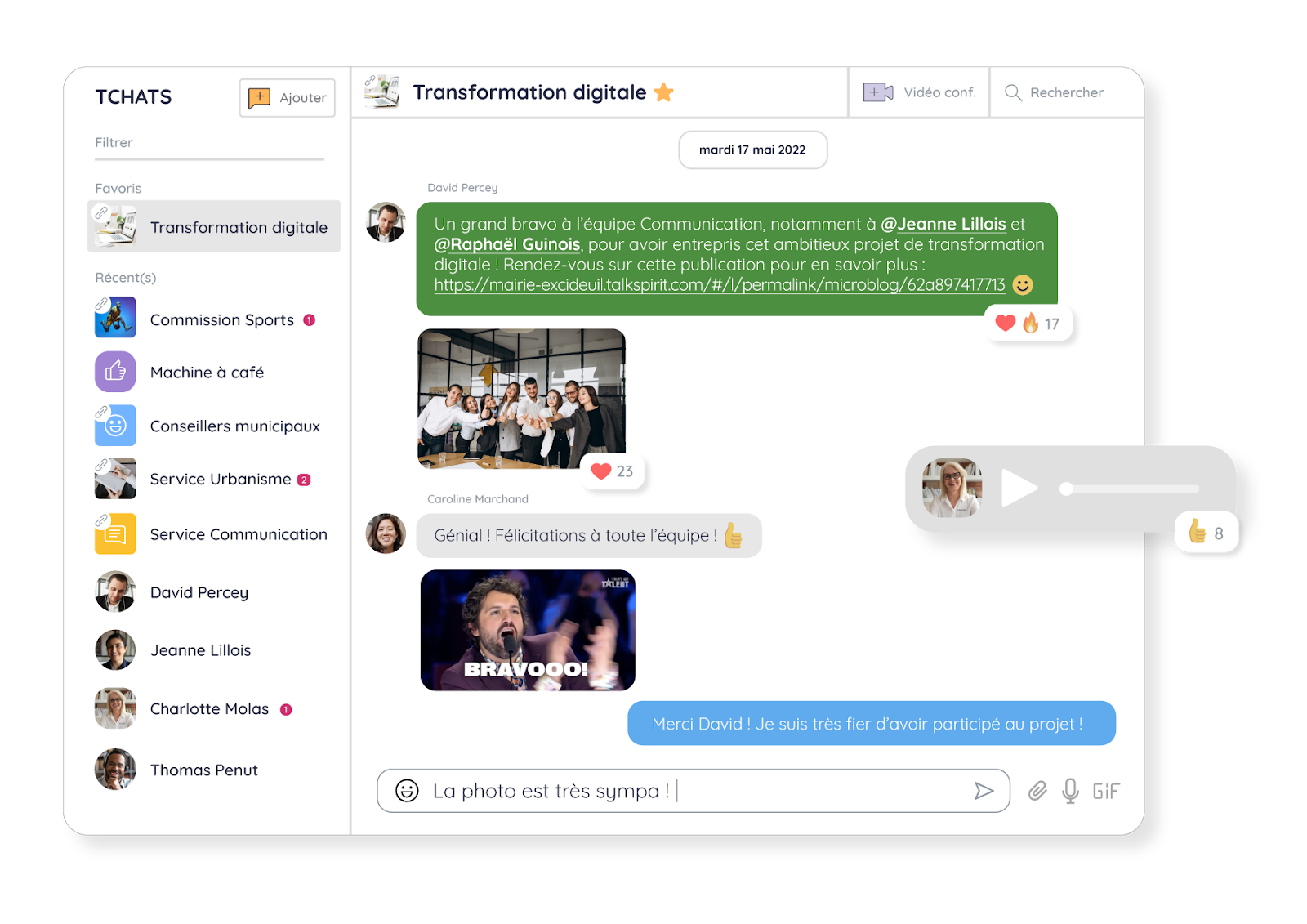
2. Use tools to facilitate communication and choose the one that best fits your team. For example, Talkspirit is excellent for quick conversations via chat. It also includes tools like a customizable welcome portal and a news feed to share key updates and news. Plus a secure drive, a shared calendar… and much more! Discover these options with a personalized demo 👇
3. Create an environment of psychological safety where everyone feels respected and heard. Open, transparent communication helps build trust and strengthens bonds within the community.
4. Organize regular events and activities (meetings, social events, brainstorming sessions, etc.). To sustain long-term engagement, vary the types of activities and include time for relaxation and fun.
5. Listen to feedback from community members. And implement actions based on this feedback to show that you value their input.
See also: 9 best practices for animating and engaging an internal community
Conclusion
A workplace community is not just a group, it’s an entire ecosystem that fosters engagement, strengthens company culture and drives innovation. It is therefore a worthwhile investment for your organization!
However, to successfully build your community, it is crucial to follow well-defined practices. From setting objectives to adopting the right tools like Talkspirit, these steps are essential for effectively structuring your community and fostering fluid, productive collaboration among your teams.
And among these steps is community engagement! To effectively kick-start engagement in your community, download our practical guide featuring client initiatives to animate their communities.👇
Access the Practical Guide
In our practical guide “10 client initiatives to animate their communities”, you will discover: 10 examples of organizations using Talkspirit to engage their communities, plus tips and advice for bringing all your members together and growing their engagement.
FAQ
It is a set of people bound by shared values, common goals and a shared culture, not simply a group of colleagues who work together. It rests on regular communication and a sense of belonging, with a social and emotional dimension in which members support one another and collaborate.
A study relayed by Inc. reveals that in organizations where employees are connected, employee productivity increases by 20 to 25%.
When employees feel connected, valued and part of a group, they are more likely to stay, which reduces turnover. According to a McKinsey study, relational factors such as a sense of belonging and recognition are often overlooked by management, yet they matter greatly to employees.
Asana’s Anatomy of Work report (2023) found that 55% of companies that had adopted collaborative work management saw their revenue grow over the three years before it was published.
There are five: the community of practice, built around a shared profession; the project community, formed around a dated objective; the interest community, built on a topic that is often outside work; the ambassador community, which carries the company’s culture and habits; and the user or partner community, which reaches beyond employees. Each one needs a different kind of facilitation: a project community ends with its delivery, while a community of practice moves at the pace of a profession.
Five tips: set objectives aligned with the company’s mission and values, choose tools that fit the way your teams talk to each other, create an environment of psychological safety, organize regular events and activities, and listen to member feedback so you can act on it.



.jpeg)