.webp)
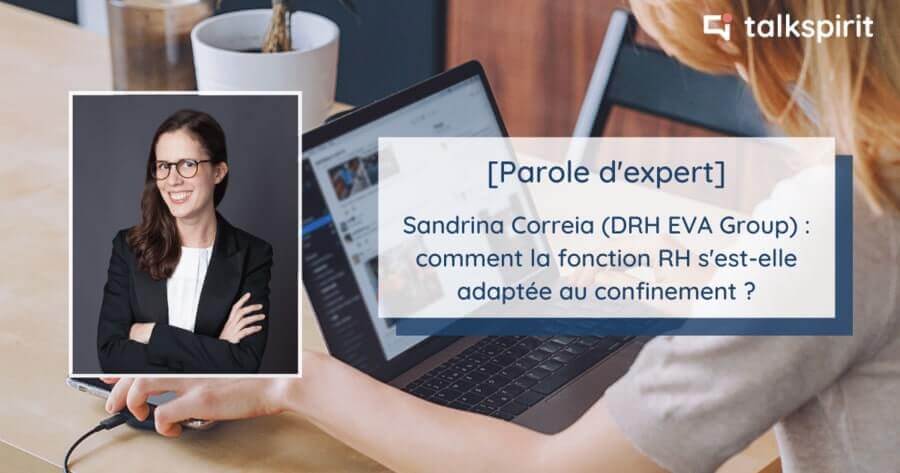
Sandrina Correia (EVA Group HR Director): How HR Adapted to Lockdown
.svg)
In these uncertain times, it is not always easy for Human Resources to make the right decisions. To fully understand how the HR function successfully managed both lockdowns back to back, we spoke with Sandrina Correia, HR Director at EVA Group. Operating across 4 continents with 10 offices, this French IT and Cybersecurity consulting firm specializes in three technology domains: Cloud & Infrastructure, Cybersecurity and Data. It serves large accounts, mid-sized companies, and SMEs in luxury, banking, industry, services, and government organizations.
Since 2007, EVA Group has been helping clients address their key challenges, namely:
- driving IT transformation and innovation projects;
- identifying and reducing their cyber risk exposure;
- designing, building, and operating high-performance, secure information systems;
- implementing governance frameworks to serve their strategy.
In this interview, Sandrina Correia addresses three key HR questions at the heart of this health crisis:
- What HR initiatives were put in place to ensure business continuity during lockdown?
- What were the main challenges encountered?
- What are the key challenges for HR in 2021? And how does she plan to address them?
How Did HR Manage the Lockdown?
Preparing Ahead of the Crisis
In our line of work, we support clients in implementing their IT transformation and innovation projects, as well as designing, building, and operating high-performance, secure information systems — including the rollout of remote working conditions.
The December strikes had already given us a preview of the work reorganization that would be needed. Then March arrived quickly and we were already prepared to work remotely for the first lockdown. I believe recent events have truly underscored the importance of HR's ability to anticipate risks and adapt quickly.
A Business Continuity Plan
From the start of March, a business continuity plan was put in place with management. We held daily check-ins to manage the two inseparable risks of this health crisis:
- ensuring employee safety and protection ;
- maintaining work continuity and commitments to clients, while rapidly identifying which activities could be done remotely and which required on-site presence — including securing field interventions. For instance, when working on a SOC [a division responsible for information security], remote work is not compatible due to confidentiality requirements.
Adapting the Recruitment Process
During the first lockdown (March 17 to May 11, 2020), recruitment slowed significantly, as the priority was supporting the return to activity for employees on short-time working. However, for certain highly specialized technical profiles where we lacked internal expertise, recruitment had to continue.
From the end of lockdown (May 11), we reopened our offices with new rules and working conditions in line with the mandatory health protocol (adapted safety rules, including monitoring employee presence flows). We were then able to plan a phased return on-site, all in compliance with regulations.
Today, with this new lockdown, teams are far better prepared. For example, we offered employees a second screen where needed to improve remote working conditions, since not everyone has the same home setup in terms of space and equipment. And everything happens remotely.
Strengthened internal communication has never been stronger than since March 17

Given the context, internal communication has never been stronger than since March 17. When face-to-face interactions decrease, you have to learn to work differently and develop new communication habits with employees, making When face-to-face interactions decrease, you have to work differently and develop new communication reflexes with employees, providing everyone with information as complete as possible by adapting our internal processes. Our onboarding workshops changed considerably when activity resumed. But to compensate for the lack of physical interaction, we developed a new welcome booklet that is far more comprehensive and engaging.
Supporting Employees and Managers
Many of our consultants are young professionals — sometimes foreign nationals living alone in France, far from their families. We therefore set up a listening helpline and psychological support service to accompany them and prevent isolation, in addition to regular check-ins with their managers and the HR team.
In parallel, it was also necessary to support and equip managers, who needed guidance to address employee concerns and accurately relay management messages, particularly around remote work implementation and the gradual return to activity within teams. We therefore organized specific workshops in the form of FAQs to address the questions raised.
A Transformation of the HR Function
At EVA Group, HR has always held a central place in the organization, particularly in attracting and retaining talent.
But today, it is undeniable that our role is evolving rapidly in this health context toward a day-to-day more than ever focused on maintaining employee safety and protection, navigating agility and work transformation, and supporting our managers — who play an essential role in the organization. And all of this on top of contributing to the business recovery.
What Are the Key HR Challenges Post-lockdown?
In my view, three fundamental challenges are shaping up for the HR function in 2021.
Employee Safety and Protection
First of all, it will obviously be necessary to maintain employee safety and protection, by embedding new everyday rules. This will be done in close collaboration with employee representatives. Maintaining social dialogue is essential today and will be just as important in 2021.
Talent Recruitment
The second challenge is supporting the business recovery by recruiting talent, in a context where work-related expectations are evolving rapidly. I see it more and more with the candidates we meet. They now ask about flexible hours and remote work feasibility. Before the crisis, these topics were rarely raised. Today they have become the norm and a genuine differentiator. To attract these candidates, companies must embrace these new expectations.
Supporting Managers
Finally, the third challenge is supporting managers, whose role is central to organizing and motivating teams. At EVA Group, the manager connects with a new employee from day one, supports them, and answers their questions throughout their journey. Yet remote onboarding and team cohesion are real challenges.
How Will You Address These Challenges?
Feedback and Training
At EVA Group, we have always placed knowledge management at the heart of innovation with a learning and training approach centered on experience sharing and knowledge exchange across all employees.
On the management side, some managers have the seniority to feel naturally at ease with communication and coaching. But for others, it may not come as naturally. We are therefore working on setting up an internal coaching unit to address these challenges.
Anticipation
One of the main challenges is truly anticipation. This is particularly difficult in the completely uncertain context we are navigating — quite complex to manage. Yes, the HR function is in full transformation, because you need to anticipate even when the short-term picture is unclear.
Flexibility
Finally, now more than ever, openness of mind and flexibility are essential. It is clear today that we are no longer in the traditional model of sending CVs, and that employment contracts are evolving toward greater flexibility.
Talent expectations — both from candidates and our own employees — are evolving fast. To attract (and retain) them, you need to be creative, responsive, and flexible in order to offer solutions that work for everyone.
*
* *
HR plays a key role in managing the Covid-19 crisis. Despite a sudden shift in ways of working, HR teams have successfully adapted and proposed innovative initiatives to support employees and managers. But the work is not done: the post-lockdown period will also present a major organizational challenge. To navigate 2021, which signals increasingly hybrid ways of working, HR will need to invest more heavily in training, while developing their own soft skills.
What is hybrid work? And why should HR pay attention? We reveal all in our white paper "The Future of Work: Embracing Hybrid Work!".
Access the White Paper
In our white paper "The Future of Work: Embracing Hybrid Work!", you will discover: the 8 key challenges of hybrid work; best practices for managers, HR, IT departments, and employees; plus the tools to put in place to facilitate hybrid work.
_
Author: Emmanuelle Abensur