How Two-Way Communication Can Foster Organizational Success

.svg)
- Two-way communication is the exchange of information in both directions, sometimes called bilateral communication: the receiver answers, and the sender adjusts.
- The model is a loop in five moments, a message, a channel, a decoding, a response, and a sender who closes the loop. Most organizations stop before the fifth.
- Four forms coexist at work: horizontal, vertical, instantaneous and asynchronous.
- Concrete examples: one-to-ones, agendas built from what the team submits, surveys followed by a published summary, chat threads where a decision is debated, comment threads, live question and answer sessions, retrospectives.
- Five benefits are covered: collaboration and engagement, job satisfaction and loyalty, productivity, where a study from Oxford University found happy and engaged employees are up to 13% more productive, better decision making, and less pressure on any single person.
- One-way communication keeps its place, for facts that are not open to debate: legal notices, schedules, safety rules.
The nature of traditional corporate structure means communication often flows in one direction. There is always a time and place for one-way communication in a professional setting. And it can have its benefits, helping managers and business owners share critical messages around the business and brand values.
But when it comes to engaging employees and ensuring there’s an open line of communication between peers and junior-senior colleagues, this approach can have its challenges. That’s why you need to prioritize effective messaging and give employees a chance to add their voice to conversations.
The solution? Two-way communication. By implementing genuine two-way communication strategies, you’ll benefit from a greater flow of information in both directions. This means your business can make tactical decisions with greater information. But what exactly does this mean and how can your teams benefit from this?
Contents
- What is two-way communication?
- How the two-way communication model works
- Examples of two-way communication at work
- How does two-way communication help organizations succeed?
- The next steps
What is two-way communication?
In the strictest sense, two-way communication is simply the transfer of information between two individuals in both directions, what is sometimes called bilateral communication. It sounds like any normal conversation, but there are some key differences. Effective communication ensures information is properly received and digested by each party. Communication is constant throughout each aspect of our lives. From impromptu discussions to carefully crafted messages, progress is made through effective communication. Businesses rely on communication to succeed, both internally between team members and externally with their customers.
We can look at workforce scheduling as an example of where this approach can benefit businesses. While one-way communication would involve simply dictating the schedule to other team members, two-way communication allows for a response, potentially changing the schedule to better suit the needs of both parties.
In business, this communication strategy should always be intentional, not a casual conversation between team members but rather a decision to discuss and explore a specific topic. Through the process of open and considered communication, businesses can grow sustainably. This way, they can ensure everybody’s interests are considered.

There are a number of types of two-way communication, as detailed below.
Horizontal communication
When employees of equal rank or status engage in a discussion or share ideas. For example, two management level employees discussing marketing strategies.
Vertical communication
When employees of different statuses or ranks engage in a discussion. This could be a team member sharing ideas with their team leader.
Instantaneous communication
As the name suggests, these conversations are almost instant. Various internal communication channels such as SMS, chats, intranets and enterprise social networks can be used for engaging in a written discussion with staff. But instantaneous conversations can also take place in-person, over the phone, or in a virtual setting (for example, in a video conferencing call).
Regardless of the platform, this gives management and team leaders a chance to communicate directly with employees by answering their questions or concerns quickly. It also gives an opportunity for peer-to-peer feedback and quick catch-ups between senior team members.
Asynchronous communication
This refers to any form of communication that relies on discussions over a long period of time. For example, it can be surveys, email chains, or even publications on your enterprise social network’s news feed. These will often contain considered responses that have been thoroughly contemplated before being sent.
These styles of communication tend to happen naturally as part of business operations, so you don’t need to worry about which category your plans fall into. The key is to ensure that you focus on the benefits of two-way communication and use that to your advantage.
How the two-way communication model works
Knowing the definition is one thing, running the process is another. The two-way communication model is a loop, not a line, and it holds together in five moments.
- Someone sends a message. A manager announces a change, a colleague asks for help, a team lead shares a draft.
- The message travels through a channel, a meeting, a chat thread, an email, a survey, a post on the company news feed. The channel decides how much nuance survives the trip.
- The receiver decodes it, and reads it in their own context, which is rarely the context the sender had in mind.
- The receiver responds with a question, an objection, a correction or an idea. That response is the feedback, and it is the one element that separates a two-way model from a one-way one.
- The sender closes the loop, by reformulating, clarifying, revising the decision, or explaining why it stands.
Step five is where most organizations stop, and it is the step that decides whether the loop was worth running. Gathering opinions and never saying what came of them teaches people that speaking up changes nothing, and the next round of answers never arrives. Closing the loop, even to say no with a reason, is what keeps the channel open. Care teams that made feedback part of how they work offer a good illustration of the discipline it takes.
Examples of two-way communication at work
The model becomes concrete as soon as you look at what an ordinary working week contains. These exchanges are two-way:
- a one-to-one where the manager asks open questions and both people leave with something to do;
- a team meeting whose agenda is built from items the team submitted beforehand;
- an internal survey followed by a published summary of what will change and what will not;
- a chat thread where a decision is debated before it is taken, rather than announced after;
- the comment thread under a post on the company news feed;
- an all-hands with a live question and answer session;
- a project retrospective, whose whole purpose is to collect what went wrong;
- a development review that runs in both directions, where the manager also asks what they should change.
These, however well written, are not: a newsletter nobody can reply to, an announcement with comments disabled, a poster in the break room, a policy update sent as a read-only PDF. They are one-way communication, which is the right choice for facts that are not up for debate, but they carry no feedback and therefore no loop.
Vertical exchanges are the ones that break down first, because the cost of speaking up is not the same at every level of an organization. Increasing transparency in a hierarchical organization shows what it takes to reopen them.
How does two-way communication help organizations succeed?
Although two-way communication is generally considered superior to one-way communication, the reasons are not always so apparent. The process takes more time, requires everyone involved to work actively together, and promotes individuals with strong interpersonal skills. Even in spite of the challenges that arise, the benefits on offer are too valuable to pass up.
Improved collaboration and employee engagement
One of the greatest parts of this approach is the promotion of collaborative working. As team members engage with each other, discussing tasks in detail, they will be working together towards a common solution. This might result in the delegation of work to specific individuals, problem-solving, or a shift in focus on the overall task itself.
Also read: How to Improve Cross-functional Team Collaboration
As a result, employees feel more in control of their own workload and tasks. They’re also able to voice concerns or propose more efficient routes to take. This helps them feel more engaged and work more efficiently with their team.
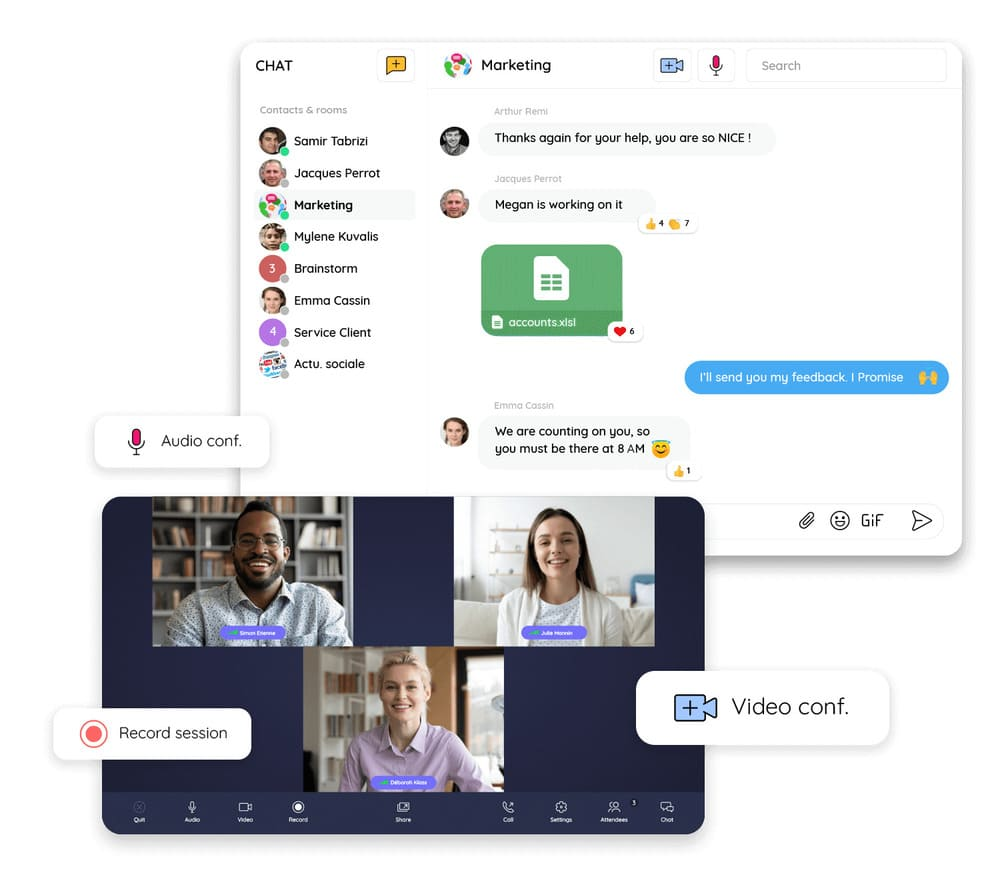
Using communication tools like Talkspirit can help you get all those benefits. Team members and managers can use it to:
- chat together through instant messaging and video conferencing,
- share and comment information asynchronously on a company news feed,
- and launch surveys to ask everyone’s opinion.
Higher job satisfaction and loyalty
Job satisfaction comes from a person finding their ‘why’ at work. This is often a combination of their passion for the job or industry they work in, their talent, and the result of what they do. So what does this have to do with communication?
Creating a two-way channel for employees to demonstrate how they feel and what their interests are is crucial. This will give managers an opportunity to help them hone their skills or take measures to improve their workflow so they can deliver greater results in their role. After all, you won’t know what issues or bottlenecks they have if you don’t ask for and listen to their complaints or opinions.
Encouraging your staff in this way is a vital part of any successful business, as your workforce is your most valuable asset. Without the support of your team, your business simply won’t grow, and problems will become larger over time. Two-way communication allows employees to be a part of the conversation. It provides feedback and ensures that employees’ voices are heard. As a result, employees are likely to be more motivated in their role. But they’ll also feel like a valued part of the team and company, which will improve employee retention and loyalty.

Improved productivity
As we mentioned, communication is a valuable tool for engaging with employees and improving satisfaction in their job and overall role in helping the company achieve its mission. As a bonus, this can also have a knock-on effect on how well they perform in that role. Because happy employees are more likely to be productive.
According to a study from Oxford University, happy and engaged employees are up to 13% more productive.
In industries that rely on individuals to operate with autonomy, often to relatively structured guidelines, this is even more crucial. For example, employees working for inbound call center services may have ideas about how to attend more calls on any given day or implement automated technology to reduce manual tasks.
Without the right communication strategy, they won’t have a channel to share their ideas and could stay stuck in an inefficient workflow. But if you open up lines of communication and offer them a chance to share feedback (and, of course, you act on it), you’ll give them the tools they need to be more productive while encouraging them to take greater ownership of their role.
Better decision making
Communication is vital for decision making. It gives you more ways to gather information or ideas and explore various perspectives from junior and senior team members. It can also help you clarify or test decisions to come to a more accurate conclusion.
What does this mean in practice? A two-way communication method means you can more easily identify problems in the first place by encouraging employees to open up to management and each other about any concerns or issues. Gathering different perspectives also means generating more potential solutions, some of which you may not have thought of yourself or tried before.
Once you’ve evaluated and implemented the solution, you can then gather feedback on its effectiveness by asking employees how well it’s working and whether they need additional support during any transition phase.
When everyone can join discussions, ask questions, and engage with a topic, the outcome of any decision is likely to improve, regardless of the situation, goal, or project at hand.
But it’s important that your team is aware that communication channels are open if they have questions or suggestions. For example, let’s imagine that your decision-making process led you to implement a cloud contact center. One of your agents is unsure about the new system and uncertain about new features, so they communicate their issue. You realize the team wasn’t given proper training to help adopt the technology. After explaining the cloud contact center benefits and how to effectively use the system, they return to work with renewed confidence.
Reduced individual pressure

Pressure can be a major problem for organizations. When employees are overwhelmed, they are less productive, and their quality of work is reduced. Most significantly, stress can impact mental health. A recent report showed that nearly 1 in 4 employees met the criteria for ‘clinically relevant symptoms’ of anxiety and depression.
When communication is spread across a number of individuals, the burden on any single person is greatly reduced. While the initial discussion may originate from one person, once the information is available to all involved, a two-way model ensures that everyone collaborates together and owns the outcome of the dialogue.
Many of the benefits lie in giving junior team members stronger voices, but in this instance, the senior team members stand to benefit most. As the pressure on these key members will already be greater, two-way collaboration is a brilliant way to give them more breathing room amidst their other responsibilities. Above all else, employee well-being should be at the forefront of your internal business decisions.
| What differs | One-way communication | Two-way communication |
|---|---|---|
| What differsDirection | One-way communicationFrom sender to receiver, and it stops there | Two-way communicationSender and receiver keep swapping roles |
| What differsFeedback | One-way communicationNone expected | Two-way communicationExpected, and acted on |
| What differsUsual channels | One-way communicationNewsletter, top-down announcement, policy PDF, poster | Two-way communicationOne-to-one, team meeting, chat thread, survey, comment thread |
| What differsPace | One-way communicationQuick to send, slow to correct | Two-way communicationSlower to run, much faster to correct |
| What differsBest used for | One-way communicationFacts that are not open to debate: legal notices, schedules, safety rules | Two-way communicationDecisions that need buy-in, problems nobody has named yet, anything ambiguous |
| What differsMain risk | One-way communicationA misunderstanding spreads unnoticed | Two-way communicationTime spent, and loops left open |
The next steps
Two-way communication offers a vast range of benefits, large and small, for your organization’s structure and those within it. From greater satisfaction for your employees to improved well-being and stronger communication, it’s a strategy that should be brought into your company structure wherever possible.
The process of fostering this style of communication is not an overnight switch, however. Your whole workforce needs to be aligned, from stakeholders to admin staff. Employees won’t likely engage with the available communication channels immediately, so be sure to showcase the available paths and promote discussion when possible.
Are you looking for some best practices and tools to improve two-way communication within your organization? Contact one of our experts to get personalized guidance:
FAQ
Two-way communication is the transfer of information between two people in both directions, sometimes called bilateral communication. The receiver does not simply take delivery of the message, they answer, and the sender adjusts. In an organization it should be intentional: a decision to discuss and explore a specific topic, not a casual exchange between colleagues.
As a loop in five moments. Someone sends a message; the message travels through a channel, a meeting, a chat thread, an email, a survey or a post on the news feed; the receiver decodes it in their own context; the receiver responds with a question, an objection or an idea, and that response is the feedback; the sender then closes the loop, by clarifying, revising the decision, or explaining why it stands. Skipping that last step is the most common failure.
A one-to-one where the manager asks open questions and both people leave with something to do, a team meeting whose agenda is built from what the team submitted, an internal survey followed by a published summary of what will change, a chat thread where a decision is debated before it is taken, the comment thread under a post on the company news feed, an all-hands with a live question and answer session, a project retrospective, and a development review that runs in both directions.
One-way communication travels from sender to receiver and stops there: a newsletter nobody can reply to, an announcement with comments disabled, a policy update sent as a read-only PDF. Two-way communication expects a response and acts on it. One-way remains the right choice for facts that are not open to debate, such as legal notices, schedules or safety rules; two-way is what decisions needing buy-in and ambiguous situations require.
Horizontal communication, between employees of equal rank or status; vertical communication, between employees of different ranks; instantaneous communication, through SMS, chats, intranets, enterprise social networks, in person, phone or video calls; and asynchronous communication, through surveys, email chains or publications on a news feed.
Five are covered here. Better collaboration and employee engagement; higher job satisfaction and loyalty; improved productivity, a study from Oxford University having found that happy and engaged employees are up to 13% more productive; better decision making, since problems surface earlier and more solutions are generated; and reduced pressure on individuals, since the burden of the dialogue is shared rather than carried by one person.