
4 Reasons Why Local Governments Should Embrace Digital Sovereignty

.svg)
Since the launch of the national cloud strategy, digital sovereignty has moved to the top of the agenda for local and regional authorities. Under circular n° 6282-SG, these bodies are now required to use sovereign cloud solutions hosted in France for all new digital projects. Yet in practice, many authorities continue to rely on GAFAM tools (Google, Apple, Facebook, Amazon and Microsoft), and are sometimes reluctant to switch.
What are the digital sovereignty challenges for local and regional authorities? Why does it matter to choose made in France solutions? And what are the risks of using US-based tools?
Here are 4 reasons why local governments should care about digital sovereignty.
Looking for a plain-language overview? Check out our practical guide “Digital Sovereignty Explained for Organizations”:
1. Ensuring the security and confidentiality of your data
Ensuring data security is one of the core challenges of digital sovereignty — and particularly critical for local authorities, which handle large volumes of personal data.
Unlike US-based tools, sovereign solutions are committed to processing your data in compliance with the GDPR (General Data Protection Regulation) and ensuring its confidentiality. Why? Because they are not subject to the Cloud Act. Enacted in 2018, this law allows the Department of Justice to compel a US service provider to hand over data stored on its servers, regardless of whether that data is located in the United States or abroad.
In practice, if you use tools such as Google Workspace or Microsoft 365 for day-to-day communication and collaboration, you are effectively accepting that the US government may access the data stored there upon request.
Despite multiple sanctions handed down by the CNIL (for example, the fines imposed on Google and Facebook in January 2021 over their cookie practices), GAFAM companies also fail to comply with the GDPR. As a result, they continue to collect ever-increasing amounts of user data — often without consent.
By contrast, a sovereign solution will help you better secure the information and documents shared within your organization, and ensure they do not fall into the wrong hands — an essential guarantee in an increasingly vulnerable hybrid work environment.
When evaluating new software, it is therefore important to ask the right questions. For example:
- Does the vendor host its data in France?
- What is its security policy?
- Does it hold a security certification? (for example, the SecNumCloud label)
 end HubSpot Call-to-Action Code
 2. Reducing dependence on GAFAM
According to the “European Digital Sovereignty” report by Oliver Wyman, 92% of Western data is currently hosted in the United States. Investing in sovereign solutions is therefore essential to prevent data from flowing abroad and to reduce our dependence on the US — and on GAFAM in particular.
While the Covid crisis had a severe financial impact on French businesses (nearly three-quarters of them saw their sales drop by more than 10% during that period¹), GAFAM companies were largely unaffected. Most of these American tech giants actually outperformed during the crisis! Amazon and Microsoft, for example, saw their revenues grow by 36% and 24% respectively between 2020 and 2021.²
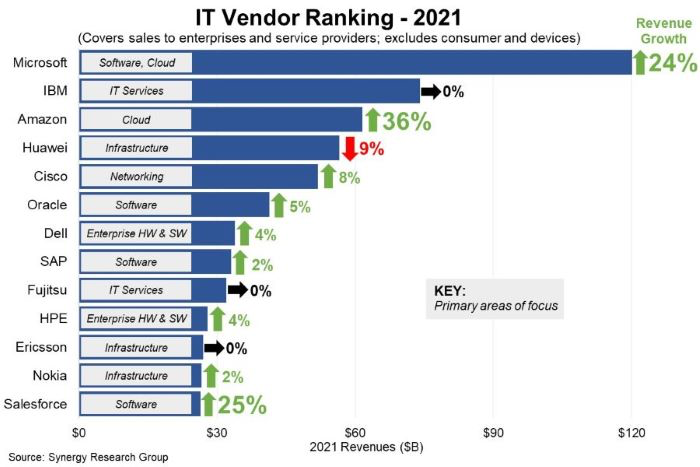
Ranking of IT service providers in 2021 (by revenue), according to Synergy Research Group
According to a study by Synergy Research Group, US tech giants (notably Microsoft, Salesforce, Adobe, SAP and Oracle) now hold 80% of the global SaaS market (Software as a Service). The same is true for cloud infrastructure services: Gartner estimates that Microsoft, Amazon, Alibaba, Google and Huawei together account for 80% of the global IaaS cloud market (Infrastructure as a Service). It is hardly surprising that local players struggle to gain a foothold!
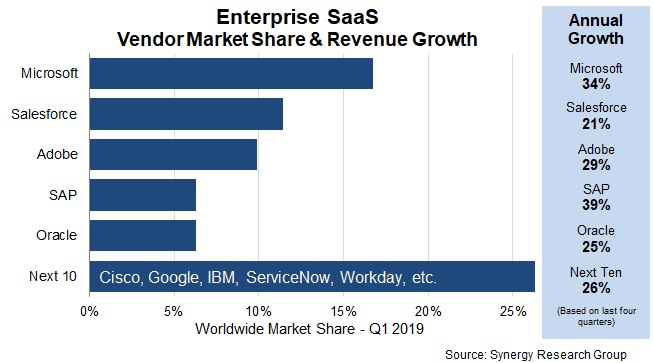
SaaS software vendor market share and annual growth in 2019, according to Synergy Research Group
Several initiatives have been launched to regulate the activity of major platforms in the European market, notably the Digital Services Act (DSA) and the Digital Markets Act (DMA), which were set to enter into force in 2023. Their respective aims: protecting users from illegal or harmful content, and ensuring a level playing field between platforms.
Despite these efforts, GAFAM growth shows no signs of slowing. If we want to retain control over our data, it is essential to strengthen our digital sovereignty — for instance, by investing in sovereign solutions.
3. Supporting local players
Faced with the overwhelming dominance of GAFAM, local players are steadily losing ground. Despite the rapid growth of the European cloud market — which quadrupled in four years — the market share of European cloud service providers is in freefall. Between 2017 and 2021, it dropped from 27% to less than 16%.³
The market’s growth has not benefited local companies — it has benefited GAFAM, particularly Amazon, Google and Microsoft, which together hold nearly 70% of the European cloud market.³ To prevent this cannibalization, it is important to prioritize French alternatives to GAFAM, which are often just as effective.
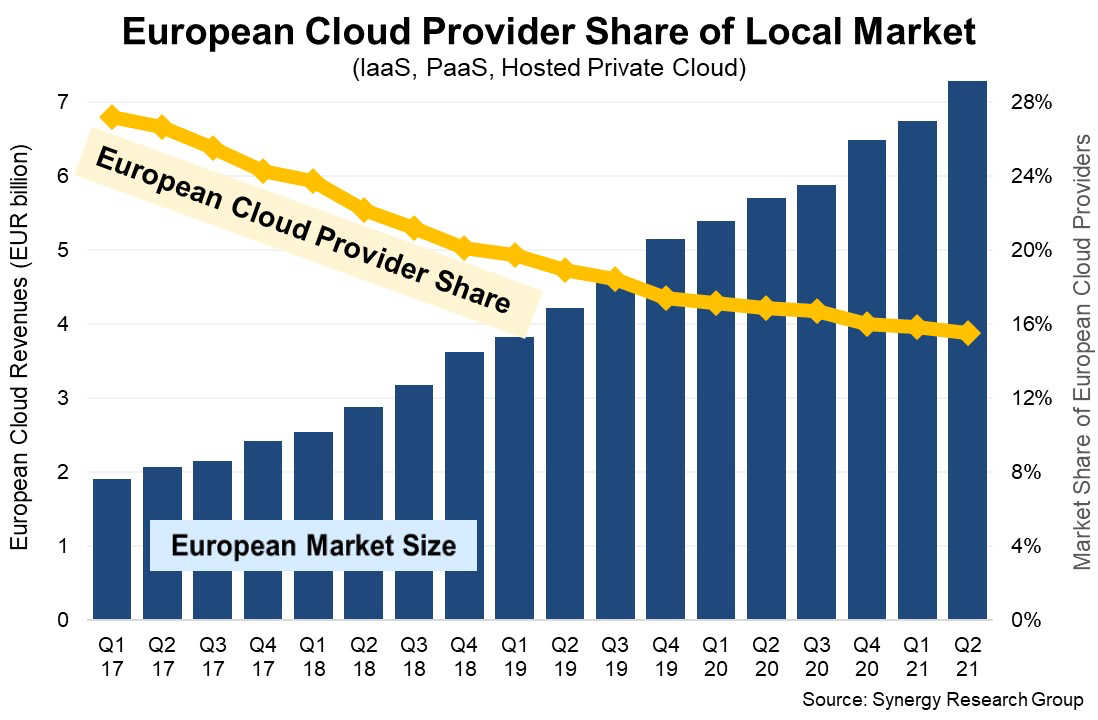
Trends in European cloud service provider market share between 2017 and 2021, according to Synergy Research Group
For local authorities, investing in made-in-France solutions means supporting the growth of local players, while contributing to the broader fight for digital sovereignty. These investments could, in the years ahead, foster the emergence of new French unicorns.
If you are looking for a French digital solution, we recommend exploring the #Solainn300 mapping, which brings together 500 digital solutions developed by 300 French companies (including Talkspirit!). Whether you need a platform for communication, collaboration, data security, or document storage, there is a made in France tool for you!
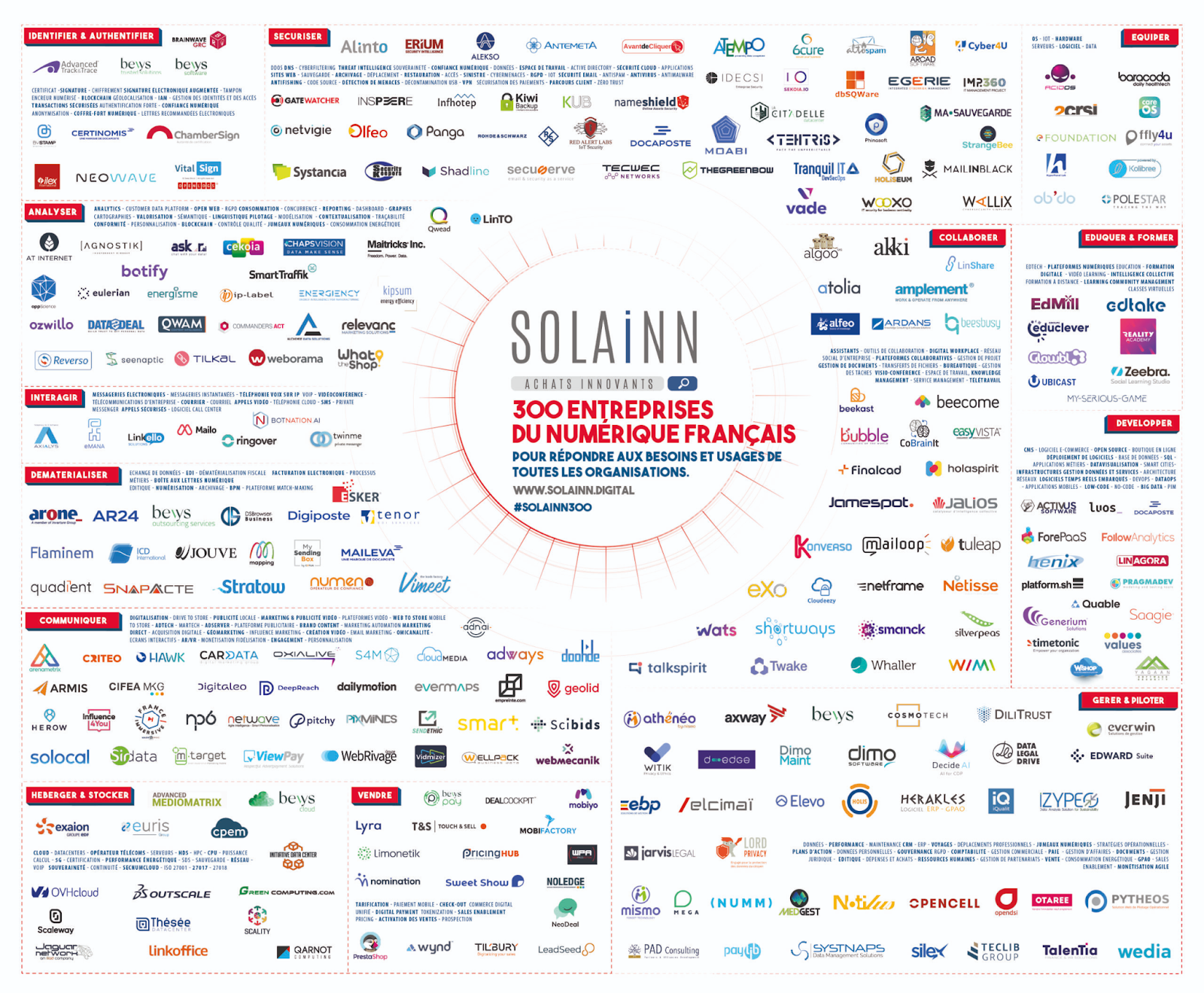
Mapping #Solainn300 of French digital companies
If you are looking for a French tool to streamline communication and collaboration between staff and elected officials, we invite you to explore our top 10 best sovereign collaborative solutions for local authorities.
4. Boosting the attractiveness of local territories
Investing in the French economy also means strengthening the attractiveness of local territories — that is, their “capacity to attract and retain populations, businesses, revenues, capital and labor”.⁴
Indeed, when local authorities choose local solutions, they ultimately contribute in fine to fostering innovation and job creation within those companies — jobs that may in turn attract more residents, businesses, and investors, and help territories flourish.
For example, investing in a French collaborative platform allows a local authority to streamline the work of staff and elected officials, while also contributing to the creation of new positions to support the software's development.
*
* *
The takeaway is clear: local and regional authorities are just as affected by digital sovereignty challenges as private-sector companies. Several actions can help strengthen this sovereignty — the most important being replacing US-based tools with French alternatives and prioritizing sovereign solutions for new digital projects (now a legal obligation for local authorities).
¹ INSEE study, December 2020
² Synergy Research Group study, December 2021
³ Synergy Research Group study, September 2021
⁴ "Territorial Attractiveness: A Challenge for Communities", January 2020
–
Author: Emmanuelle Abensur