.webp)
[Webinar] AI Opportunities and Risks: What Next-Generation Companies Need to Know
.svg)
Artificial intelligence at work… What a mystery! This technology has long sparked questions about its benefits and its risks, particularly at the heart of next-generation organizations — those that fully embrace digital technologies and innovation in their operations.
A enquête menée par la BCG revealed that 49 % of regular generative AI users believe their job could disappear over the next decade because of it. But what about its impact on workplace practices ? On privacy and data protection ? On ethics and our relationship with machines ? 🤔 Well, those are exactly the questions we tackled at notre dernière table ronde on the subject! 🎥
In this article, you’ll find a summary of our panelists’ responses to help you understand the real opportunities and risks of AI in business, and make the most of the benefits it brings. And who better to shed light on this than experts? Here are the profiles of our speakers:
- Philippe Pinault, co-founder and CEO of Talkspirit,
- Philippe Le Maire, CEO of SafeBrain.AI & Abbana, cybersecurity and artificial intelligence engineer,
- Bertrand Duperrin, founder and blogger at Bertrand Duperrin’s Notebook.
Now, let’s dive in! 👇
What Is the Impact of AI in the Workplace?
AI has been on everyone’s lips since the launch of ChatGPT, which made it visible to the general public. According to Philippe Pinault, it is perceived as a “disruptive technology”, comparable to the Internet or social media, that reshapes existing paradigms.
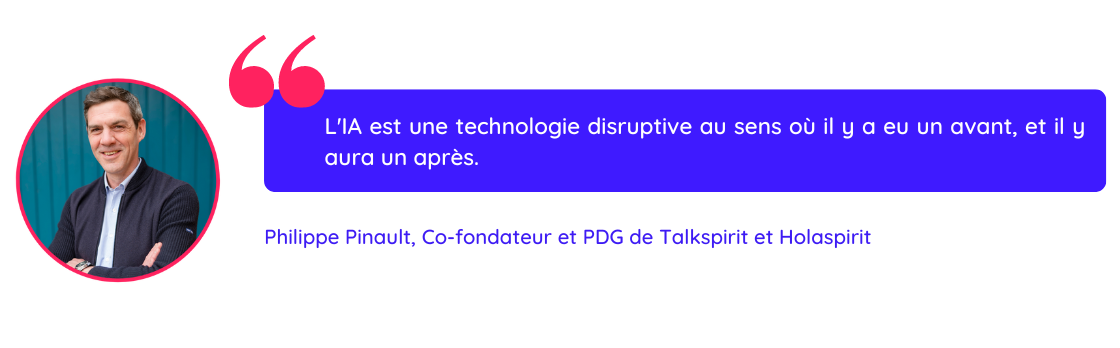
He also notes that for now, “it’s still very hard to identify the long-term impacts of this disruptive technology. In the same way that, in 1994 — only thirty years ago — it was absolutely impossible to imagine the world we live in today!” But what we do know is that AI can play a fundamentally important role and genuinely transform the way we work !
That said, AI is not a magic wand and doesn’t solve every problem. As Bertrand Duperrin puts it: « Technology gives us the means to do things differently. After that, there are two types of organizations: those that will transform themselves to get the most out of technology, and those that won’t. »
For AI to be truly effective, it requires genuine understanding and full adoption. Philippe Le Maire emphasizes the role of employees. In his view, « The main topic isn’t AI itself — it’s the people in the organization. Employees understanding and embracing this technology is essential. »
How to Integrate AI into Our Work Today?
First of all, integrating AI isn’t simply about layering new technology onto existing processes. It requires a rethinking of the organization to align employees with the tool. To do this, Bertrand Duperrin recommends « rebuilding the organization around AI, because AI won’t become a change agent on its own. » This means rethinking internal processes and the organizational structure to better integrate AI. This can involve training employees, adapting ways of working, and creating an innovation culture where AI is seen as an opportunity. What Duperrin is telling us is that AI won’t force change on organizations: it requires trust, flexibility and a new organizational mindset.
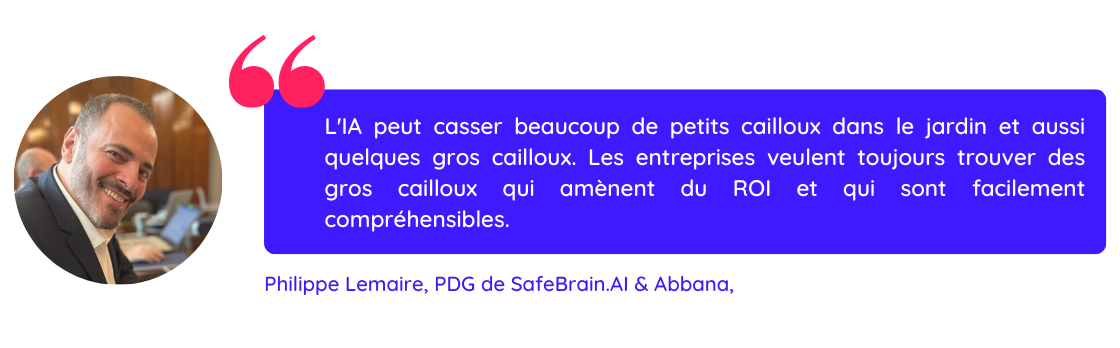
Through the metaphor of « pebbles », Philippe Le Maire explains how AI can solve both small and large everyday problems, such as:
- drafting emails faster,
- summarizing documents,
- generating contenu,
- offering personalized services like bot FAQ, making processes more efficient.
However, to limit AI risks and achieve successful integration, a pragmatic and careful approach is necessary. Organizations must choose the right AI solutions for the right use cases and establish clear règles de gouvernance. And as all three experts will tell you: watch out for the risks ! 🚨
How to Address AI Risks Around Data Protection?
Data protection is a critical challenge in AI deployment! Here are some practical tips from our experts to minimize AI-related risks:
- Philippe Le Maire stresses the importance of “protecting your data ». In his view, “For AI to be relevant, you need to share a huge amount of data with it!”. He adds: “I and many people who understand this don’t want GAFAM to know everything about us: who we are, what we like, what we don’t like, what our goals are, etc. That information needs to stay confidential — because Big Tech’s interest is in using that data to train their next AI.” He recommends 2️⃣ things:
- Choose solutions that mask the information sent to AI systems, for example through pseudonymization or anonymization.
- Use the right tool for the right purpose — for example, for marketing, you can use a non-proprietary LLM (Large Language Model).
- Philippe Pinault adds that organizations must also verify “the legal and regulatory framework that applies,”, particularly in Europe with GDPR. He stresses that the one thing you should ABSOLUTELY avoid is “sending sensitive data to non-sovereign AI systems hosted in the United States.”.
- Finally, he urges staying vigilant. In his words, “The weakest link in security is often the individual. It’s often the individual who is unaware of the risks they’re exposing their organization to with certain practices. And I think there is a real deficit today in terms of guidance, training, and education about what AI’s stakes really are.”
Talkspirit: a 100% Sovereign Solution
The risk posed by Big Tech extends to all the tools you use! To limit these risks, you can now work with 100% sovereign solutions, for example with Talkspirit. Our all-in-one Digital Workplace helps you meet your communication, collaboration, community engagement and governance needs — all while remaining sovereign. It includes several AI-powered features, such as:
- a chatbot FAQ that automatically answers employee questions;
- an organigramme intelligent that uses AI to generate role content, mapping your organization twice as fast!
Discover how Talkspirit can transform your organization today!
What About Ethical Challenges?
The AI risks related to values, diversity and sens du travail raise important ethical questions. Our experts acknowledge that “it scares people”, as Bertrand Duperrin puts it. For him, it’s clear: « AI will never be more or less ethical than those who design it and those who use it. »
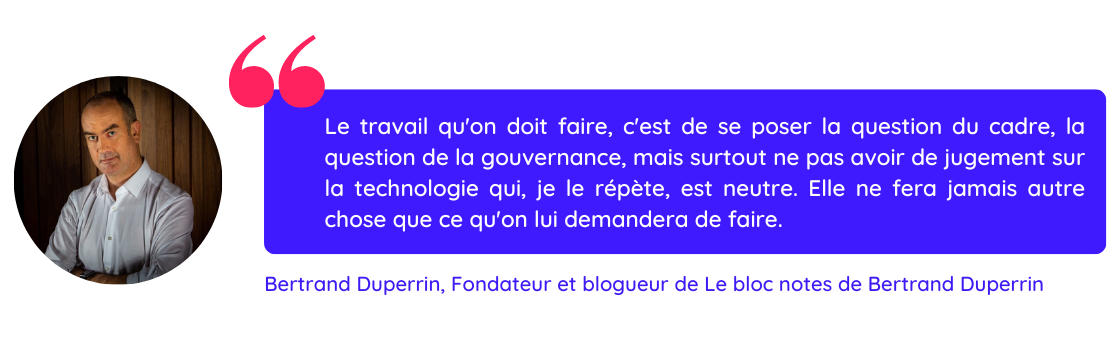
He explains that technology is neutral and ethical questions must be addressed at the human and organizational level and organizational level. This is also why “algorithms can amplify existing biases,” because they can reproduce and accentuate the prejudices present in training data depending on their origin (for example, an American AI will have an American perspective). Philippe Pinault agrees. In his view, “a technology cannot be completely disconnected from a cultural and values-based foundation. »
Consequently, organizations must make technology choices that align with their values and mission. Philippe Pinault explains that they “will no longer be able to oscillate between an ambition to create positive impact and decisions that are disconnected from it.”
In the end, AI ethics rests on human decisions and the governance frameworks put in place. Organizations must be aware of the ethical implications of their technology choices and act accordingly to ensure responsible AI use.
Conclusion
Artificial intelligence can bring incredible benefits to organizations! But watch out for the risks! Adoption must be approached with caution, discernment and awareness. To fully benefit from the opportunities AI offers, follow the key steps: choose the right AI for the right use cases, establish clear governance rules, raise your teams’ awareness of ethical and security issues. As Bertrand Duperrin puts it: « bringing AI into a company is a bit like adding a new employee. It’s a cultural and human choice, beyond technology. » Now it’s up to you to make the right choice by taking into account your organization’s needs and values!
Want to discover more solutions and examples of AI use in the workplace? Check out our practical guide and explore 6 concrete examples of artificial intelligence use in business. 👇
Access the Practical Guide
In our practical guide, you’ll find: 6 examples of artificial intelligence use, best practices for applying them within your organization, and examples of AI tools to help you optimize your performance.