
[Infographic] 10 Key Figures to Understand Digital Transformation

.svg)
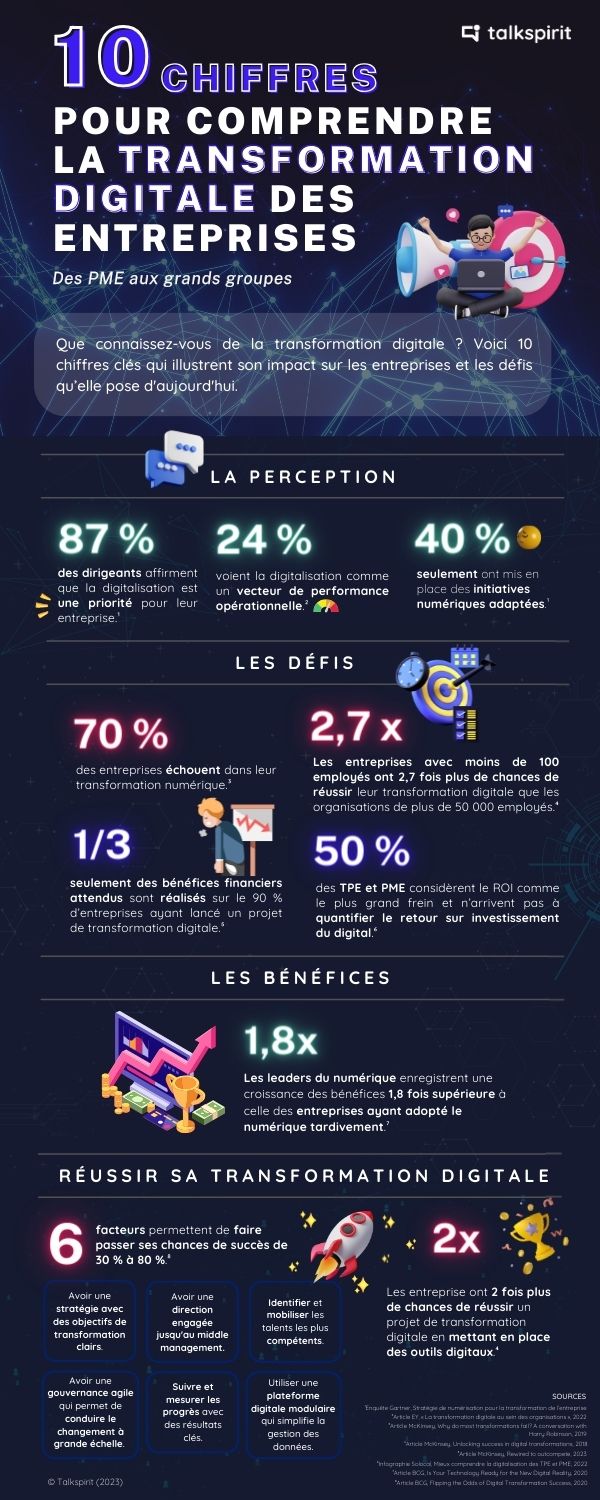
- 87% of senior leaders call digitalisation vital to their company, yet only 40% have taken digital initiatives to scale (Gartner).
- Nearly 70% of digital transformations fall short of their objectives; the six factors BCG listed in 2020 raise the odds of success from 30% to 80%.
- Companies with fewer than 100 employees succeed 2.7 times more often than those with more than 50,000 (McKinsey, October 2018).
- Large companies capture on average only 31% of the expected revenue lift and 25% of the expected cost savings (McKinsey, June 2022).
- Close to 80% of employees use collaborative tools, 44% more than before the pandemic (Gartner, August 2021).
- In 2026 the same gap is playing out on AI: 74% of technology executives get value from their use cases, only 24% a return on investment across several of them (KPMG, March 2026).
Digital transformation has been a hot topic for years, but what do the numbers actually say?
In this article, we break down the key figures on digital transformation to help you understand the trends, challenges, and opportunities of this revolution, and its impact on businesses. 🚀
One caveat before we start, because a figure without a date says very little: the 10 statistics gathered here come from studies published between 2018 and 2022. The table at the end of the article gives the source and the year of each one, and a final section sets them against the most recent data available, from 2026.

Digital transformation, a strategic priority
A priority no one disputes…
Going digital is no longer optional. According to a Gartner analysis, 87% of senior leaders see this transformation as vital to their company's survival. Markets move, so organisations have to move with them.
Digital transformation is far more than a technology add-on: it lifts efficiency, productivity and operational performance. 📈
Yet despite these ambitions, only 40% of those leaders have actually implemented adequate digital initiatives. This figure highlights the barriers to digital transformation, a reminder that companies must overcome real challenges to fully realise their digital ambitions.
Want to learn more? Explore our infographic featuring 10 key figures to understand digital transformation in business!
…but one that comes with its share of obstacles
Running a digital transformation is rarely plain sailing. Nearly 70% of digital transformations fall short of the objectives the company set for itself, according to a BCG study published in 2020. Change on this scale remains a serious challenge, not least because of short-term pressures. For example:
- The need for quick returns, or a tight budget;
- Resistance to change;
- Or the need to comply with new security standards.
There is, however, a glimmer of hope for smaller organisations: those with fewer than 100 employees are 2.7 times more likely to report a successful digital transformation than organisations with more than 50,000 employees. That is the finding of the McKinsey survey "Unlocking success in digital transformations", published in October 2018.
Although 89% of large companies have a digital or AI transformation under way, a McKinsey survey from June 2022 delivers a sobering verdict: on average they captured only 31% of the expected revenue lift and 25% of the expected cost savings. For 50% of small and mid-sized businesses surveyed by Solocal in France, the hardest part is measuring the return on investment. How do you calculate the ROI? Is the project actually worth it? The one thing to remember: always weigh the pros and the cons.

The power of digital tools
No digital transformation gets far today without digital tools: collaboration platforms, digital workplaces, enterprise social networks, intranets, and more. Close to 80% of employees use these tools, a 44% rise on the period before the Covid-19 pandemic (Gartner survey published in August 2021). Collaborative tools have become part of the furniture.
So how do you fit them into a strategy? The October 2018 McKinsey survey quoted above shows that the most frequently cited objective, named by 68% of respondents, is digitising the organisation's operating model. Fewer than half use digital tools to launch new products, services or partnerships. In other words, most companies turn to digital solutions to drive organisational change and prefer to lay the foundations before attempting anything more disruptive.
Looking for an all-in-one digital workplace, 100% made in France? Talkspirit is built for exactly that. Our collaboration platform speeds up your digital transformation by improving how your teams work together and how transparent information is. To try it out:
Request a Talkspirit demo
The gains digital tools deliver
Adopting digital tools also has a real effect on the success of a digital transformation project. Companies that have moved to cloud platforms report bringing new capabilities to market 20 to 40% faster, according to a McKinsey analysis published in September 2020. That speed is a competitive advantage in itself.
Timing matters too. Companies that moved early on digital transformation were right to do so. 🚀 A BCG study published in 2020 found that digital leaders which started early report earnings 1.8 times higher than those that waited.
These figures matter because they point to one thing: the size of the gap between a digital transformation that works and one that does not. 📊
Measuring the benefits of digital transformation
Want to know the benefits your digital transformation project has delivered? Its real impact? Get out the calculator and measure your KPIs! 🔍 This will help you identify adjustments needed to optimise your early actions. Let's look at what the numbers tell us about digital transformation!
Read also: Digital transformation: methodology and tools, the webinar recap
Key Success Factors
The best performers captured around 50% of the financial value their recent transformations generated, according to that same June 2022 McKinsey survey. Even for the best, a solid ROI takes work. ☝️
To increase the odds of success, several key factors are essential. The same 2020 BCG study lists:
- A "transformation strategy with clear objectives",
- Securing "the commitment of senior leaders and of middle management (team leads and other intermediate managers) to drive change at every level of the organisation",
- Setting up "an agile, flexible and adaptive governance",
- "Identifying and mobilising the most capable talent",
- "Tracking objectives and key results clearly", for instance with the OKR method,
- Putting a modern technology platform in place, such as a digital workplace.
BCG goes as far as stating that companies which act on these six factors see their odds of success rise from 30% to 80%. You know what to do. 😉
One more thing: want to explore innovative governance models to make your teams more agile? Download our white paper on the subject: best practices, expert advice and accounts from companies that went first 👇

Where do companies stand in 2026?
The figures in this infographic describe digital transformation as it stood between 2018 and 2022, when the question was about tooling and ways of working. The subject has moved on since: artificial intelligence now absorbs the budgets and the roadmaps.
KPMG's Global Tech Report 2026, published on 10 March 2026 and based on 2,500 technology executives across 27 countries, shows that the underlying problem has not changed: 74% of respondents say their AI use cases deliver business value, but only 24% achieve a return on investment across several use cases. The gap between ambition and value captured, which McKinsey measured on digital in 2022, is playing out again on AI.
Two further figures from that report show how much road is left: 11% of the executives surveyed believe they have reached the highest level of technology maturity, while 50% expect to get there within the year; and 92% think managing AI agents will be an important skill within five years. We look at that shift in our article on sustainable AI in the workplace.
| Figure quoted | Source | Year of publication |
|---|---|---|
| Figure quoted87% of leaders call digitalisation vital, 40% have taken digital initiatives to scale | SourceGartner, digitalisation strategy insight page | Year of publicationpage carries no publication date |
| Figure quoted70% of transformations fall short of their objectives, 30% meet them | SourceBCG, Flipping the Odds of Digital Transformation Success | Year of publication2020 |
| Figure quotedSix factors that raise the odds of success from 30% to 80% | SourceBCG, Flipping the Odds of Digital Transformation Success | Year of publication2020 |
| Figure quoted2.7 times more likely to succeed below 100 employees than above 50,000 | SourceMcKinsey, Unlocking Success in Digital Transformations | Year of publicationOctober 2018 |
| Figure quoted68% of respondents aim first at digitising their operating model | SourceMcKinsey, Unlocking Success in Digital Transformations | Year of publicationOctober 2018 |
| Figure quoted31% of the expected revenue lift captured on average, 25% of the expected savings | SourceMcKinsey, Three New Mandates for Capturing a Digital Transformation's Full Value | Year of publicationJune 2022 |
| Figure quotedClose to 80% of employees use collaborative tools, 44% more than in 2019 | SourceGartner, digital worker experience survey | Year of publicationAugust 2021 |
| Figure quoted20 to 40% less time to bring a new capability to market after moving to the cloud | SourceMcKinsey, How CIOs and CTOs Can Accelerate Digital Transformations Through Cloud Platforms | Year of publicationSeptember 2020 |
| Figure quoted1.8 times higher earnings for digital leaders that started early | SourceBCG, publication on the post-Covid digital reality | Year of publication2020 |
Conclusion
The numbers say more than words here. One thing is certain: digital transformation holds enormous potential. But as these statistics show, success depends on understanding the challenges and opportunities it brings, and adjusting as you go. It also means looking at what other companies do and at what the analysts measure.
One last habit, the most useful one when hunting for statistics: check their date, and the date of the survey behind them. A percentage from 2018 describes a market as it was, not as it is.
And what better way to do that than through concrete success stories? We share 10 examples of successful digital transformation projects in the following guide:
Download the Practical Guide
This practical guide covers 10 successful digital transformation projects implemented by 10 companies across different industries, with quantified results for each company, plus digitalisation best practices you can apply within your own organisation.

FAQ
87% of senior leaders consider this transformation vital to their company's survival, according to Gartner, but only 40% have actually taken digital initiatives to scale. The Gartner page carrying both figures does not state a publication date.
Nearly 70% of digital transformations fall short of the objectives the company set for itself, according to a BCG study published in 2020. Organisations with fewer than 100 employees are 2.7 times more likely to succeed than those with more than 50,000 (McKinsey, October 2018).
Close to 80% of employees use these tools (collaboration platforms, digital workplaces, enterprise social networks, intranets), a 44% rise on the period before the Covid-19 pandemic. The figure comes from a Gartner survey published in August 2021.
The most frequently cited objective, named by 68% of respondents, is digitising the organisation's operating model. Fewer than half use digital tools to launch new products, services or partnerships. Source: McKinsey survey, October 2018.
BCG lists six of them in a study published in 2020: a strategy with clear objectives, commitment from senior leaders and middle management, agile and adaptive governance, identifying the most capable talent, clear tracking of objectives and key results (with the OKR method, for instance), and a modern technology platform such as a digital workplace. Companies that act on all six see their odds of success rise from 30% to 80%.
The ten figures in the infographic come from studies published between 2018 and 2022: McKinsey in October 2018 and June 2022, BCG in 2020, Gartner in August 2021, with the Gartner digitalisation strategy page the only undated source. The table at the end of the article gives the source and year of each one. The most recent data quoted is KPMG's Global Tech Report 2026, published on 10 March 2026: 74% of technology executives get value from their AI use cases, 24% a return on investment across several of them.