A Guide to Tactical Meetings (Agenda Template Included)

.svg)
- A tactical meeting is a team’s operational check-in: keep each other updated, and clear the obstacles that block a project.
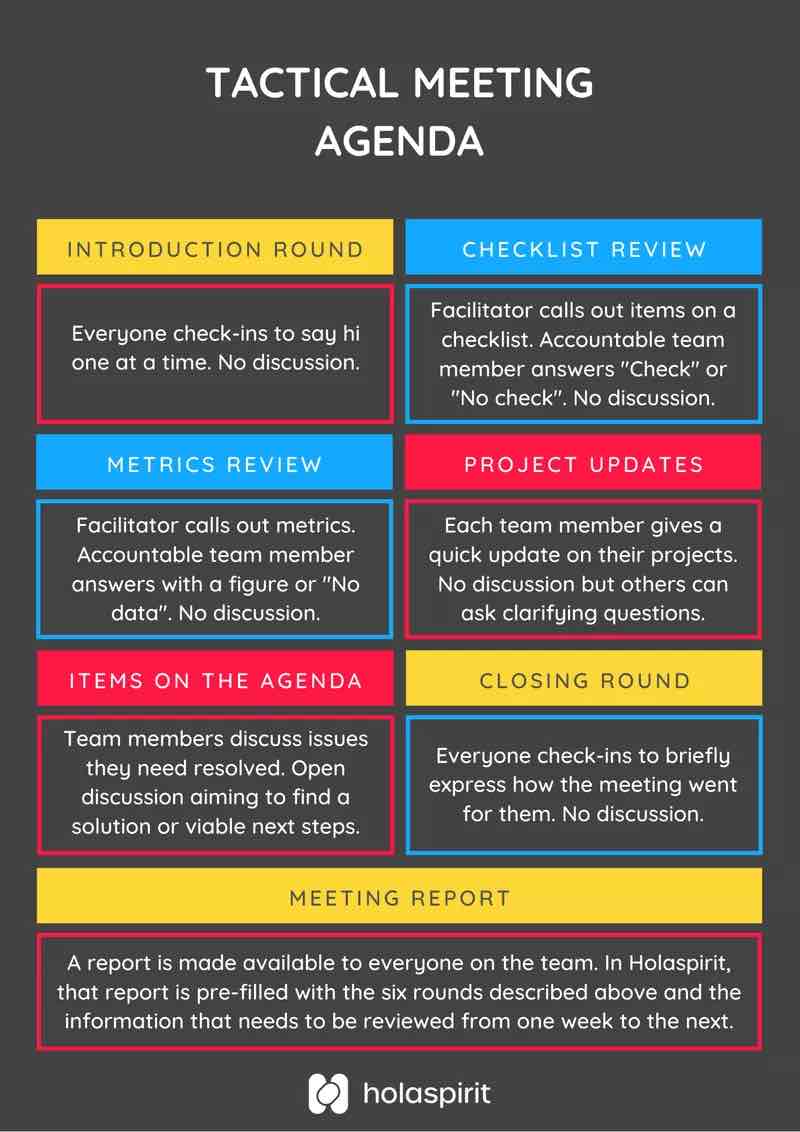
- The agenda has six rounds: check-in, checklist review, metrics review, project updates, agenda items, closing round.
- Two roles are agreed before the meeting starts: a facilitator, who runs the agenda, and a secretary, who captures the notes.
- The checklist and metrics rounds carry no discussion: check or no check, a number or no data. Discussion belongs to the agenda items.
- Tactical meetings handle operational work, governance meetings handle roles and policies: keeping them apart is what keeps the tactical meeting short.
- A ready-to-copy agenda template is included, along with the HolacracyOne cheat sheets.
Most weekly meetings end the way they started: a long round of updates, one or two decisions, and the same blockers waiting for next week. Tactical meetings fix that with a single thing, a fixed agenda everyone knows before walking in.
This guide walks through the six rounds of a tactical meeting, who facilitates it, what gets discussed and what does not, and the agenda template you can copy for your next team meeting.
What are Tactical Meetings?
Tactical meetings are focused on the day-to-day activities of a team.
The goal is simple: keep each other updated about what’s going on and ask for help to move forward with a project if needed.
Many teams like to host a weekly tactical meeting and a monthly strategic meeting. Others prefer to check-in on a daily basis or every other week.
What’s important is that the meeting agenda is clear for everyone and everybody feels comfortable sharing and nobody feels stuck with a problem for too long.
What is the Value of a Tactical Meeting vs. Other Kinds of Meetings?
Tactical meetings follow a clear agenda that ensures that everybody gets an opportunity to share what’s on their mind and contribute to helping other team members.
Because the meeting structure is very clear and there is one person in charge of ensuring the meeting runs smoothly (the facilitator), tactical meetings tend to run more smoothly and get less easily sidetracked by one issue.
The format of the meeting also encourages transparency and accountability because it provides an opportunity for each attendee to share their progress.
How to Run a Tactical Meeting
Before starting a tactical meeting, the team must assign a meeting facilitator (more on that later) who will go through the items of the agenda described below and ensure that the meeting runs smoothly.
A secretary is worth agreeing on too: someone to capture notes, decisions and the agenda items raised during the meeting.
First round: Check-in
The first phase of a tactical meeting is the check-in round. It’s a quick opportunity for everyone to say hi and how they’re feeling.
Checklist Review
In this round of the meeting, the facilitator reads through a list of recurring items that need to get done.
Whoever is responsible for getting that item done answers “Check” or “No check”.
For example:
- sent invoice for the month
- next event scheduled
- article published
There’s no discussion around these items. It’s just a matter-of-fact round.
Metrics Review
In this round of the meeting the facilitator goes through a list of metrics that are monitored on a regular basis.
Whoever owns that metric answers the number or “No data”.
For example, the number of:
- active users last week
- attendees at last week’s event
- social media posts scheduled to promote last week’s article
There’s no discussion around these metrics. We just deliver and take in the information.
Project Updates
The facilitator goes through ongoing projects asking something along the lines of: “Any updates?”
Each team member quickly states what changed since the last meeting.
For example:
- “No, no updates.”
- “Yes, the purchase order was approved, we’re waiting for the equipment to arrive.”
- “Yes, we received keynote speaker’s bio. Now moving on to the promotion phase of the event.”
- “Yes, we defined the scope of events we want to track. Now we need to discuss what’s the best way to setup the tracking.”
Meeting attendees don’t need to list everything they did or explain in detail why something didn’t move forward. (If there’s an issue on the project, it can be addressed in the next round)
However, other team members can ask questions if there’s something they didn’t understand or need more information on the project priorities or objectives for example.
Items on the Agenda
If there’s anything a team member is having trouble with, they are encouraged to add an item to the agenda of the tactical meeting.
They can do that in preparation for the meeting or during the meeting.
It can be done on the spot, with the facilitator asking each team member if there is topic they’d like to discuss.
Or team members can proactively add an issue to the agenda of the meeting. For example by:
- writing it on a board during a physical meeting,
- sending a message to the facilitator before or during the meeting, or
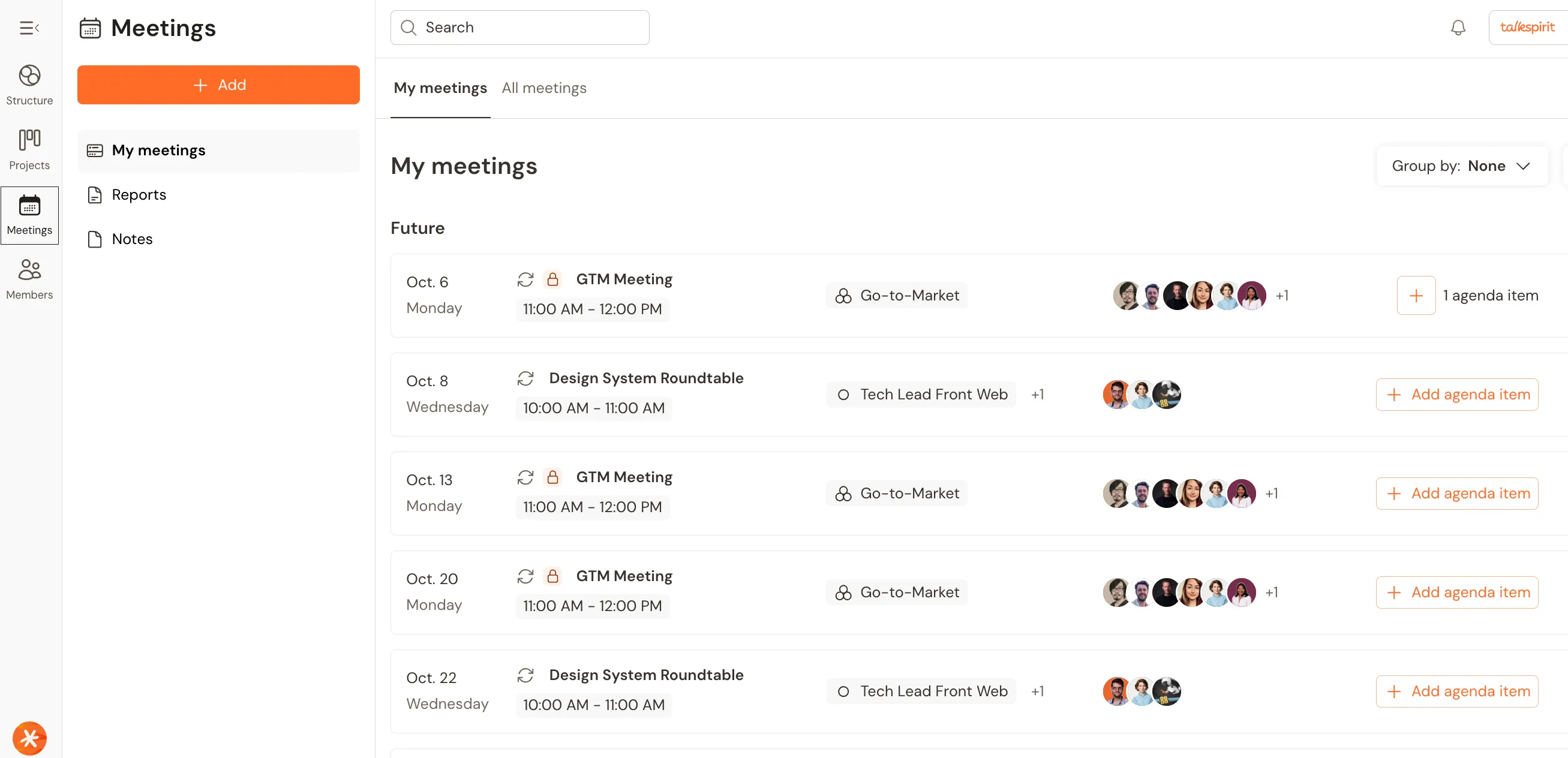
- adding an agenda item to a shared view of the meeting in Holaspirit.
In any case, the facilitator starts the discussion of each item by asking the team member: “What do you need?”
And closes the discussion of each item by asking the team member: “Did you get what you need?”
Examples of agenda items include:
Requesting a project or action
For example, “Some of us work with multiple calendars and it’s a pain to schedule meetings. Can we find a solution so that calendars of all business units are public to the rest of the company?”
Requesting information
For example, “I’m wondering what’s going on with this client, would you mind bringing me up to speed?”
Sharing information
For example, “I’m struggling to read other people’s code, can we work on best practices for documentation?”
Last round: Closing the Tactical Meeting
Each attendee briefly expresses how the meeting went for them.
When Would You Recommend Tactical Meetings?
Weekly tactical meetings will provide most value for organizations where:
- project deadlines seem to get pushed further back all the time,
- information gets lost between team members,
- people often get sidetracked during meetings,
- meetings tend to end without any decision being made,
- team members feel like they need more support to deliver results.
The meeting structure described above encourages productive discussions and efficient decision-making.
What advice would you give someone trying a tactical meeting for the first time?
Advice #1: Get People to Buy-Into the Experiment
Before you get started with tactical meetings, you need people to be on board.
- share your desire to give tactical meetings a try with your team,
- explain how it would work (see meeting template above), and
- why you think it’s worth a shot.
For example, you could write a short email saying something like:
I think we’re all tired of hour-long meetings that don’t move the needle. Who would be up for trying another type of meeting to review our week next Tuesday? It would only last 30 minutes and here’s how it would work. Would you be ok if we gave this a try ?
Advice #2: Agree Beforehand Who Will Facilitate the Meeting
If your team is already part of a holacratic organization, chances are the decision has already been made.
If you’d like to try the tactical meeting approach outside of the Holacracy framework, you’ll need to make sure a facilitator is agreed before the meeting.
Here are a few options:
- offer to take up the role for the first tactical meeting, or
- have each team member take turn facilitating the meeting, or
- ask people to vote for a team member on Holaspirit or Doodle.
Advice #3: Use Timers and Cheat Sheets to Stay On Topic
One of the best things about tactical meetings is that information that was hidden or lost suddenly comes to light when people are encouraged to share where they need help to move forward.
The downside is that people suddenly get super enthusiastic and excited working together which can lead to long and passionate discussions about how to resolve issues.
How do you prevent that from happening but still keep the enthusiasm alive?
1- Practice time-keeping. Don’t be afraid to use a timer. For example 2 minutes for short rounds that don’t call for discussion or 5 minutes per agenda item.
2- Ask specific questions that keep things moving. Use cheat sheets to stay on point like the ones provided by Organisation Builders or HolacracyOne.
3- Stop the meeting when it’s time. If you didn’t get a chance to discuss all the items on the agenda, too bad. Everybody will do better and get more to the point next time.
The worst thing you can do is create a habit of meetings that last longer than expected. That’s not how you build efficiency and trust in decision-making.
4- Schedule workshops to follow up on key projects. Tactical meetings are not the place to discuss issues or projects in depth. If something can’t be resolved in a couple of minutes, agree to schedule a team workshop or one-to-one meeting and move on.
Tactical, Governance and Strategic Meetings: Which One Handles What?
A tactical meeting is not the only format a circle runs. It handles operational work, while a governance meeting handles structure: roles, accountabilities and policies. Mixing the two is the fastest way to see a tactical meeting drift into a debate about who owns what, and run an hour long.
| Meeting | What it handles | What comes out of it | Typical rhythm |
|---|---|---|---|
| MeetingTactical meeting | What it handlesThe operational work of the circle and the blockers of the moment | What comes out of itNext actions and projects, each owned by a role | Typical rhythmOften weekly |
| MeetingGovernance meeting | What it handlesStructure: roles, accountabilities and the policies of the circle | What comes out of itRoles created, changed or removed | Typical rhythmOften monthly |
| MeetingStrategic meeting | What it handlesDirection and priorities for the period ahead | What comes out of itShared priorities, not action items | Typical rhythmMore spaced out, often monthly |
Sources: the tactical meeting process and the governance meeting process published by HolacracyOne.
If meetings stay the sticking point even with a clear agenda, the issue usually sits one level up, in how the team decides and splits the work. We covered that in our article on meetings and your organizational operating system.
Additional Resources
- Liip’s detailed Facilitation Handbook
- Organisation Builder’s high-level Cheat Sheet
- a walkthrough of meeting templates in Holaspirit
Finding the right framework for tactical meetings
Tactical meetings are an essential part of Holacracy. However, you don't necessarily need to implement the whole Holacracy methodology to get started. Depending on your organizational needs, you could implement part of Holacracy, or just another organizational model altogether. There are many other innovative models to choose from (such as Teal, Agile, Constitutional Management, ect.). So feel free to explore before committing to a specific model. And if you're curious about those models, don't worry: we've put together a white paper that explains it all 👇
Access White Paper
In our white paper "The Ultimate Guide to Organizational Models", you'll get: a comprehensive overview of innovative organizational models (like Agile, Teal, Holacracy, Constitutional Management, and more), testimonials from pioneer organizations that have successfully adopted it, best practices for choosing, implementing and measuring the effectiveness of our model, as well as digital tools to facilitate the transition.

FAQ
Tactical meetings are focused on the day-to-day activities of a team. The goal is simple: keep each other updated about what's going on and ask for help to move forward with a project if needed. Many teams host a weekly tactical meeting and a monthly strategic one.
Six rounds. Check-in, a quick opportunity for everyone to say hi and how they're feeling. Checklist review, where the facilitator reads recurring items and the owner answers check or no check. Metrics review, same principle with numbers. Project updates. Then the agenda items themselves. And a closing round.
Because the structure is explicit and one person, the facilitator, is in charge of keeping it moving. Tactical meetings tend to run more smoothly and get less easily sidetracked by one issue, and the format encourages transparency and accountability by giving every attendee a turn.
No. Whoever is responsible for an item answers check or no check; whoever owns a metric answers the number or no data. There's no discussion around these items: it's just a matter-of-fact round, and that is what keeps the meeting short.
Those where project deadlines seem to get pushed further back all the time, information gets lost between team members, people often get sidetracked during meetings, meetings tend to end without any decision being made, or team members feel they need more support to deliver results.
Get people to buy into the experiment: share your desire to give tactical meetings a try, explain how it would work, and why you think it's worth a shot. And agree beforehand who will facilitate, outside a holacratic organisation, that decision hasn't been made for you.