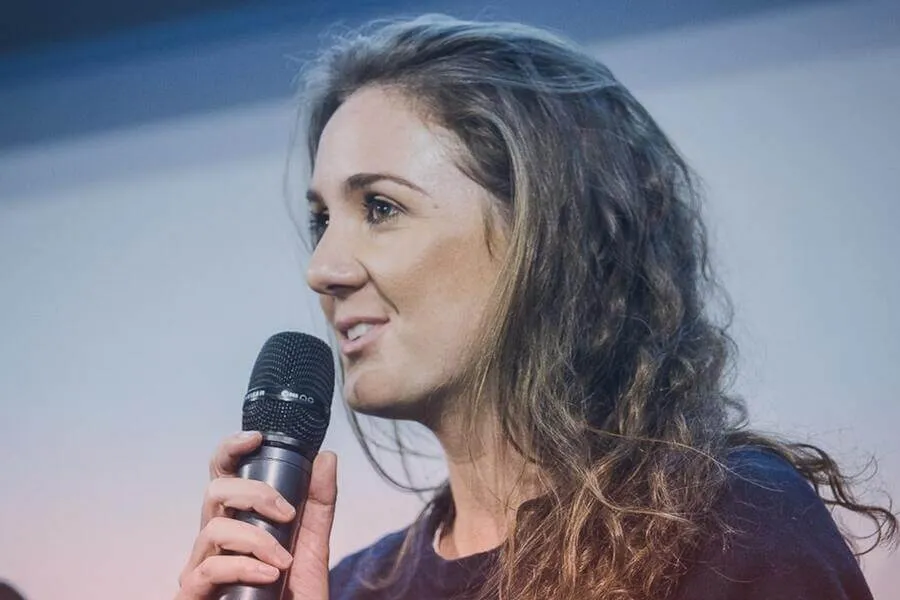
Marjolaine Grondin, Jam: Transform, Yes — But Don't Forget to Commit
.svg)
Setting up strategies, creating dedicated teams with a CDO on board, bringing employees along, training, choosing tools... For a fair number of companies in France, the roadmap for digital transformation is drawn up and the work has started. But do those same companies know why they are transforming, other than "because it has to be done"? And before anything else, shouldn't they find their purpose and commit to it? That is what Marjolaine Grondin, co-founder of Jam, invites us to think about today.
Read also: A Necessity: Managing Change
Hello Marjolaine, you are the co-founder of Jam. In a nutshell, what does it involve?
Marjolaine Grondin. Jam is the first conversational media outlet, helping hundreds of thousands of young people understand current affairs and work out where they stand on them. We also support brands, helping them join the conversation, better understand what young people expect today and communicate their values.
You chose "commitment" to talk to us about digital transformation. Why that choice?

Marjolaine Grondin. For me that word carries meaning. It gets to the root of the problem. Today we talk a lot about digital transformation, we hear that you have to adapt to new habits in order to stay in the race. In that context, digital transformation becomes a necessity. But do we really understand why we need to transform? That, to my mind, is the essential question to ask. Transformation is an opportunity, but choosing one digital tool rather than another is not a neutral decision.
Commitment and engagement come up a lot on social media. Is there a link with the word you chose?
Marjolaine Grondin. No, it has nothing to do with reach, likes and shares. It is more about committing to a cause, to a subject, alongside your community, and seeing that commitment through, finding your purpose, taking a stand. That is what makes digital transformation an opportunity. It lets you ask yourself the right questions. Take the example of MAIF. The insurer decided to transform its call centre to fit what consumers actually expect and to respond better to their expectations in terms of smoothness and responsiveness. They chose to completely overhaul their practices, bringing in more tools and more automation, but without dehumanising anything, keeping human contact. It was a chance for them to improve the customer experience, but also the employee experience. And to me that is very representative of commitment.
Which companies are the "committed" role models today? Isn't there a bit too much marketing effect behind it, along the lines of greenwashing?
Marjolaine Grondin. Today it has clearly become unavoidable for brands to commit, not to settle for selling a product, and to put forward a vision for society as well. So it is essential that this comes through in marketing.
Take the example of Patagonia this time. Since the 1970s the company has been committed to the environmental cause, and it does not do things by halves: eco-design, exemplary working conditions, and so on. Danone recently scrapped its CSR department, thereby stating that social and environmental issues are everyone's business and must run through every level of the company, not just one department. Carrefour has just launched Act for food, and the group's commitment is clear and backed by figures, it is concrete.
But of course, there are others who are riding the trend. We are currently running a study on young people and commitment. We are surprised by the first results: brands like H&M and Apple are identified by young people as responsible, and that is not entirely the case...
Has commitment become central because young people are looking for meaning?
Marjolaine Grondin. Our clients tell us: "we have no choice but to change, young people are asking us to! " So yes, young people are driving that change! But the movement is a global one: it comes both from the energy of youth and from what we expect at work and in the way we consume. The very lifestyle-driven values that used to go with consumerism have given way to societal values. To put it simply, the trend used to be buying the latest handbag; now people are more likely to carry an organic cotton tote bag to make a strong statement. We live in a time when 22,000 students sign a Manifesto for an Ecological Awakening, saying they will not go and work for companies without strong values, and when young people get actively involved in movements like Youth for Climate, which grow bigger by the day. We are torn between an urgent need to change things, a fear that it will not work, and at the same time a hopeful desire and motivation. We often lament the world we live in, where full employment no longer exists. And yet we also have more opportunities, in terms of learning and mobility, than our grandparents or even our parents ever had.
If you had only one piece of advice to give companies, what would it be?
Marjolaine Grondin. I always come back to this: always ask yourself the question "why" It is essential for a company's performance, for its longevity, whatever its size. Take instant messaging tools. They are brilliant tools that let you communicate at any moment and I strongly recommend using them. But I am also convinced that their use has to be given a framework, in order to make room for "deep work" and allow people to work on substantial subjects. Let us be more reasonable and more intentional in the way we use digital tools.