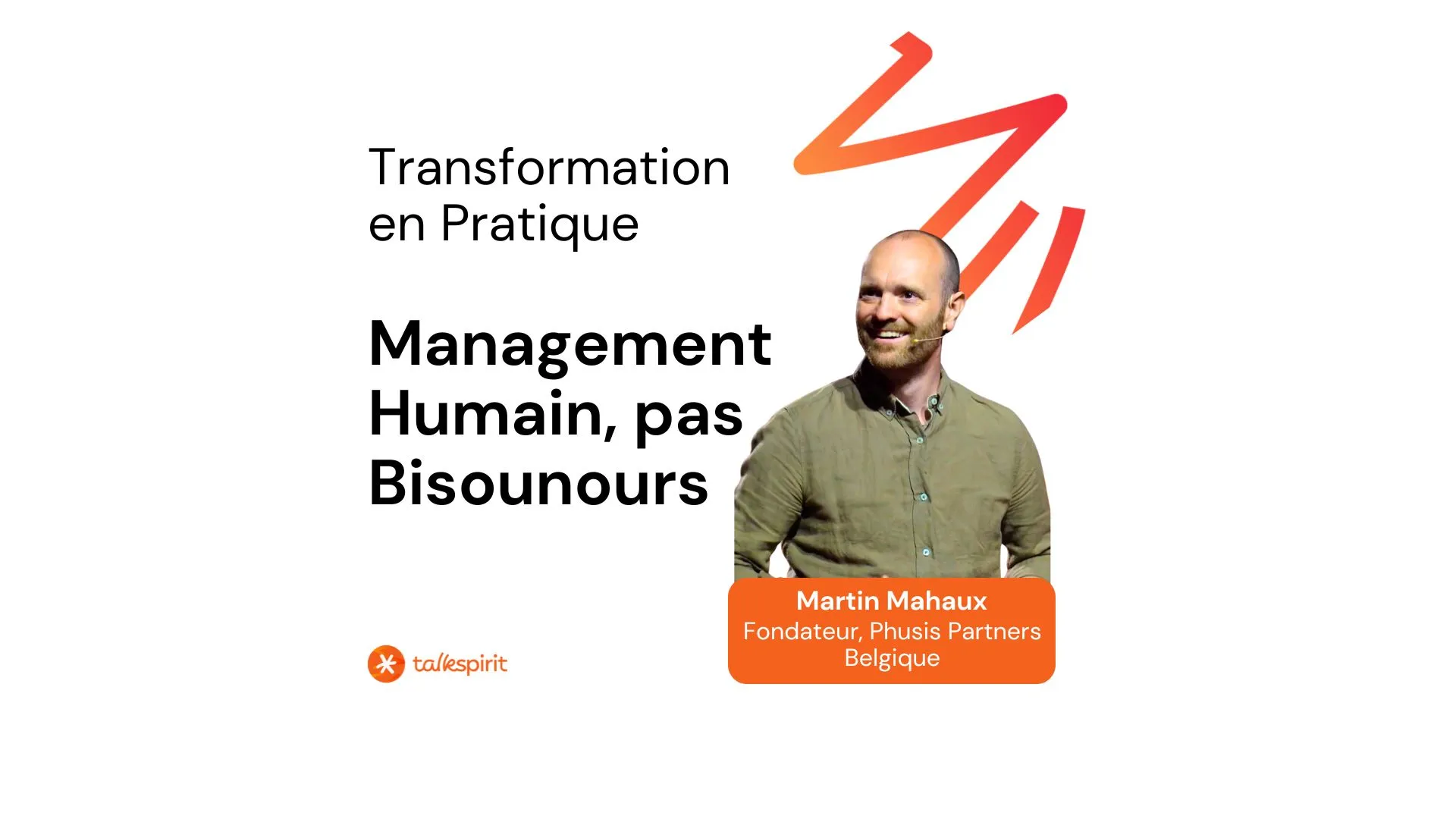
Human Management — Not "Nice Guy" Management: Interview with Martin Mahaux, Founder of Phusis Partners
.svg)
At Talkspirit, we shine a spotlight on partners who are experimenting with new ways of working. In this interview, Martin Mahaux describes how Phusis helps organisations of all sizes move toward practices better suited to today's world, working across structure, culture, and leadership.
Who is Martin Mahaux and what is Phusis Partners?
Martin: I am the father of two children and, for the past 10 years, a guide for transformations, in particular within Phusis, which I co-founded 8 years ago. I happily describe myself as a pragmatic idealist. I was lucky enough to do a PhD on questions of collaboration.
Trained as a software engineer, and not very good with computers or programming, I ended up being the bridge between the IT people and "real people" 😉. That led me to discover the world of co-construction and collaboration, which I made the subject of my thesis, tackling some fairly unexpected topics such as using improvised theatre to make collaborative creativity easier.
Suffice to say I was a bit of an alien at university! There you go, that may be an interesting way of answering "who am I": at once a technician, an engineer, and an improviser, a creative. At once an idealist and a pragmatist...
My role at Phusis, besides being a founder, concerns governance and structural questions. I am not a certified individual coach, for example. I am really much more about the collective and about structures.
Phusis was founded eight years ago to bring new ways of working into organisations. Originally, were you mainly targeting large organisations?
Yes, that was our first target. At the time it seemed to us that this was where support was most lacking, support that would be genuinely oriented towards disruptive models on the one hand, and on the other hand carry the seriousness and the change management that large companies need. Today we have kept that capability, but we work more or less everywhere, in private or public organisations, from 25 to 5,000 people.
Our purpose, today, is something we express as a triple reconnection: enabling people to reconnect with themselves, with others and with what is around them. We believe that is the key to new ways of working together, better suited to today's world.
What, in your view, are the main challenges organisations face today?
It all starts with this world that is changing, and changing faster and faster. That is probably the most striking feature: it never stops moving. It is fascinating, tiring and stressful, all at once.
Today, every company is in transformation. It is trying to cope with this new situation, often by trial and error, because there is no ready-made solution.
Some do "even more of what they did before", to the point of installing a bureaucracy of control that jams everything up; others throw the baby out with the bathwater and end up with no management framework at all. You then see self-managed teams, but with no arrangement for taking decisions, handling conflict or collaborating effectively.
The result in both cases: a loss of bearings, falling engagement, difficulty passing signals up from the field... The requests vary: sometimes very pragmatic (a lack of efficiency), sometimes more ideological (alignment with values). Often it is a mixture of the two.
What methods or approaches do you observe?
The classic management method is still the hierarchical pyramid of power. It has worked, and it has the advantage of being simple to understand: "the boss is right". But its limits are clear today, especially in the face of complexity and the need for collective intelligence.
So some people propose models where everything is decided together, but that is just as disastrous: you fall into the tyranny of the group, which in the end is no more pleasant than the tyranny of the boss.
So you have to find something more subtle: distributed governance, rather than "shared" governance. You create clear islands of power and responsibility, where everyone has as much autonomy as possible. Once you have decided who decides what, you can "get off each other's backs" a bit 😉.
But this takes time: clarifying roles, responsibilities, and putting the right frameworks in place.
Let me take the opportunity to correct a received idea: that of horizontal governance. The intention is good, more fairness, but it denies the need for verticality in order to manage complexity.
In a human body, cells form tissues, tissues form organs, organs form systems: there is a verticality necessary for managing complexity. Yet the brain does not directly command cells to divide; they have their own autonomy.
You can therefore use verticality without a power hierarchy. Each person decides within their own scope. Verticality helps coordinate complexity without imposing "a boss above".
In short, there is a myriad of nuances in these new ways of working. Our role is to find, with each organisation, the approach that matches its reality and its primary challenge.
How do you intervene concretely in these transformations?
We work across three dimensions: structure, culture, and leadership.
- Structure is the rules of the game;
- Culture is the beliefs and values;
- Leadership is the ability to mobilise.
You cannot separate structure and culture: they have to stay aligned. If you change the law without shifting beliefs, or the other way round, you create an inconsistency. That matters, because many organisations make the mistake of working on one or the other without really considering the alignment.
Early in my career, my tools linked to improvised theatre were widely used in seminars and off-sites, where employees came to open their eyes to other management principles. Purely cultural, those seminars left employees starry-eyed... But nothing had changed in the structure, and by Monday, back at the office, it was a cold shower. Conversely, very structural consultants would change the org charts without touching the culture, and leaders would then complain that they were not reaping the expected benefits of the change...
Today we combine the two: structure and culture, plus work on leadership at every level.
Leadership is the engine of change. In a system that has no need to evolve, you need management. When you have to get moving, you need leadership.
We work a great deal on that dimension: we bring leaders together, not only managers, from every level of the organisation, we question them about their own stance, we talk a lot about systemic and relational intelligence, and then we invite them to think through and steer a small change project, so as to reconnect each of them with their own leadership through a positive experience of change.
What about mindsets? What changes are most needed?
First, we have to stop treating human beings like robots. It is not only a question of ethics: it no longer works.
Then, we have to get past the idea that "managing humanely" means being a soft touch. That is not it: you have to combine kindness with high standards. In a tyranny, high standards reign supreme and kindness has no place.
But bringing kindness back must not make high standards disappear, at the risk of rushing towards the individualism that already characterises our Western societies.
If you let individuals do exactly as they please, if you never sanction toxic behaviour, the collective is inevitably damaged, and you see that drift in many organisations where a certain managerial courage is missing.
Another mental model to revisit: the manager as the "all-purpose person". In every team, there is the core work, and there is the managerial or non-core work that enables collaboration.
Why should a single person necessarily take on all non-core tasks? Strategic vision, conflict management, talent development, operational coordination, team facilitation… These aspects of today's manager's role, from whom ever more is expected, are very different from each other, and require highly varied skills that are rarely all present in one person.
These roles could perfectly well be split up according to each person's strengths, but "we have always done it that way"... It makes the manager's job very complicated, caught between a rock and a hard place, with different and often incompatible stances, and in the end a lot of suffering...
We continue too often to do as we always have, without stopping to question it.
What role does technology play in all of this?
Technology is part of the structures: it shapes behaviour. And it is a mirror of the management systems it is designed within. Without our necessarily realising it, these tools play a large part in perpetuating systems that are sometimes toxic but embedded in our habits...
For example, Microsoft Teams carries in its deep structure the idea of a management pyramid. The same goes for most employee engagement surveys, for instance, which ask questions along the lines of "How does your manager handle conflict?" and aggregate the results by manager so they can be compared with each other...
To support new organisational models, new technology is essential.
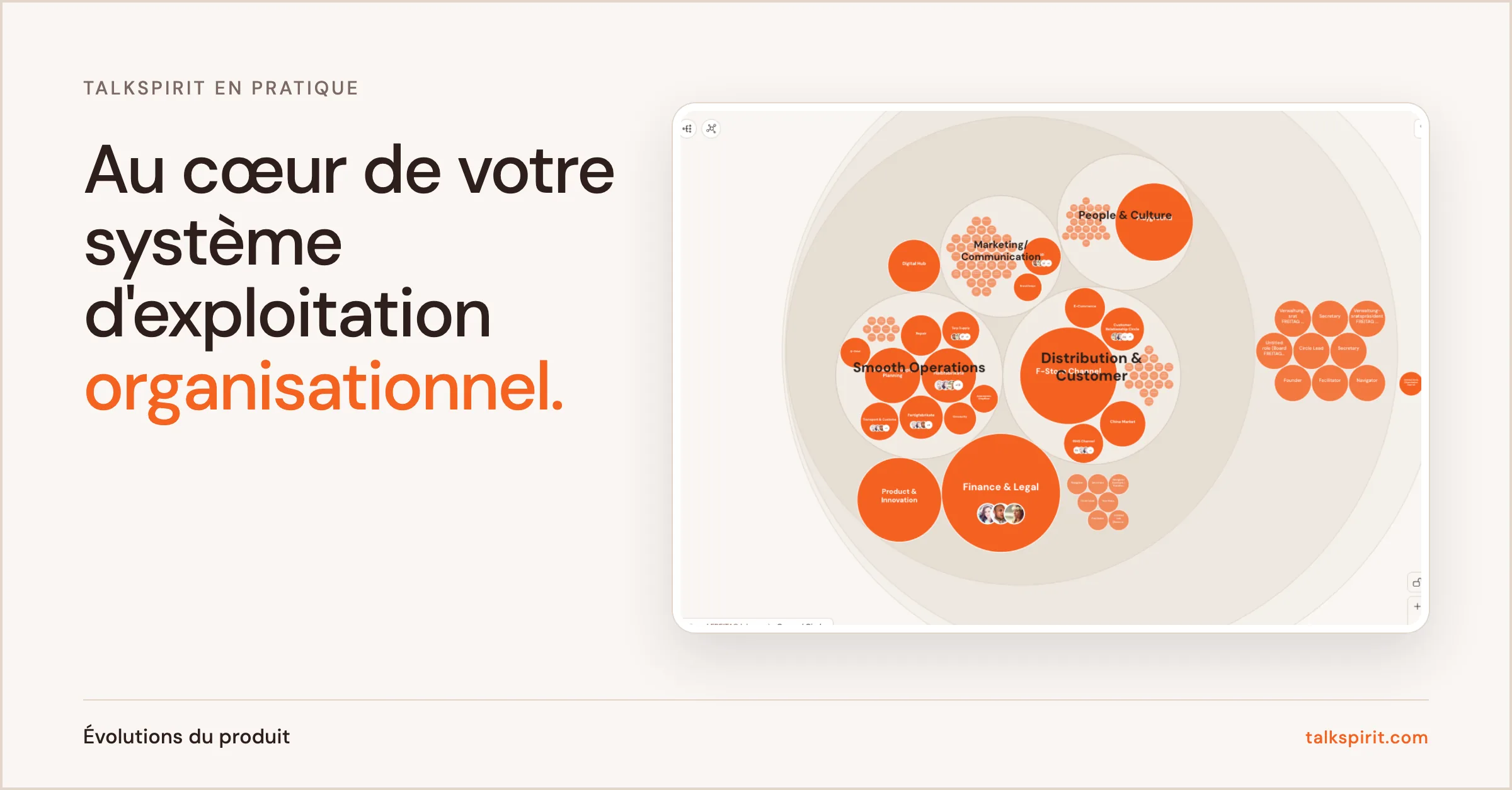
To manage distributed systems, you need tools capable of mapping the organisation, making it visible and navigating through it. Information has to be available and transparent.
And the tool should be able to "make itself forgotten". What we want is quality human interaction.
AI is obviously part of the landscape. But the key question is: does this technology give me power back? Or does it take it away from me? That is what separates the technologies that bring us closer from those that alienate us.
Can you share a moment where this approach became concrete?
Yes, two stories.
The first: in a large company of around 2,000 people, senior management wanted to get rid of the word "manager" within six months. Quite the utopia, which in the end became a transformation journey lasting several years. During that journey, one front-line manager had taken quite a few initiatives, and had gradually taken on the role of facilitator, a role that leads meetings and collaborative dynamics. Six months later, he was facilitating the executive committee.
It is a fine example of potential revealed, of values put at the service of the collective, beyond job titles.
The second: a participant in our Authentic Relating training told us how this approach had transformed her relationship with her teenager, which had been difficult for years.
Beyond organisational performance, it is people we care about. If people change the way they connect, everything else follows.
What do you see as the most significant impacts you create?
Our purpose speaks of a triple reconnection:
- with oneself (desires, values, identity),
- with others,
- with the world around us.
Concretely, this means enabling each person to reconnect with themselves within systems that, too often, push people to disconnect in order to "cope".
When you disconnect from yourself, you also disconnect from others and from the world. That is where we want to have an impact, on an almost political dimension that we own.
More concretely, our impact ranges from improving strategic decision-making to clarifying operational roles and responsibilities, taking in the transformation of conflicts into spaces of richness, and plenty more of course.
We do not claim to have magic numbers. We collaborate with researchers, but these phenomena are complex. We learn as we go, with humility.
If you had to give one piece of advice to a leader in transformation?
Vulnerability. It is not weakness, it is the ability to show your weaknesses and to talk about them. That is what creates psychological safety and trust.
And this well-known phrase: "Be the change you want to see in the world."
The leader is part of the system and carries a great deal of responsibility for its current state. Questioning yourself, experimenting, being yourself the ground on which transformation happens, that is essential.
Are there questions you keep asking yourself?
Yes, a lot of them around artificial intelligence at the moment. It calls into question our professions, our ways of working, and even our relationship with what is human.
Can you do human management with robots? How can we ensure that this technology strengthens our humanity rather than diminishing it?
More broadly, where are we heading? Toward a techno-supremacy, or toward a more conscious and collective use of technology?
And beyond the big questions, we are still faced with very concrete ones: why is this particular organisation where it is, and what can be done to help it move forward? That is what makes our work so fascinating.
Thank you very much, Martin. A final word?
A big thank you to you and to Talkspirit for this initiative. There is still a lot of "evangelising" to do around these approaches, in quotation marks, because the last thing we want is for it to become a dogma. Thank you for bringing together the people who are trying to move these new ways of working forward.