.webp)
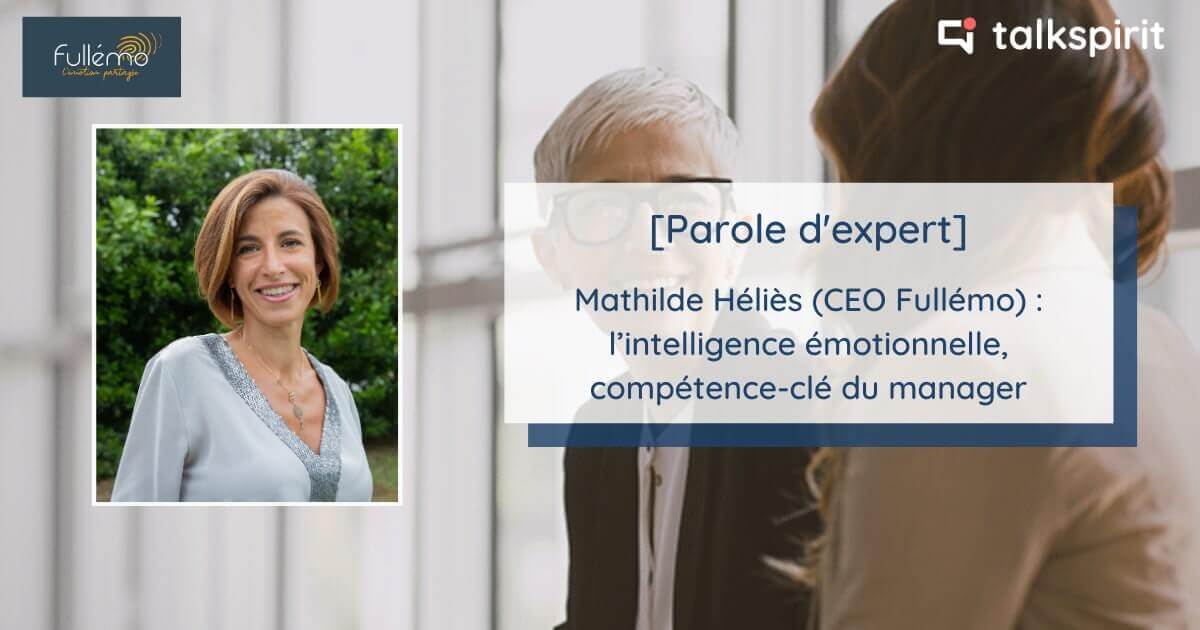
Mathilde Héliès (CEO Fullémo): Emotional Intelligence as a Key Management Skill
.svg)
Technical skills alone are no longer enough to perform well and build strong workplace relationships. soft skills have become the essential competencies managers need to excel and adapt to any situation. In today’s context, one capability stands out: emotional intelligence, c’est-à-dire la capacité à se mettre à la hauteur de l’autre et à s’adapter au contexte dans lequel on évolue.
To understand the full significance of this managerial skill, we spoke with an expert on the topic: Mathilde Héliès, CEO of the HR consulting firm Fullémo. Spécialisé sur l’amélioration de l’expérience émotionnelle des collaborateurs, Fullémo accompagne les individus et les entreprises à co-construire des expériences professionnelles positives et motivantes, pour permettre à chacun de s’épanouir au travail.
Dans cette interview, Mathilde Héliès apporte son éclairage sur cette compétence-clé qu’est l’intelligence émotionnelle, et répond aux questions suivantes :
- What are the benefits of emotional intelligence for companies and employees?
- Why is emotional intelligence an essential skill for managers?
- How can you develop your emotional intelligence?
Benefits for Companies
A Stronger Employer Brand
I believe the best way to build a strong employer brand is to have employees who are genuine ambassadors, because they truly value their experience as employees.
And it is the emotional experience lived by the employee toward the company that determines whether they become a detractor or an ambassador. For instance, 92% of candidates share a bad interview experience with others, and 78% subsequently decline the offer.¹ Emotional intelligence therefore has a real impact on attractiveness and your employer brand.
Better employee engagement
Studies have shown that there is a link between emotion, retention, and engagement. For example, Meyer and Allen identified three levels of individual commitment: normative, continuance, and affective. It is this last dimension, affective commitment, that reflects emotional attachment to the organization. It is what motivates people to stay because they want to, not because they have to.
What shapes this perception is not so much the physical work environment, but the events experienced and how each individual interprets them. Note that the employee experience, « c’est le résultat de l’appréciation émotionnelle d’une personne lors de ses interactions avec une entreprise ». Ainsi, 59 % des émotions négatives vécues au travail sont liées à des mauvaises relations avec les collègues et les managers.²
Benefits for Employees
Stephen Fineman, a professor of organizational behavior, describes the workplace as a true emotional arena. To perform well in this environment, emotional skills are a genuine asset for employees.
More Effective and Creative Work
Studies show: emotions have a direct impact on performance and effectiveness at work. Comme l’affirme Richard Lazarus, « les individus qui ont des expériences positives sont plus confiants ».
Similarly, the Losada ratio shows that the more positive interactions are within a company, the better the performance. The study found that high-performing teams have a ratio of six positive interactions for every negative one, while underperforming teams have a ratio of one positive to three negative.
Furthermore, emotional management can generate more creative solutions to problems.
Better Workplace Relationships
Emotional intelligence also has an impact on social relationships, as it fosters pro-social behaviors such as helping others, cooperation, and building social bonds.
A person with high emotional intelligence can build and maintain healthy relationships on a daily basis, and stay on course more easily when challenges arise. These strong interpersonal relationships help build a positive climate, energize teamwork, manage conflicts more effectively, and overcome resistance.
Greater Capacity for Influence
The capacity for influence is also strengthened. A person who has developed their emotional intelligence is more attuned to all the signals their interlocutor sends.
They can therefore continuously adapt, find the right register, and use the right communication style intuitively, adjusting not only their words but also their posture. As a result, people with high emotional intelligence are often better leaders.
Better Health
Finally, emotional intelligence has a positive impact on health. It strengthens the immune system and helps people produce fewer stress hormones , for example. As a result, employees who have developed their emotional intelligence are less absent from work, less prone to psychosomatic illness, and less likely to experience burnout .
An Essential Skill for Managers
A Driver of Well-being at Work

Managing is first and foremost managing emotions. When a manager can handle their own emotions and help others do the same, they gain a real edge. Because they can take care of themselves and their team, and maintain balance by protecting themselves from energy-draining situations.
Being emotionally intelligent also means not being overwhelmed by one’s own emotions or those of others, and knowing how to regulate them. That is why emotional management is the most powerful driver of well-being, engagement, performance, and team retention.
Read also: How Work Is Evolving: What Role for Quality of Work Life?
Just as important remotely as in person
In my view, emotional intelligence is just as important remotely as in person, though managers must be more attuned when working remotely, parce qu’il a moins accès à certaines manifestations physiques. Il pourra toutefois se concentrer sur les expressions du visage ou la voix, par exemple.
Read also: Hybrid Work: Management Best Practices
However, managers must also take circumstances into account : pendant le confinement, par exemple, l’impact psychologique en premier lieu, mais aussi les conditions matérielles ou familiales dans lesquelles le salarié et le manager doivent travailler sont des paramètres importants.
How can you develop your emotional intelligence?
The Role of the Company
I believe companies are and will increasingly be expected to cultivate a pleasant and positive employee experience. To do so, they will need to rethink what they offer employees, especially during in-person time. For example, they can rethink the work environment pour que – en présentiel – les collaborateurs soient dans les bonnes dispositions pour se concentrer sur les activités d’exploration. Le bureau doit être un lieu de partage et de dynamisation collective qui stimule les collaborateurs.
At Fullémo, we take a multi-sensory approach. We work on the visual experience, leveraging art to stimulate creativity. We also work on scent. Why? Because certain scent profiles have emotional properties qui permettent de réactiver des émotions et de favoriser des types de comportements. Par exemple, des facettes gourmandes vont favoriser le travail d’équipe et l’optimisme.
The Role of the Manager
For their part, managers must adopt a situational management style, with a dual stance:
- They must foster remote execution by supporting employees, clearly defining their objectives, and providing regular check-ins.
- They must also maintain in-person exploration, through team meetings and collaborative workshops, to nurture informal relationships and facilitate collective intelligence.
Read also: Recap: “Managing Hybrid Teams: A How-to” Webinar
Best Practices
To develop emotional intelligence, the best first step is to start with a self-assessment to understand where you stand, what skills you have mastered, and what you need to work on. For this, the EQ Pro test is ideal.
From there, there are many ways to self-educate (blog posts, podcasts, and more). Fullémo shares many reading and podcast recommendations on its serial learners blog.
Emotional intelligence is a synthesis of different disciplines (for example, psychology and communication). Plus on va s’intéresser à ces sujets, plus on va pouvoir développer cette sensibilité et ces compétences relationnelles et émotionnelles.
Finally, you can seek professional guidance to interpret your assessment and build your skills. At Fullémo, we offer emotional coaching to unlock and develop emotional intelligence, improve well-being, and build harmonious relationships. We also provide training, including for managers.
Read also: A Necessity: Managing Change
*
* *
Aujourd’hui, le travail génère encore beaucoup d’émotions négatives. Développer ses compétences émotionnelles, c’est se donner les moyens de ne pas se laisser polluer par les émotions négatives, de retrouver l’équilibre, et de savoir s’ajuster en permanence aux situations et aux interlocuteurs.
Want to learn more about the skills and best practices for managing in a hybrid work context combining in-person and remote work? Check out our white paper: “The Future of Work: Embracing Hybrid Work!”
Access the White Paper
In our white paper “The Future of Work: Embracing Hybrid Work!”, you will discover: the 8 key challenges of hybrid work; best practices for managers, HR teams, internal communications, IT departments, and employees; plus the tools to put in place to facilitate hybrid work.
¹ Study conducted by Robert Walters in June 2015
² Affective Events Theory (AET) by Weiss and Cropanzano
_
Author: Emmanuelle Abensur