
All Clear: Ways to Improve Transparency in the Workplace

.svg)
- Transparency starts with culture: information sharing rules written down, published and reachable by everyone, and responsibilities made explicit.
- Sharing the bad news as well as the good is what makes the effort credible; announcing only wins undermines it.
- Managers either carry information or block it: train them, and recognize the ones who set the example.
- Make the organization legible in one place: roles, circles, internal policies and objectives visible together and kept up to date.
- Write down what stays confidential (individual pay, performance reviews, client data), or everyone decides on their own.
- Measure it: a tracking chart, shared OKRs and employee feedback, anonymous if needed, show whether the effort lands.
You remember it from elementary school: that “telephone game” where one child whispers a message to another child next to them, and on and on until the message has been passed around the room. Sometimes also called “Chinese whispers,” it’s the perfect example of a company whose communication has become muddled and lacking transparency. The end result? A pile of misunderstandings, paranoid or skeptical team members juggling contradictory information, and a slide in overall company performance. 📉
There’s a way to achieve clearer, more open communication to avoid this mess. Our secret: improving transparency in the workplace. And the benefits of this transparency don’t stop there! It also plays a role in talent retention. Discover 5 tips 🖐️ below to adopt transparent communication and avoid information chaos!
The gap to close is wide. In the study we ran with Ipsos among 1,000 French employees (January and February 2024), only 12% found their company completely transparent, and 67% of those who saw their organization as opaque also found its strategy for the next twelve months unclear. Transparent information and a legible direction go together.
Tip #1: Integrate transparency into your business culture
Integrating the notion of transparency into your enterprise culture is the first step towards achieving transparency in the workplace.
To start with, make sure everyone has the same understanding of your business’s culture and policies. Define clear policies around information sharing within your organization. Clarify the responsibilities of managers and employees.
For example, you can publish these rules in a publication that remains accessible to all. The Talkspirit Structure module is built for exactly this: roles, circles, accountabilities and internal policies are published in one place and kept up to date, so everyone can see the scope of their own role and who decides what. When in doubt, no need to ask for clarification! ☝️
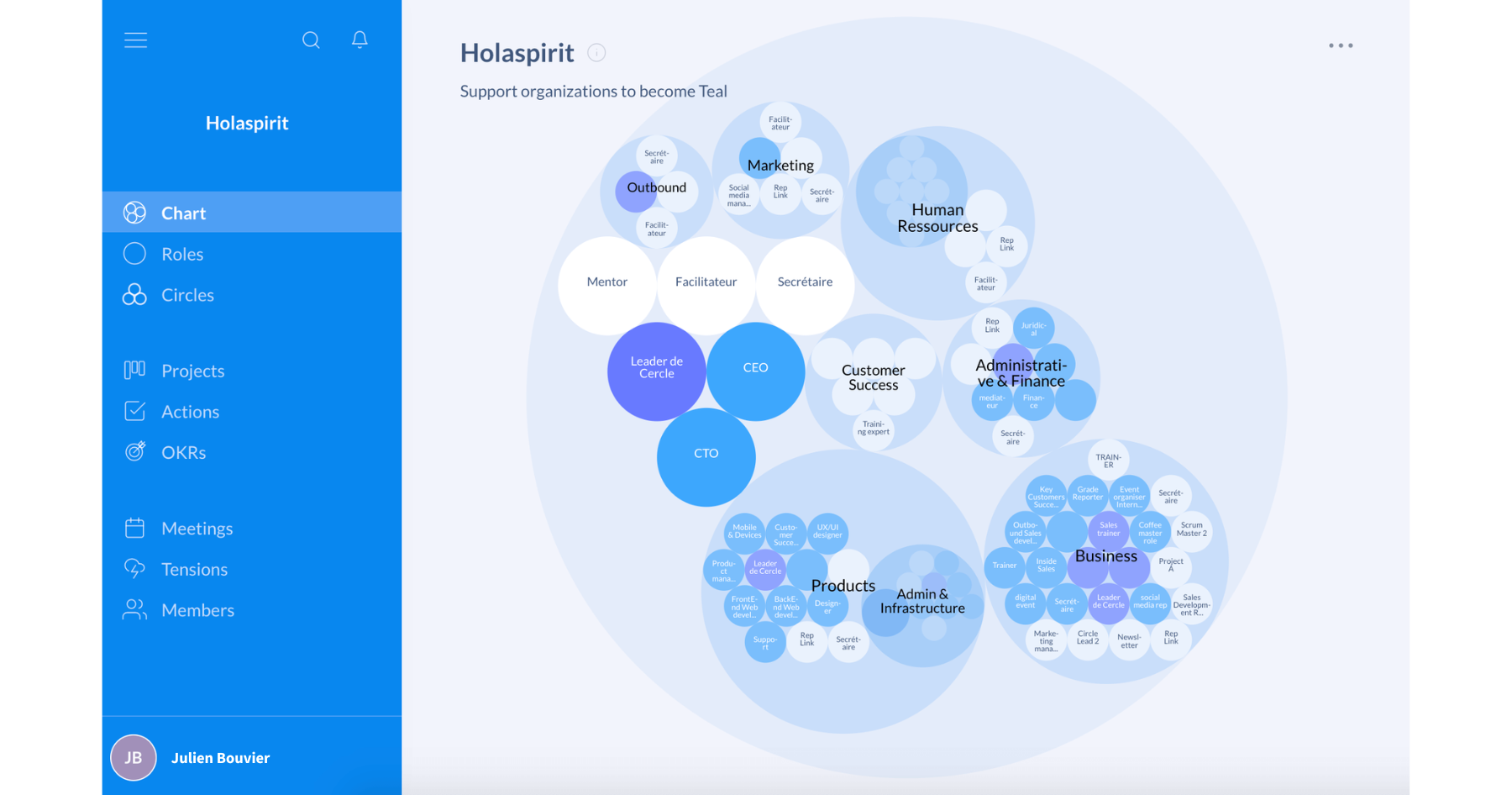
Then you have to explain and justify your approach! “Is it really necessary to introduce a new way of communicating?” “Do we need to be transparent with all types of information?” You’ll certainly run into these questions, and to raise awareness among your employees, you’ll need to have THE answers!
To engage your teams in this new culture and dispel their doubts, you will need to:
- demonstrate how developing transparency can actually improve the entire company’s performance
- explain how to share information, who should do it, and what data should remain confidential
- always, always welcome constructive ideas and feedback
- encourage empowerment: show everyone that they all have their part to play in the company’s success
You’ll benefit from a solid business culture your teams will embrace, a culture that helps to improve the transparency of information within the company.
Tip #2: Communicate on the positive as well as the negative
To make all the information circulates internally in a more transparent manner, you’ll need to review your internal communications. This doesn’t necessarily entail a complete overhaul. Our advice here is simple: change the tone and be more transparent!
Information is not just for the few: it has to be shared by all. To improve transparency, your organization needs to ensure that every voice counts. For example, you can change the way you share information. Say adios to top-down meetings where managers monopolize the floor and are closed to discussion. These meetings are a far shout from transparency in the workplace… 😅
Instead, create a space where information flows freely, whether it is positive or negative. That’s all your employees want and expect from you! Yep, sharing both good and bad news helps reinforce management’s credibility. It demonstrates your commitment to transparency, and it sets the example for fellow employees. 👏
Now you can optimize your internal communications with Talkspirit! This all-in-one platform comes with several features which you’ll discover below:
- a news feed that lets you funnel and share targeted information
- a home portal to share essential news and happenings
- chat and videoconferencing for real-time communication
- groups and publications to facilitate exchanges

Request your Talkspirit demo today
Tip #3: Bring managers on board
Transparency happens at every level! As the intermediaries between management and employees, managers have a key role to play in improving the transparency of the business’s information. They must set an example by adopting open communication and sharing feedback transparently.
Read also: Increasing transparency in a hierarchical organization, ORS Group’s story, and 4 tips to involve managers in internal communication
You need to encourage managers to model the transparency you want to create. Provide them with specific training on the importance of transparency in leadership. Show them how their exemplarity can inspire and motivate employees to adopt similar practices.
Recognize and reward managers who embody the values of transparency. Your feedback is a source of motivation for other managers, and it will likely encourage them to follow suit. By placing managers at the heart of your internal communications strategy, you create a positive domino effect that spreads to all levels of the company, promoting transparency in the workplace. That’s a home run! ⚾
Watch Talkspirit CEO Philippe Pinault’s video to find out how to develop transparency within your organization!
Tip #4: Map your organization using a suitable solution
The great thing about the digital age we live in is all the tools available. And software that simplifies information sharing and encourages transparency in the workplace exists!
Self-management platforms provide the right spaces for employees to clarify their roles and responsibilities, share ideas and collaborate seamlessly. That is what Talkspirit covers with its governance and role clarity modules. Two of them bear directly on transparency:
- The Structure module provides a transparent overview of the division of responsibilities within the organization. It answers the questions “who does what,” “why” and “with whom.”
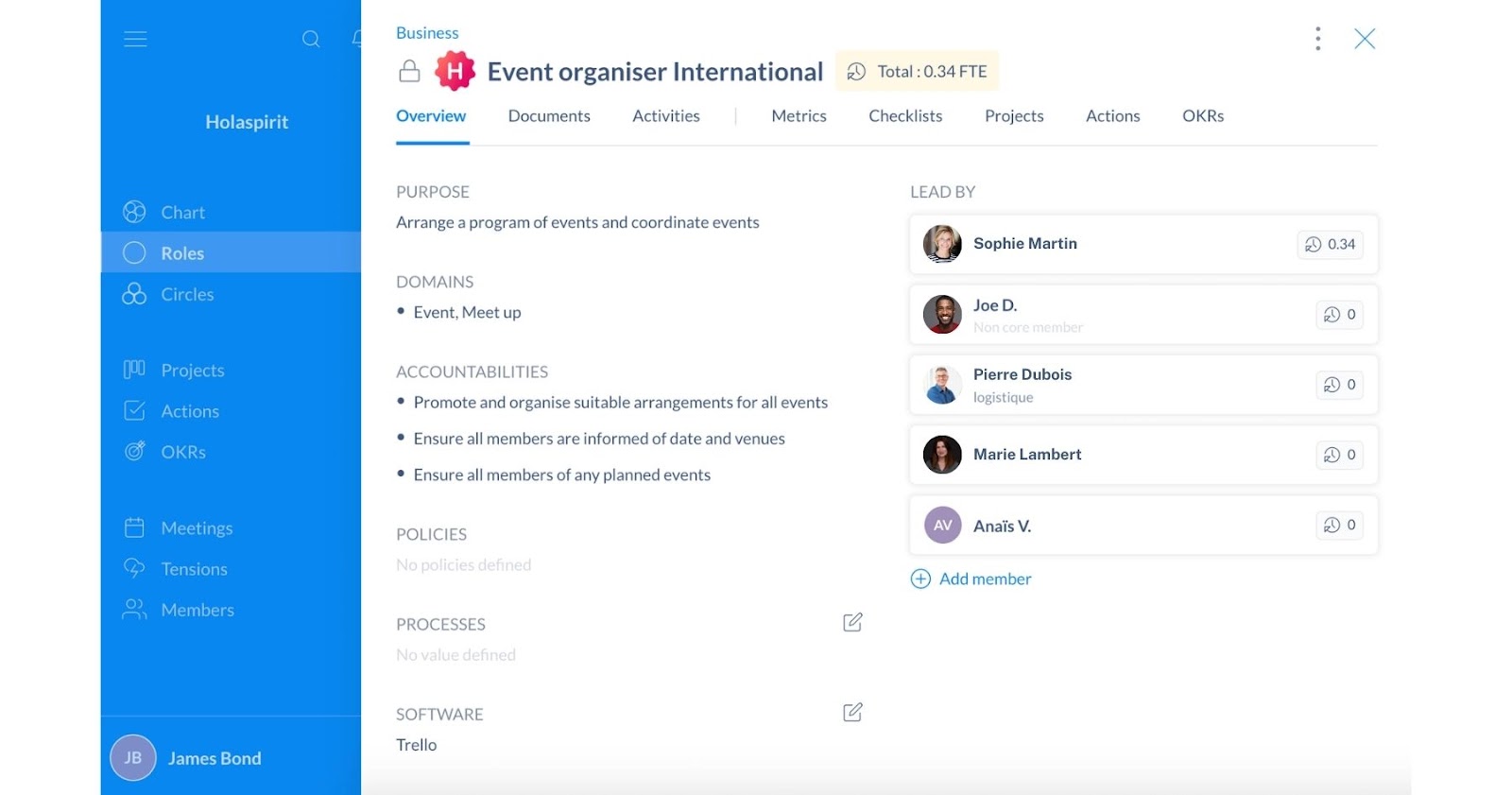
- The Goals module (OKR, for objective key result, a method of tracking objectives by key results) provides complete visibility of the company’s strategic objectives, as well as those of each team. As a result, each team member has full transparency over his or her contribution to achieving these objectives.
Of course, the question of security is crucial. So, choose a secure solution to protect your sensitive data!
Talkspirit is ISO 27001 certified, a certification that guarantees the highest levels of security and confidentiality. That is the flip side of internal transparency: the more information you open up, the more the platform holding it matters (our about page sets out our commitments).
Tip #5: Measure your ROI
To know whether your efforts and those of your teams are effective: you have to gauge them, and always transparently. 😉
To get started, create a tracking chart. Set out clear objectives, for example with the OKR method, and review progress on all your OKRs on a regular basis. Then, share them internally to demonstrate transparency.
Access to this information alone isn’t enough! Business transparency also means giving meaning to data. Draw up a detailed report on your company’s performance, and present it to your employees. In this way, your employees can assess for themselves the impact of your transparency approach.
Numbers speak for themselves, and so do your employees! They’re an additional resource for evaluating the ROI of a business transparency strategy. Don’t hesitate to ask them for feedback, even anonymously! Use this feedback to refine your approach and better identify the grey areas in your internal communications. In the end, you’ll have enough information to finetune your information-sharing strategy accordingly! 👍
What gets shared, what stays confidential
Transparency does not mean telling everyone everything. The difficulty lies elsewhere: nobody knows what belongs in the open and what belongs behind a door, so everyone decides on their own. Writing the rule once and publishing it settles most of the problem. Here is a starting point to adapt to your own organization.
| Information | Shared by default | What justifies restricting it |
|---|---|---|
| InformationRoles, accountabilities, internal policies | Shared by defaultOpen to the whole company | What justifies restricting itNothing: this is the base of a legible organization |
| InformationStrategy, objectives and OKRs | Shared by defaultOpen to the whole company | What justifies restricting itA deal under embargo, until it is announced |
| InformationDecisions and trade-offs | Shared by defaultOpen, together with the reasoning behind them | What justifies restricting itThe individuals named in the decision |
| InformationCompany results | Shared by defaultOpen, at the level of detail you announced | What justifies restricting itThe disclosure rules of a listed company |
| InformationSalary bands and pay ranges | Shared by defaultOpen: these are rules, not individual cases | What justifies restricting itNothing, once the framework is settled |
| InformationIndividual pay, performance reviews, health data | Shared by defaultClosed | What justifies restricting itThe privacy of the people concerned |
| InformationClient data and contracts | Shared by defaultRestricted to the roles that need it | What justifies restricting itContractual confidentiality and the GDPR |
What matters is not where exactly the line sits, but that the line is written down and known. Closed information whose reason for being closed is understood costs nothing in trust; open information nobody knows where to find adds nothing to it.
A final word
So, there are our 5 tips for improving information transparency in the workplace. Now all you have to do is put these tips into practice to optimize your internal communications and start earning a return on your investment.
Again, the benefits of transparency go beyond what we’ve discussed thus far. This approach is also proving to be a fundamental pillar in forging strong relationships within your team.
Want to find out more about talent retention levers? Download our white paper on the subject!
Access the White Paper
In our white paper “How to Strengthen Employee Loyalty and Prevent Quiet Quitting,” you’ll discover the main causes of disengagement at work, as well as ways to improve talent retention and avoid quiet quitting.
FAQ
With the company culture. Make sure everyone shares the same understanding of the culture and policies, define clear rules on information sharing, and clarify the responsibilities of managers and employees. Publishing those rules somewhere permanently accessible keeps them visible.
Yes. Creating a space where information flows freely, whether positive or negative, reinforces management's credibility, demonstrates a commitment to transparency and sets the example for other employees. Announcing only the wins has the opposite effect.
Individual pay, performance reviews, health data, and client data and contracts, which stay restricted to the roles that need them. Roles and accountabilities, internal policies, strategy and objectives, on the other hand, are worth opening to the whole company. What matters most is that the line between the two is written down and known.
As intermediaries between management and employees, they must set an example through open communication and transparent feedback. Specific training on transparency in leadership, plus recognition for the managers who embody it, creates a knock-on effect across every level.
One that holds roles, accountabilities and objectives in the same place. The Talkspirit Structure module publishes the organization chart, the circles and the internal policies, and the Goals module gives visibility on the OKRs of the company and of each team. Talkspirit is ISO 27001 certified, which matters as soon as the information you open up becomes sensitive.
Create a tracking chart, set clear objectives such as with the OKR method, follow progress regularly and share it internally. Then draw up a detailed performance report and present it to employees, and ask them for feedback, anonymously if needed.