
A Guide: How to Run Effective Meetings in Organizations of the Future?
%252520(1)%252520(1).webp)
.svg)
- Seven rules run the meeting itself: set a goal, open up the communication, appoint a facilitator, use visuals, keep it short, close it properly, and confirm the new responsibilities.
- One person dominating the conversation is one of the biggest meeting challenges, reported by more than 70% of respondents in a recent study.
- Most of a meeting’s effectiveness is settled before it opens: who is invited, in which format, at what moment, and what will be written down afterwards.
- Invite by role rather than by rank, and send the written record to everyone else.
- Five formats cover most needs, governance, tactical, project review, check-in and all-hands, each with its own purpose, attendees and cadence.
- The step by step section shows the sequence in the Talkspirit Meetings module, from the check-in to the full report.
A self-managed organization is a business model that more and more companies are adopting. Perhaps leaders, managers and/or CEOs have figured out how the labor force has slowly shifted since the pandemic. With that being said, what has pushed many leaders to adopt such a model?
The answer is simple, but quite complex to shift to, or even for many traditional organizations to grasp on it and actually make a change.
Truth is, Millenials and the generation after that, are looking to work for organizations that hold their same values, they want to feel appreciated, seen and valued; they want to work for a team and organization that has a purpose and subsequently one, that makes an impact in the world.
This new way of working is rather a team of people who are guided by a framework of goals, milestones, and projects but are able to operate within that framework as they please, working with autonomy and decision-making.
So in the article, we’re sharing a guide on how to run effective meetings for self-managed organizations who wish to be part of the change in the workforce. And you can do that even more effectively with Talkspirit, the platform that took over from Holaspirit: its Meetings module carries the agility, Holacracy and role based practices that fit your organization, whatever its size.
#1 Set a goal for the meeting
With so much to do and so little time on everyone's hands, you want your meeting to be as productive and efficient as possible. This is why you should decide on the goal of the meeting in the early stage of planning it and make it a focal point.
This way, you can inform the meeting participants about the aim of this planned gathering and have them:
- know what to expect
- understand the importance
- think about the best ways to contribute
- understand whether or not the meeting is closely related to their role or department
👉 Example: Let's say the goal of the meeting is to brainstorm ideas for the new social media campaign. The marketing team members will know it's their duty to take the lead and bring out their experience and expertise. Others would be able to help them come up with the best ideas.
If the goal of the meeting is straightforward, all the participants will be able to prepare and contribute the best way they can.
#2 Nurture a culture of open communication
You want everyone in your self-organized organization to be fully aware of their unique roles and feel appreciated. This is why you can't let any of the team members take full control over the meeting and impose their beliefs or conclusions.
So, set some ground rules and focus on open communication:
- everybody’s welcome to speak and pitch in ideas
- people need to respect each other's time to speak
- people are encouraged to speak their mind
Supportive and open communication will bring out the best in everyone.
💡 Article pick: How Does Leadership Impact Team Performance?
#3 Have a facilitator
Even though you're organizing a meeting in a self-organized organization, you still need to have a facilitator who'll make sure the meeting runs smoothly.
One person dominating a conversation is one of the biggest meeting challenges, according to more than 70% of respondents in a recent study. So, the facilitator is not there to decide who gets to speak and for how long. On the contrary, these meetings need to be inclusive and respectful towards everyone.
👉 The role of the facilitator is to:
- prepare an agenda and send it out before the meeting
- prepare the necessary documentation, data, and information
- announce the points to cover and open discussions
- control the timing of the meeting
Make sure the facilitator is trained to run a meeting fairly and help everyone respect the rules you've previously set.
💡 Article pick: 10 Tips to Facilitate your Meetings, Making them Inclusive and Effective
#4 Include visuals
An effective meeting is one where everyone's on the same page and knows what each party is talking about. In most cases, visuals can help people be more attentive and process the ideas and concepts discussed more easily.
This way, even if the topic of the meeting isn't closely related to a person's area of expertise, they can still be active and contribute with their ideas.
You can create a number of different visuals that will help you:
- present data
- introduce new concepts
- explain complicated processes or notions
You could create handouts with visuals or simply include them in a presentation that the facilitator will control as the meeting progresses. Either way, it will help keep the meeting on the right track.
#5 Keep it short
The next thing you'll need to cover is making sure the meeting is short but effective. You don't want it to go on forever and people need to be aware of the limited time you all have to reach a conclusion or solve a problem together.
So, you need to:
- let people know how long is the meeting going to last
- ask them to keep things simple and concise
Additionally, you'll need to make sure there's a set timeframe for each point on the agenda. With a clear timeframe, people will be more motivated to speak only when they have something truly important to say, and when they know they can contribute.
Also, short but frequent meetings will keep everyone willing to attend and give their best to contribute.
#6 Bring to a closure
Finally, to conclude an effective meeting, it needs some sort of closure and positive result. This is why the facilitator needs to pay close attention to what everyone's saying and potentially even take notes.
Once the meeting reaches an end, the facilitator will need to sum up all the major conclusions you've reached together and thus present the results of everyone’s hard work.
This will deepen the sense of togetherness and teamwork among everyone involved and have them leave the meeting feeling like they've done something productive and good for the organization.
#7 Confirm new responsibilities
As a result of your successful meeting, people will be taking action as agreed. It's important that you reach your goal and confirm new responsibilities for everyone involved.
Hopefully, all team members will take initiative, and assign themselves the new tasks and duties that will guide everyone towards the mutual goal.
💡Article pick: Niceshops Shares Their Journey with Holaspirit
Before the meeting: who is invited, when, and in what format
The seven rules above govern what happens once everyone is in the room. Most of what makes a meeting effective, though, is settled before it opens: who is invited, at what moment, in which format, and what will be written down afterwards.
Invite by role, not by rank
In an organization that runs on roles rather than on a chain of command, the invitation list follows the agenda: the people invited are the ones holding a role that the decision will touch. Everyone else receives the written record instead. The room stays small enough for a real discussion, and nobody sits through an hour without a reason to speak.
💡 Article pick: Our Step-by-Step Guide to Effective Governance Meetings
Pick the format before picking the slot
Not every subject deserves a synchronous meeting. Sharing information travels better in writing, where each person reads it when it suits them. A decision that involves several roles, or a tension that has to be worked through together, is what a live meeting is for. Once the format is settled, the slot and the room follow, and a hybrid meeting only works when the remote participants hear and are heard as well as the people sitting at the table.
💡 Article picks: Essential Meeting Room Equipment for Modernizing Your Workspace and 10 tips and tricks for improving the efficiency of your remote meetings
The agenda and the decision record are the two artifacts
An agenda circulated beforehand, one line per item with the intent stated (inform, decide, resolve a tension), lets everyone arrive prepared. A record written afterwards, one line per decision with the role that carries it and the date it was taken, is what keeps that decision alive once the room empties. Those two documents are what turns a series of meetings into a governance practice rather than a habit.
💡 Article pick: A Guide to Tactical Meetings (Agenda Template Included)
The five formats below cover most of what an organization actually needs to convene.
| Meeting type | What it settles | Who attends | Typical cadence |
|---|---|---|---|
| Meeting typeGovernance meeting | What it settlesRoles, accountabilities and the rules of the circle | Who attendsThe role holders of the circle | Typical cadenceMonthly to quarterly |
| Meeting typeTactical (triage) meeting | What it settlesObstacles blocking ongoing projects and actions | Who attendsThe team members concerned by the agenda | Typical cadenceWeekly |
| Meeting typeProject review | What it settlesProgress, risks and next steps of one project | Who attendsThe project's role holders and its sponsor | Typical cadenceAt each milestone |
| Meeting typeCheck-in or stand-up | What it settlesPriorities and workload of the day or the week | Who attendsThe whole team | Typical cadenceDaily to weekly |
| Meeting typeAll-hands | What it settlesStrategy, results and direction of the organization | Who attendsEveryone | Typical cadenceQuarterly |
📈 Easy steps to run an effective meeting with Talkspirit
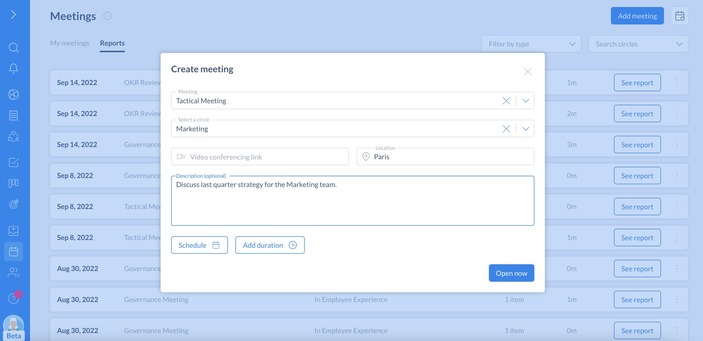
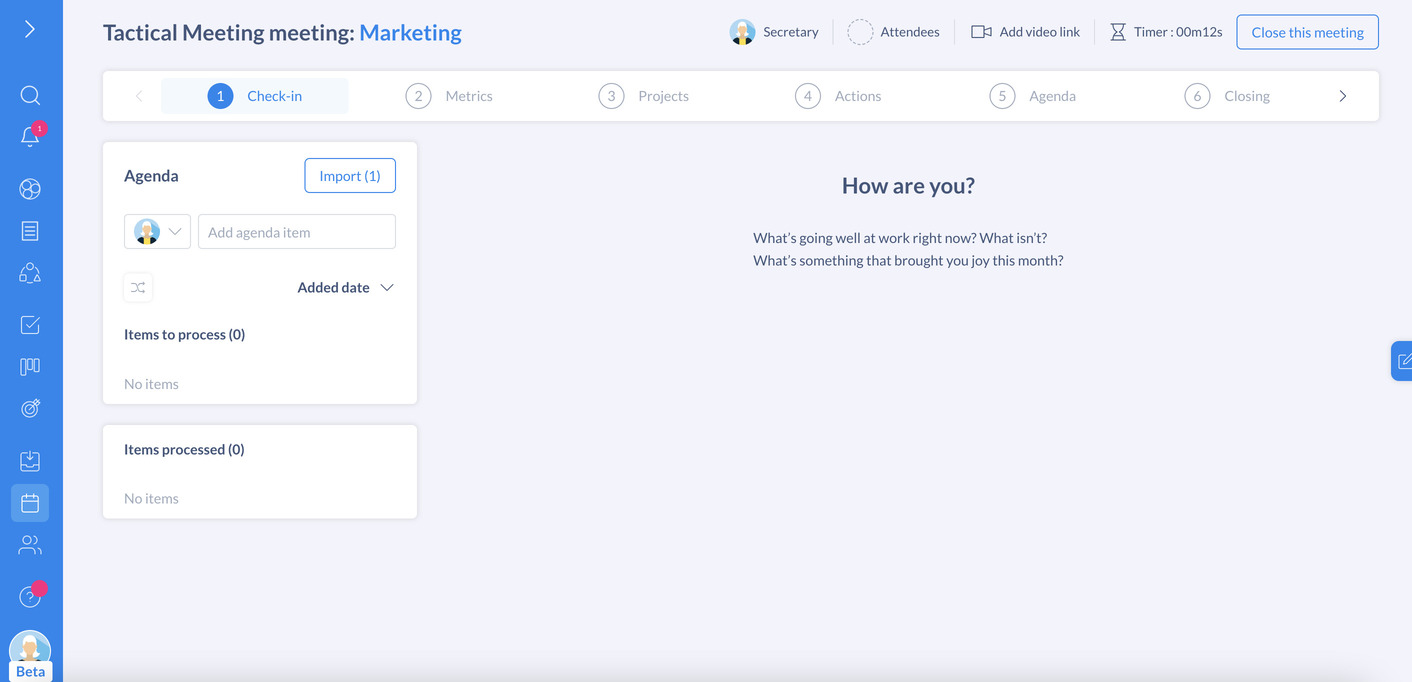
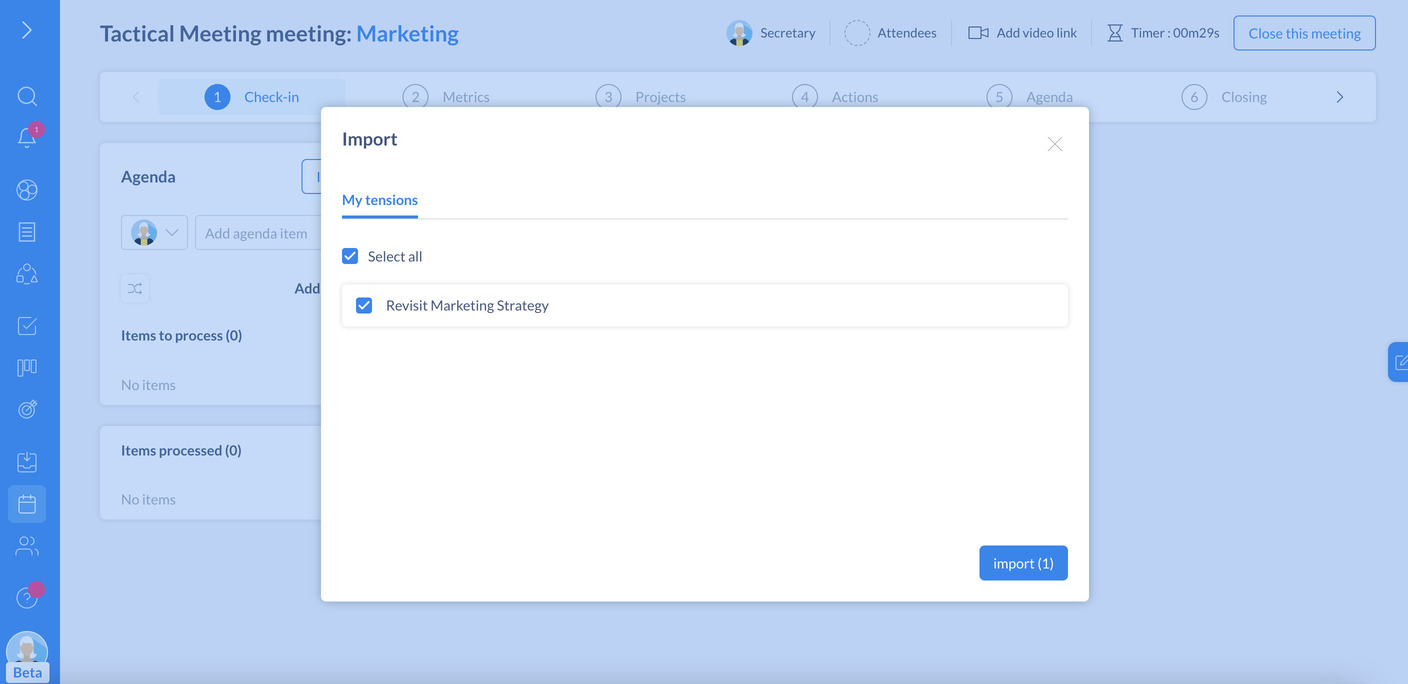
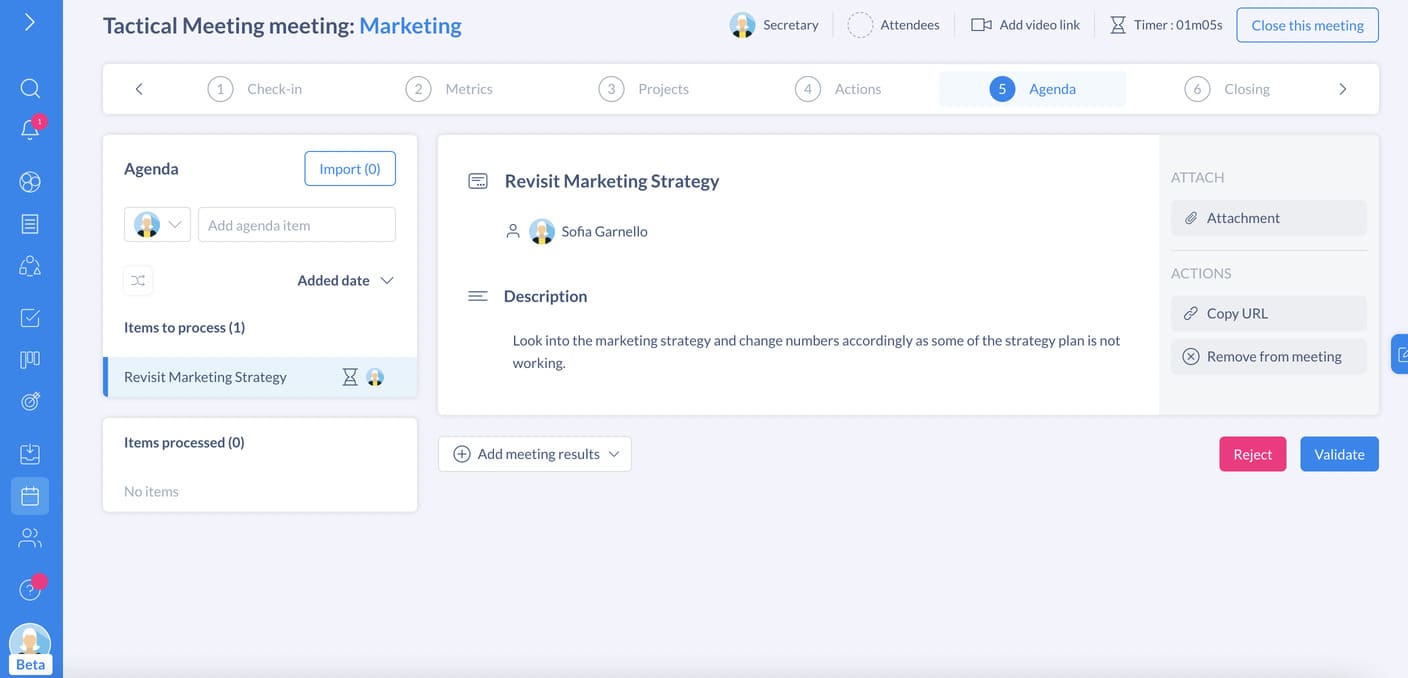
The screenshots below come from Holaspirit, the governance platform that has since merged into Talkspirit. The sequence is the same in the Meetings module: create the meeting, check in, bring your tensions, work the agenda, review the projects, close, and get the report.
Step #1 Create your meeting
👉 You’re able to specify your type of meeting, with who (team) and a brief description.
#2 Check-in with everyone
👉 a great tool to make sure everyone is present, and everyone is able to contribute to such meeting.
#3 Import your tensions (if you have any!)
👉 This is a crucial step since once you import your tensions from your inbox, they will appear in the agenda ready to be discussed with the rest of the team.
#4 Discuss your agenda!
👉 This is part of the meeting where you’re able to really voice out your tensions, wins, questions, etc. And it’s a great way to start a dialogue to solve, validate or reject.
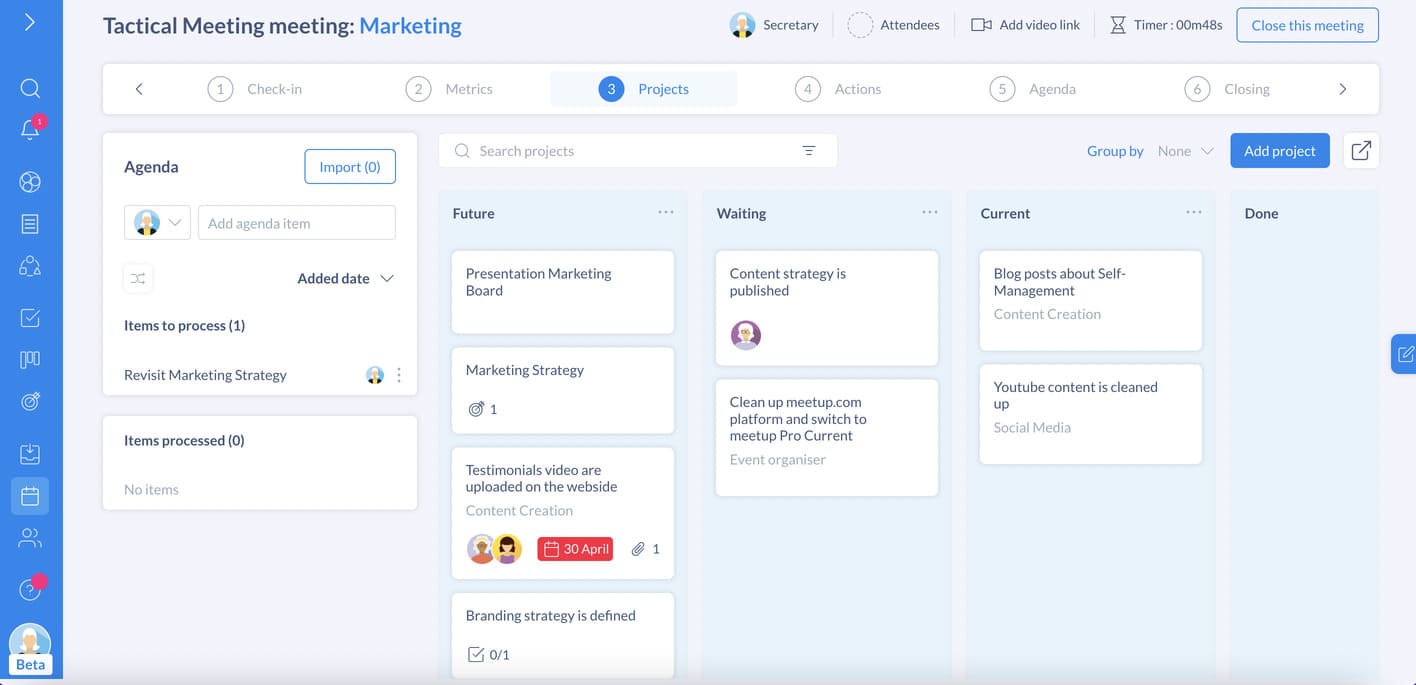
#5 Projects
👉 Great to discuss about your on-going projects to keep everyone informed where you stand with project and its processes.
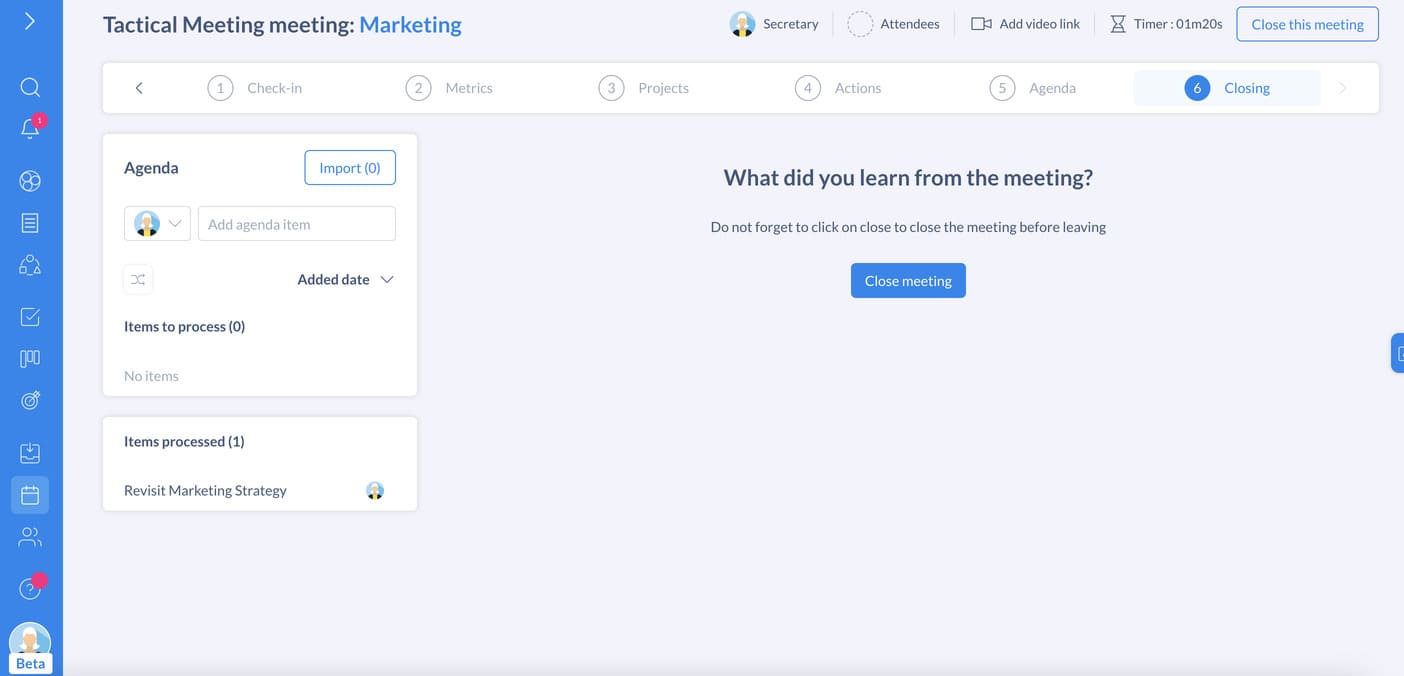
#6 Close up
👉Everyone gets to say a little something about the meeting, feelings and outcomes.
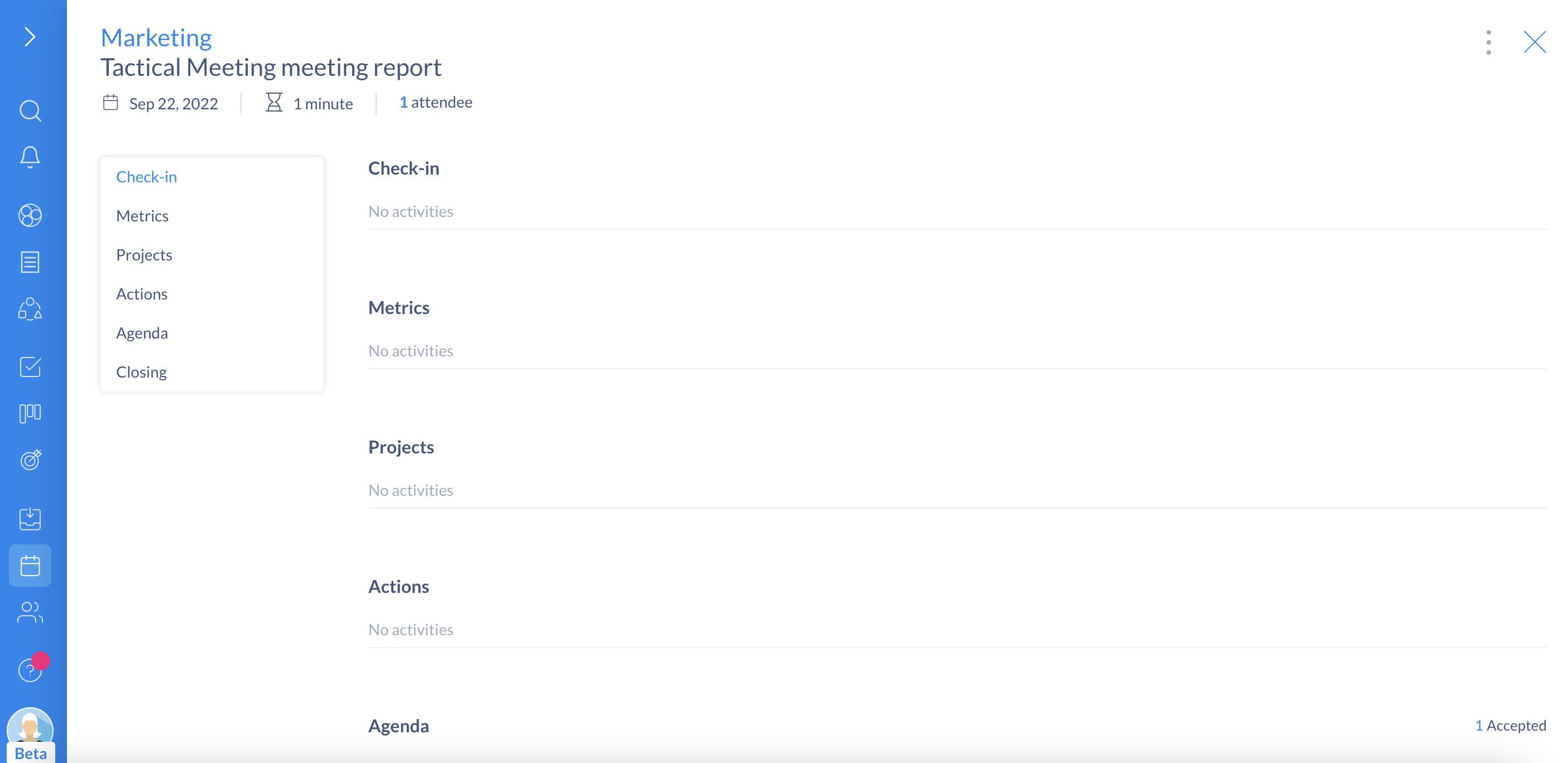
#7 Get your full report
👉 A great tool to run meetings in real-time with an after report of what went on. A great feature to keep everything on track, organized and transparent amongst the organization.
Final Thoughts
Running an effective meeting in a self-organized organization may sound complicated or even intimidating at first. But, with the right preparation and planning, you can make all of your future meetings a success.
The tips we've shared above will help you bring all the people around the same idea and have them contribute to the meeting actively and respectfully. Start applying them today!
Want to see what these meetings look like in practice? Book a demo of Talkspirit and bring one of your own agendas, whether it is a governance meeting, a tactical one or a project review.


Explore similar articles

%252520(1).webp)
Frequently asked questions.
Deciding on the goal early and making it a focal point lets participants know what to expect, understand the importance of the meeting, think about the best ways to contribute, and see whether it is closely related to their role or department.
The most frequently cited one is a single person dominating the conversation, reported by more than 70% of respondents in a recent study. The facilitator is not there to decide who speaks and for how long: the meeting has to stay inclusive and respectful towards everyone.
The facilitator prepares an agenda and sends it out before the meeting, prepares the necessary documentation, data and information, announces the points to cover and opens discussions, and controls the timing of the meeting.
The people holding a role that the decisions on the agenda will touch, and no one else. Everybody else receives the written record instead. Building the invitation list from the agenda rather than from the org chart keeps the room small enough for a real discussion.
Short but effective. Tell people how long the meeting will last, set a timeframe for each point on the agenda, and prefer short but frequent meetings, which keep everyone willing to attend and give their best to contribute.
Create the meeting by specifying its type, the team and a brief description, check in with everyone, import your tensions so they appear in the agenda, discuss that agenda, review ongoing projects, close up with everyone saying a little something, and get the full report afterwards. The screenshots in this article come from Holaspirit, now merged into Talkspirit.