.webp)
[BFM Business] How to Reduce Your Company's Digital Footprint
.svg)
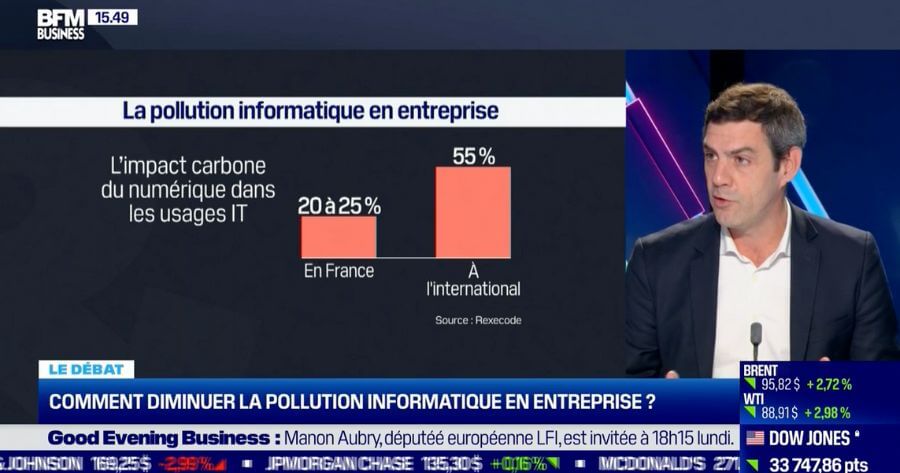
What is the environmental and energy impact of our digital usage? And what solutions exist to reduce digital pollution in the workplace? These were the questions addressed by Philippe Pinault, Co-founder and CEO of Talkspirit, and Victor Thion, Co-founder of Cleaq, on the BFM Business set, in the Tech&Co Business show on Saturday 12 November 2022, hosted by Frédéric Simottel.
Here is a summary of the show, including the eco-friendly practices shared to promote digital sobriety in the workplace.
Watch the replay:
Digital pollution by the numbers
It is hard today to grasp the full environmental impact of our digital usage. Let us start with a few figures to put the topic in context.
"Digital technology accounts for 4% of global greenhouse gas emissions and 2% in France — already well above civil aviation", Philippe Pinault points out. "A figure that could double by 2025."
And for good reason: our consumption of IT hardware keeps growing. "Hardware accounts for 80% of the total impact of digital technology" insists Victor Thion. This over-consumption is compounded by ever-increasing digital usage — which, in fine, contributes to rising digital pollution generated by companies.
Hybrid work: a good way to reduce digital pollution?
Several solutions exist to reduce this digital pollution. One of them? Hybrid work, which combines office-based and remote working. This organizational model is gaining ever more traction today because it helps reduce companies' energy consumption, while offering greater flexibility to employees.
For Philippe Pinault, hybrid work is therefore "one of the solutions to the shift in working patterns — one that would help limit our carbon and energy footprint." He cites in particular the Agency for Ecological Transition (ADEME), which estimates that "remote work could reduce our commuting by 69%" — generating significant savings in energy and fuel.
Several solutions today make it easier to work in hybrid mode. Among them: Talkspirit, a 100% French communication and collaboration tool that simplifies information sharing, energizes exchanges, and streamlines teamwork. The solution includes video conferencing, chat, groups, a news feed, a welcome portal, a library, a drive, an office suite, a shared calendar, and much more! Request a personalized demo to discover all of Talkspirit's features 👇
Read also: Hybrid work: the eco-friendly solution to reducing your company's energy consumption?
What eco-friendly habits to adopt?
Of course, hybrid work is not the only solution for limiting digital pollution and its environmental impact. Several other eco-friendly practices can make a difference, including:
- Sending fewer emails (and reducing attachment sizes), since sending an email consumes more energy than a lightbulb burning for 25 minutes.
- Buying refurbished devices (rather than new ones). For reference: manufacturing a 2 kg computer alone requires 800 kg of raw materials and generates 124 kg of CO2 equivalent (out of the 169 kg emitted over its entire lifecycle).
How to roll them out?
Before adopting these eco-friendly practices, it is first essential to measure your carbon and energy footprint using dedicated tools (such as Greenspector, Greenly, Fruggr, etc.).
Finally, as Philippe Pinault points out, all of these actions must be accompanied by an awareness-raising approach to help employees adopt more responsible digital practices — a cause that Talkspirit is fully committed to.
*
* *
Want to discover more best practices for reducing digital pollution in your workplace? Download our checklist featuring 10 examples of initiatives to achieve digital sobriety:
Access the checklist
In our checklist "10 best practices for achieving digital sobriety", you will find: examples of initiatives and tools to reduce your digital carbon footprint, along with tips for evolving your practices and involving employees in the process.
¹ The Shift Project Report 2018
² "The Hidden Face of Digital", ADEME Report, 2019
–
Author: Joelly Kahono