Living Organizations with Bastoun Talec, HappyWork
.svg)
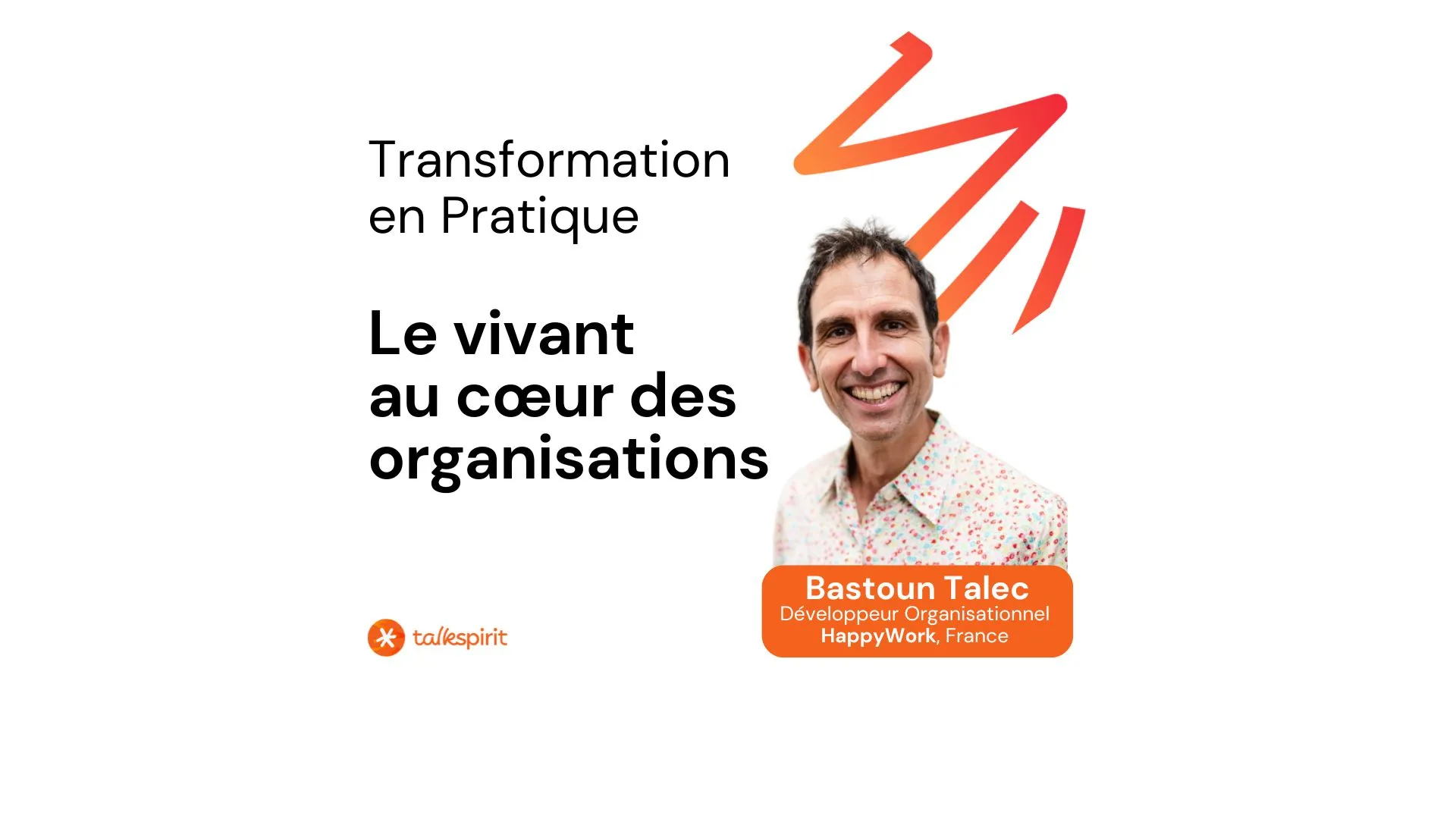
At Talkspirit, we love giving the floor to our partners who accompany organizations through their deepest evolutions. In this new interview, we meet Bastoun Talec, organizational developer at HappyWork, based in France. He shares with us his vision of today's challenges, his approach to supporting transformations, and the big questions that still drive him.
1. Who is Bastoun Talec and what is HappyWork?
HappyWork's mission is to grow organizations that help people grow. My ikigai comes down to one great aspiration: to ensure that the organizations of tomorrow are places where people genuinely want to come to work, and where they leave better than when they arrived. That is what drives me in life.
2. What do you see as the main challenges organizations face today?
The most important thing is for the women and men who work in and join organizations today to vitalize those organizations — so they can better withstand the complexity of the world and the acceleration of business. This is captured in the formula coined by the US Army in the 1990s: the famous acronym VUCA (volatile, uncertain, complex, ambiguous).
This means organizations must simultaneously think long-term — not in terms of rigid planning, but in terms of clarity and aspiration around the company's project — while remaining adaptable in the short term.
Avoid the trap of thinking and acting solely in response to pain points.
The main challenge for contemporary organizations, as I see it?
To move beyond — without dismissing — curative approaches, and aim instead for an organization in excellent health. To ensure that self-sustaining care supplants administered remedies.
3. How do you help organizations transform?
We always work with the idea that the organization is a living system. We start from where it is, and we do not take it where it does not want to go — or cannot go.
Transforming does not mean going from A to B — it means learning to become nomadic.
As a former athlete, I also know how much I owe to sports coaching. I see myself a bit like a cycling instructor facing a population that has never seen a bicycle. My role is to help people get on the saddle, and then to create the conditions for the practice to spread.
In practice, we often start by working with leaders to verify their commitment to operating differently — to fostering autonomy and skill development among their teams. We then use self-diagnosis: rather than a classic audit, we co-facilitate a process where teams themselves assess their governance, roles, the quality of their meetings, and so on. Self-diagnosis generates far greater ownership and agency.
Finally, through working with us, the shared foundations of the organization evolve and deepen. Because sharing a common vocabulary, setting explicit rules, building Self-Management skills, and adopting more "adult" reflexes and postures at work… all of this can be learned. So there is a training dimension to what we do.
At HappyWork, we equip organizations with the 5 Rs, which form a living framework for transformation:
- Purpose: There is not one but many purposes within every organization. Beyond the company project, every team, project, and individual role is underpinned by a purpose. The more intentions are clarified and kept evolving, the more galvanized the organization becomes.
- Rules: explicit and shared, to strengthen psychological safety.
- Roles: endowed with strong agency, limited only by respect for the purpose and the rules.
- Regulation: distinct rituals to cooperate, update roles, and prioritize. Gaps between what is and what could be otherwise are reduced. "It feels good," say the vast majority of participants in these renewed meeting formats.
- Relationships: here, we help people formalize relational agreements between one another, clarifying mutually desirable and expected behaviors.
The organizations we support continuously revisit their 5 Rs and thereby strengthen their immune system.
4. What are the biggest mindset shifts required?
Behind your question lies the question of blockage. Blockage, which I surface through an inventory of fears.
Fundamentally, the root fear is the fear of death, which underpins many human behaviors.
This manifests as fears of loss: loss of legitimacy, loss of control, loss of certainty, loss of privacy, loss of power, loss of a little peace and quiet, and so on.
Transformation often requires a greater degree of openness than many leaders (and employees alike) are willing to accept. My work is to help these people tame their fears — to reassure them about what they will not lose, but will instead see made explicit: their legitimacy, their roles, their resources. Not all fears disappear, but many can be tamed as the ground on which they took root becomes clearer.
5. What role does technology play in embedding new behaviors?
Technology now makes possible what was less feasible twenty years ago: distributing leadership.
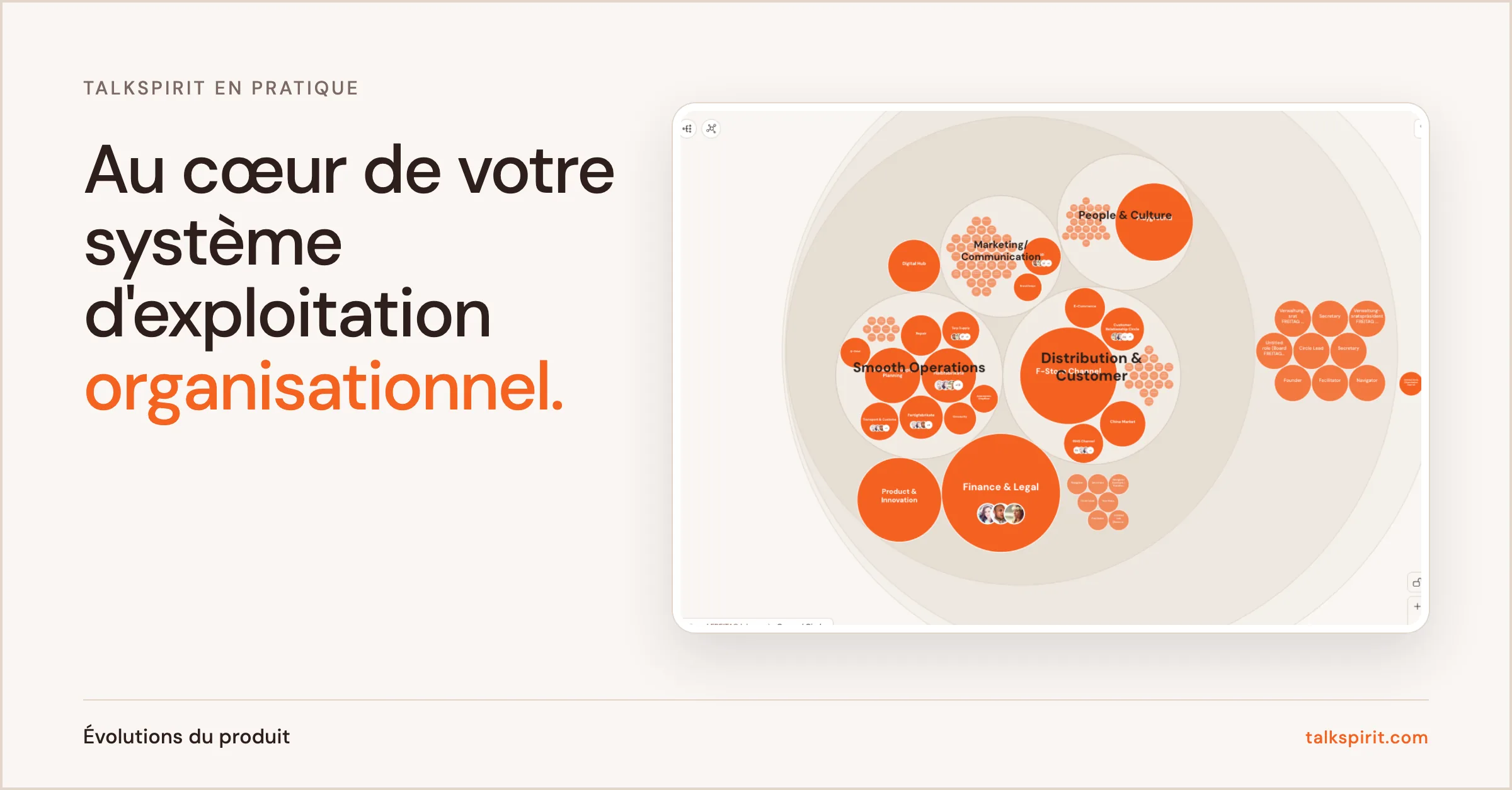
A tool like Talkspirit makes it possible to map governance in circles, and to make roles and responsibilities visible. It is a digital support for the organic — reflecting the living reality of the organization, rather than rigid org charts of boxes and rectangles.
But a word of caution: technology must remain subordinate to ethics. It is a tool in service of a project. Heidegger, among others, urges us to master technique — not to become its slaves.
6. A moment that made it all concrete
Many come to mind! Those moments — not always obvious — when a click happens, when an inflection takes place.
In a consulting firm of around a dozen people, a team member, Julie, proposed in a governance meeting the creation of an R&D role dedicated to reducing the carbon footprint and societal impact. That proposal, once adopted, changed the company's trajectory.
Another team member, Géna, at a foundation, once told me: "I could never work again in an organization that doesn't operate this way. My neurons are wired differently now."
These testimonials hint at the scope of what unfolds in a 5R approach.
7. If you could share one piece of advice with leaders, what would it be?
Rather than advice, I prefer to offer questions. Einstein said that if you have an hour to solve a problem, spend 55 minutes finding the right question.
Here is a sample of questions I find useful for any leader:
- In which part of my organization am I dispensable?
- What is preventing my team members from being better? And what is my responsibility in those obstacles?
- What do I truly want from my professional life?
8. What questions do you continue to ask yourself?
Two big questions still run through me. The first: can everyone be responsible? The answer may be no. Some people, due to mental or social fragilities, cannot fully be. But everyone who can must be.
The second: how will organizational law evolve? Today, Anglo-Saxon-style shareholding drives excessive, short-term financial performance. But will we see legal models emerge that better reconcile capital and labor, and better foster cooperation and the sustainable health of organizations? This remains a marginal path, but a crucial one for the future.
Closing word
As Bastoun puts it: "Let's not forget to be happy at work."
At Talkspirit, we share this conviction. Our role is to offer a platform that brings clarity, transparency, and coherence to organizations that want to experiment with new governance models and unlock their collective intelligence. Partners like HappyWork bring the human depth and pedagogy needed to bring teams along on this journey. Together, we help organizations turn their practices into lasting impact.