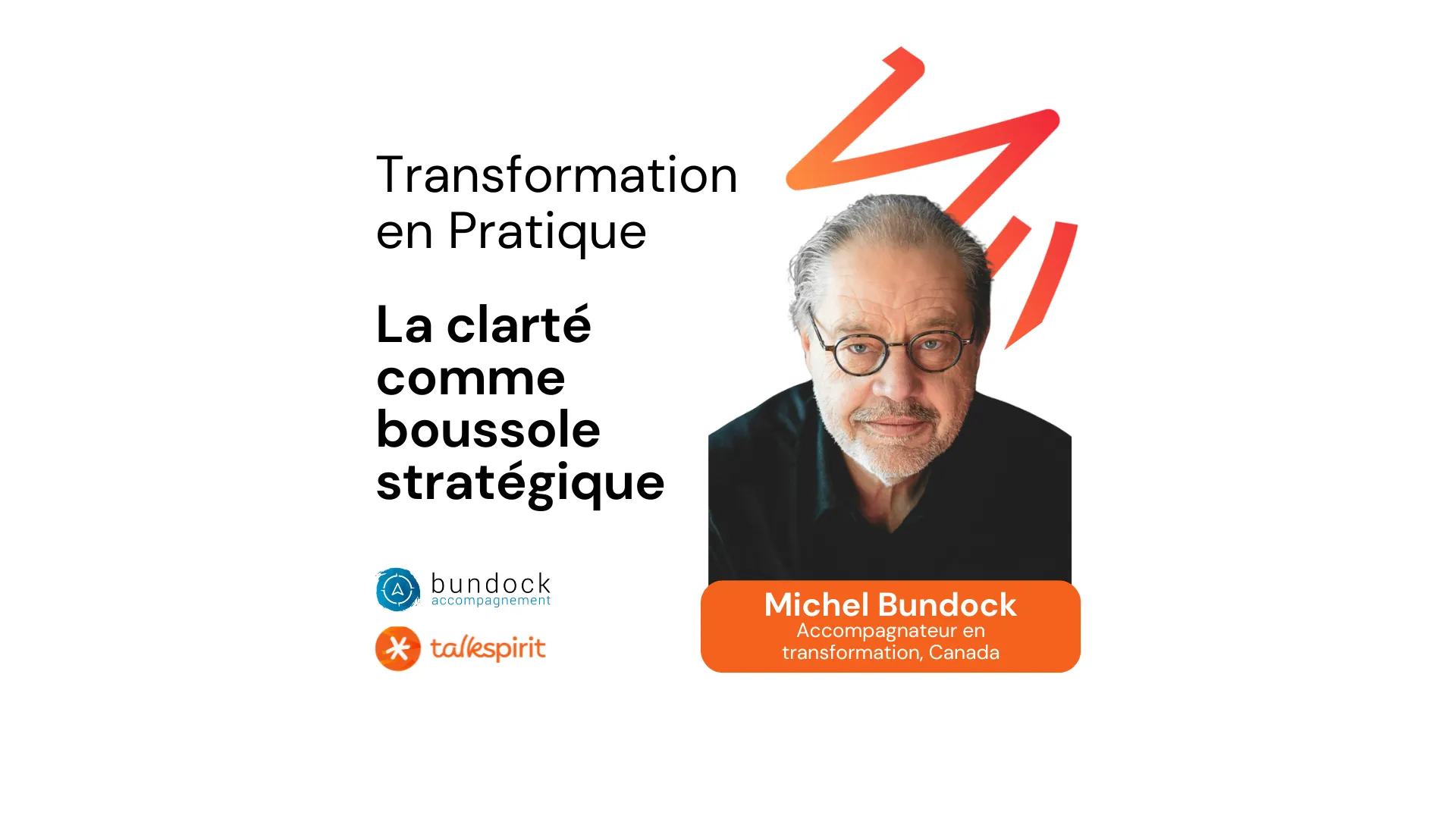
Clarity as a Strategic Compass, with Michel Bundock
.svg)
In this new episode of Transformation in Practice, we welcome Michel Bundock, based in Québec, Canada. With nearly forty years of experience working with SMBs and their leaders, Michel shares a view of the organisational transformations under way that is both clear-eyed and deeply human.
Over the course of the conversation, he explores the challenges tied to growing complexity, to reconciling stakeholder expectations, and to the necessary evolution of structures, roles, and managerial postures. A reflection rooted in experience, fed by striking images and by one clear thread: clarity as a condition of adaptation.
To start, could you introduce yourself and tell us about your background?
I am Michel Bundock, 66 years old, from Québec, Canada. I provide tailored support to leaders through their strategic shifts, after spending 35 years in a network of business owners then known as the Groupement des Chefs d’Entreprise. It was a community of practice among entrepreneurs.
That is where I gradually discovered the emerging new practices, those that make companies more inspiring and better equipped to face the state of indefinition we increasingly live in. I was lucky enough to gain a view of nearly 40 years of change in SMBs, working alongside some 2,000 business owners.
What are the major challenges organisations face today?
There are many changes, but one challenge particularly draws my attention: reconciling the expectations of different stakeholders.
In the past, in an entrepreneur’s mind, there were shareholders, customers and employees.
Today, the environment has widened: suppliers, society, local areas… everyone is voicing needs and aspirations.
Leaders must navigate this in an increasingly unstable environment. And that instability is hard, because by definition every stakeholder likes a certain form of stability. Yet the jolts of history we are living through collectively create the unexpected all the time.
This calls for a new level of psychological and social maturity. I often use this image: you cannot control the wave, but you can control the board you ride. Many people are still trying to change the wave, when the real challenge is learning to navigate better.
How do you concretely help leaders and organisations transform?
I draw a great deal on my own experience. I was a leader myself for 15 years, an observer for decades, and I have taken part in many events in Québec, Europe and the United States to see how organisations are evolving.
I first help entrepreneurs and leaders build their awareness: what do they really aspire to? What are their actual challenges?
A company is always, in a certain way, the reflection of the individual who leads it, in their strengths as well as in their flaws.
This awareness often leads to a growth in confidence. Then I work with leadership teams so that they can share a common vision of the future. Not a homogeneous vision, but at least a north star: the path is uncertain, but the direction is clear.
From there, I work on culture and structure. To my mind, the two are inseparable. They are a yin and a yang: you cannot work on one without the other.
When you talk about structure and culture, what are the key areas of work?
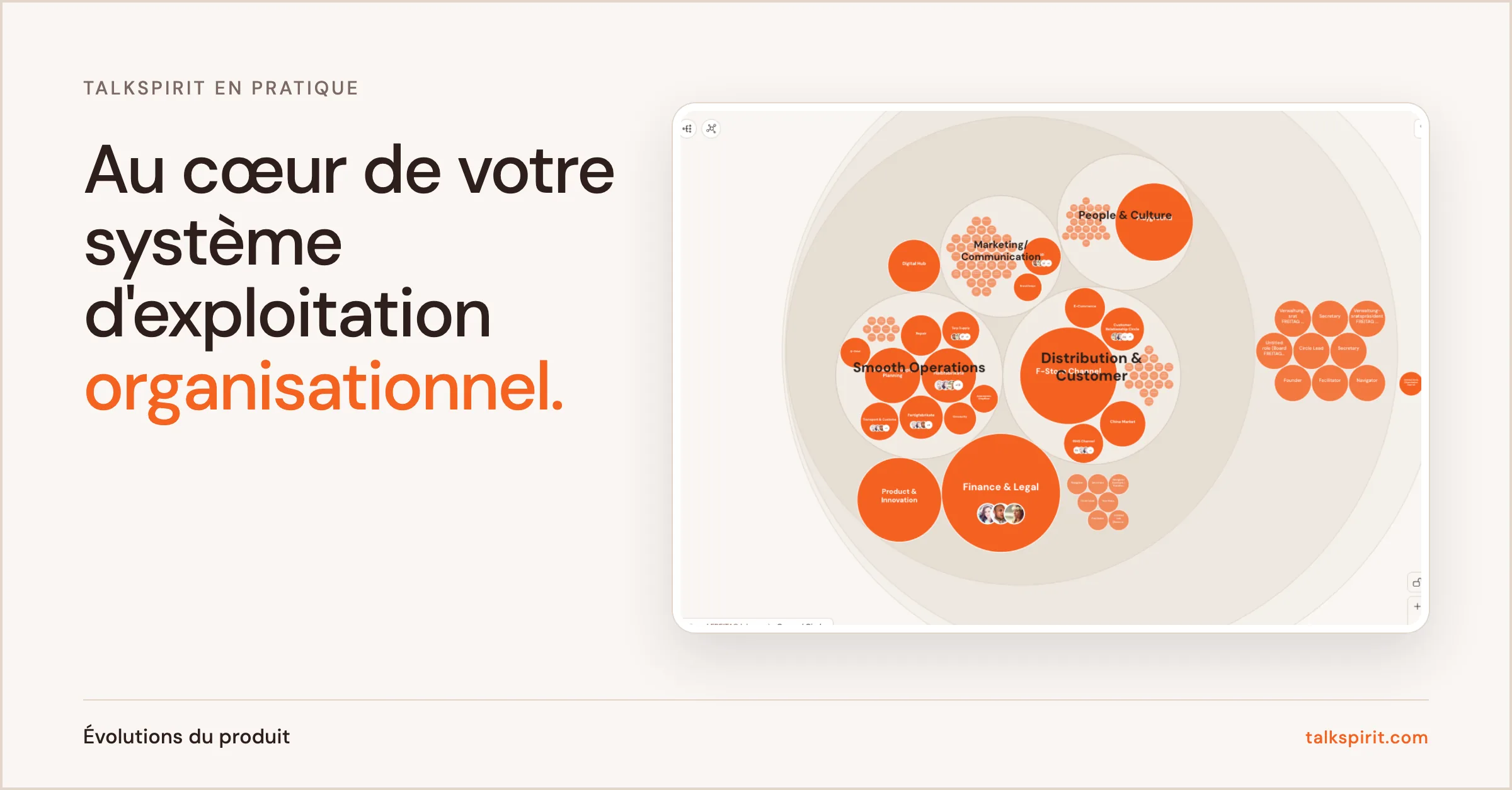
On the structural side, a major shift is the move from a logic of posts and titles to a logic of roles. A person is no longer defined solely by a post, but by multiple roles, each corresponding to a specific contribution.
This makes it easier to reconcile the company’s needs with individual talents. You often uncover hidden talents that went unused because they did not fit within a job description.
On the cultural side, there is an immense body of work around internal entrepreneurship, the capacity to take initiative, clarity in decision-making… and above all meetings.
Meetings are often underestimated in their real cost: financial cost, energy cost, and the friction they create. Working on governance bodies, on who meets with whom, why, and how decisions get made, often reveals the “backstage” of companies: implicit relationships, grey areas, power games.
What shifts in mindset are necessary to support these transformations?
A fundamental change is the move from a relationship of subordination to a relationship of collaboration.
In collaboration, I no longer work for someone, I work with someone. Authority is no longer carried by people, but by roles and responsibilities.
This requires more transparency, more agility, and new tools to support this horizontal flow of work. Meetings, digital tools, and collaborative platforms then become essential.
What role does hierarchy still play in this model?
There has sometimes been an illusion that all hierarchy could be removed. To my mind, horizontality concerns the way we work, not the existence of a wider system.
Every role sits within a whole: a department, an organisation, a market, a society. I often use the analogy of the human body.
The liver is autonomous in its function, but it is part of the digestive system, which is itself part of a body. It cannot function elsewhere.
In the same way, roles, circles and departments fit together within a living system.
The challenge for the leader is to make that system as fluid and adaptable as possible in the face of complexity.
Could you explain simply the difference between roles, circles, and departments?
A role is a specific contribution, often smaller than a post. An HR post, for example, can be broken down into several roles: hiring, celebration, support, and so on.
A circle brings roles together around a shared purpose. It is close to a department, but subtler, because people rally around the “why”, not only around numerical targets.
What motivates employees more and more is not only performance, but meaning: what am I contributing to?
What role does technology play in these transformations?
The more complex the environment, the more important technology becomes. Complexity comes primarily from interactions: between people, between the inside and the outside, with customers and stakeholders.
When you move, say, from 50 posts to 200 roles, you need tools to make that complexity readable and fluid. Platforms make it possible to keep information up to date in an agile way, rather than freezing it in documents nobody reads.
Technology, when well designed, can transform complexity into simplicity.
Do you have a concrete example of a transformation you are currently supporting?
I am currently working with an organisation that started by clarifying its vision and its purpose, its north star. Then we worked on the business model, and only afterwards on roles and circles.
The value of this is that you do not start from individuals, but from what the organisation needs in order to accomplish its mission. Then you look at who, in the current team, can play those roles, what is missing, and how to bring in outside people where necessary.
That makes it possible to optimise talents, reduce certain costs, and create value at multiple levels: for clients, employees, and the market. Value creation is not limited to profit.
What advice would you give to leaders who genuinely want to transform their organisation?
If you want to do more than renovate, if you want innovation, you have to accept a particular path.
I draw on an idea attributed to Schopenhauer: every great transformation goes through three stages: “it is ridiculous”, “it is dangerous”, then “it is obvious”.
We saw it with heliocentrism, with women’s right to vote, with the internet… and today with artificial intelligence.
In Québec, we say: “better to be seen as a fool than to miss your chance.” Boldness is a form of curiosity. And opposition, when it appears, also forces you to clarify your thinking.
What questions do you still ask yourself today?
The big question remains: how do we effectively reconcile the tension between the needs of the organisation and those of its stakeholders?
That tension is not negative in itself. It represents the gap between what is and what could be.
I also think a great deal about the maturity of teams. There are enormous gains to be made in terms of happiness, creativity, and productivity when teams develop emotional maturity and a genuine ability to work together.
How do we create companies made up of adults, and not of adolescents? That is a central question for me.
A word to conclude?
There is a great deal of latent potential waiting to be released in the majority of organisations, that calls for more clarity.
For me, the key word for the future is: clarify the route, the vision, the tensions, the roles, the responsibilities and the possibilities!
Clarity is light. And light is both awareness and warmth. Everything revolves around that.