
AI Crosses the Threshold of Organisations


- A new colleague: for Frédéric Losfeld, AI is not a tool like the others. It interprets a request, prepares a decision and, with the right access, chains actions together. It has to be onboarded with method.
- An amplifier: AI speeds up what it finds in the organisation, its strengths as well as its silos, its reporting and its approval paths.
- Time saved: without a decision on what to do with it, it turns into more work. Automation is the chance to re-examine the work itself.
- Governing agents: knowing which agents exist, what they are for, who is accountable for them and what they can act on, in a framework that lets teams try things.
This article by Frédéric Losfeld, founder of F-Cube and a Talkspirit partner, was first published in French on the F-Cube blog on 8 September 2026. Talkspirit republishes it in English with his agreement.
Stéphane had stopped reading the minutes.
Head of production, nearly two hundred operators, a four-hour leadership meeting on Mondays, a production meeting every morning and three project groups. His diary was full. He discovered the agenda as he walked into each meeting and spent less and less time with his teams. Then he made a discovery: some files he handed in late were never chased. So he started to sort.
I told his story in an article on performance (in French). Stéphane loved his job. But by asking him to do everything, his organisation had led him to decide, on his own, what he would stop doing.
Today, Stéphane’s company is offering him AI. It could prepare his meetings, write his minutes, analyse his files. What a relief, he is told, for him and for his colleagues! Files would arrive faster, there would be more analyses, and every meeting could produce a magnificent list of extra actions.
Would Stéphane get time back for his teams on the shop floor? Or would AI simply speed up his organisation’s biases and finish wearing him out?
The answer will depend a great deal on how we introduce and use AI in companies. And even more on what we are prepared to change.
A UFO in the organisation
Imagine you could replace 30% of your workforce with the best experts in the world in each of their fields. Wouldn’t success be guaranteed? That is what PSG did between 2021 and 2023, with three of the world’s best players in its starting eleven: Messi, Neymar and Mbappé. And yet they did not win the Champions League. They won it in 2025 and 2026, with a completely different team and no stars. Why am I telling you about PSG?
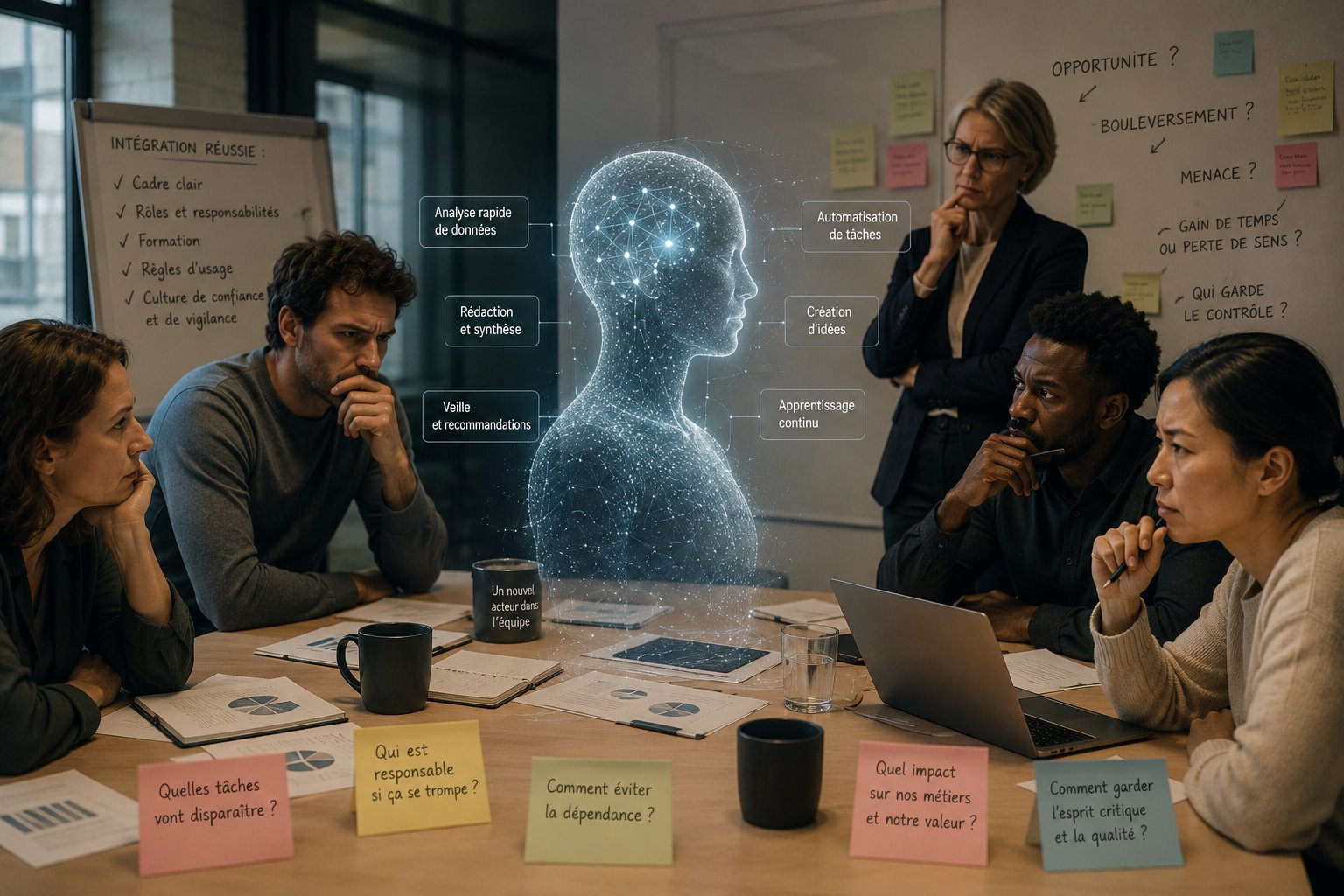
Because with AI, you quite literally have the world’s best experts at your disposal. That will not make you the champions of your sector. To stay with the PSG metaphor, the question is how you integrate these champions, and how your organisation adapts to them to get the best out of the team. That is why I talk about AI as a new colleague. A colleague of an entirely new kind, whose abilities and limits do not fit our usual categories. A UFO in the organisation.
We are used to bringing tools into our companies. They let us calculate, make, transmit and store. We learn to use them, then we organise the work around what they can and cannot do. With AI, something different happens.
We can give it a badly worded question, ask it to look for what is missing, to weigh several hypotheses against each other and to propose a way forward. With the right access and tools, an AI agent can also chain actions together: consult documents, query a piece of software, prepare a change, check a result and adjust what it does next. How autonomous it is depends on how the system is built and what permissions it is given. The agent architectures described by Anthropic are a good way to understand this shift from answering to acting.
This changes its place in the organisation. AI takes part in work that, until now, we had to share out mainly between people: interpreting a request, looking for a solution, preparing a decision, acting in an environment that is only partly known.
So how do you onboard such an extraordinary new colleague?
We know more or less what it takes when an employee, a contractor or a new piece of software arrives. We are much less good at welcoming something that can contribute to our reasoning and carry out part of the work, while making mistakes with perfectly calm self-assurance.
Its fluency tells us too little about how sound its answer is. And giving it a task gives it neither our experience of the work on the ground, nor our understanding of the relationships between people, nor the responsibility we bear towards them.
So we will have to learn to work with this strange colleague. With a little more method than “deal with this and come back when you’re done”. Which, let’s admit it, could also improve the way we bring some humans on board.
Cooperation takes organising
Take a simple situation: an urgent order arrives at a manufacturer. Sales wants to answer the customer quickly. Production has to check it can meet the deadline. Purchasing has to make sure a component is available.
Imagine an agent could gather this information and prepare a proposal. Before we even talk about how powerful it is, one question comes up: what will it have access to?
The official schedule, or also the knowledge that a machine is showing signs of weakness? The theoretical stock, or what the storekeeper knows about which parts are actually usable? The general terms of sale, or the particular commitment made to this customer last week?
Much of what makes work possible lives in conversations, in everyday adjustments and in people’s heads. AI does not magically pick up that context because someone bought it a subscription.
Giving it the means to contribute therefore means being clear about the task, the information available and what a good result looks like. Answering the customer quickly, fine. But should we favour margin, keeping a promise, stable production or the customer relationship? And what do we do when these intentions conflict?
And here we are, already talking about management.
Cooperation is also about how the work is shared out. In our example, the agent could look for the information and flag inconsistencies; the people concerned would weigh the trade-offs; sending a commitment to the customer would remain subject to a defined approval. On routine, well-known orders, within clear limits, we could go further towards autonomy. Then watch the results and adjust.
This progression forces us to look at errors. Where do they happen? What is missing to avoid them? What do humans really need to check? If everything has to be redone by hand, the benefit is doubtful. If nobody looks at anything any more because the first answers seemed good, we are setting ourselves up for other surprises.
Finally, cooperating with an AI means keeping our ability to push back on it. Being able to say: “Your reasoning holds, but you’ve missed what matters here.” That assumes we have taken the time to understand what it proposes, and kept the skills needed to challenge it.
Delegating a task commits the person who delegates it. That remains true when the one it is delegated to has no chair in the meeting room.
AI will amplify what it finds
This, in my view, is where the essential part plays out.
AI arrives in an organisation that already has its habits, its fears, its decision paths, its small arrangements with the rules and its grand statements about trust. It will be used through all of that. The goals we give it, the information we open to it and the actions we allow it will bear the mark of that organisation.
A company that reassures itself by multiplying reports could produce even more of them, more detailed and more frequent. Another could use the same capabilities to give teams the information they need to decide without always going back up to their boss.
The technology opens both possibilities. The choice is made inside the company.
This idea of amplification echoes the DORA 2025 report on software development, in which AI appears as an amplifier of existing strengths and weaknesses. That finding concerns one specific field. Even so, it invites us to look at what we are speeding up in our own organisations.
Exceptionally well-equipped silos
Back to our urgent order. Now imagine each department has its own agent. Sales’ agent looks for a way to satisfy the customer. Production’s protects the schedule. Purchasing’s optimises supply. Each can produce a well-argued analysis, based on its own data and perfectly consistent with its own goal.
And each could have good reasons to conclude that the problem lies with the others. We would then have equipped our silos with a formidable capacity to defend their positions. Sales would demonstrate that the order must be accepted, production that it must be refused, purchasing that we must wait. The arbitration meeting could go on for quite a while.
The quality of local analyses is not enough to make a good collective decision. It takes a shared intention, shared criteria for trade-offs and a place where contradictions can be discussed. Without these, better-performing agents could make disagreements faster to produce and harder to untangle.
Conversely, if teams know what they are trying to achieve together, AI can help them explore the consequences of their choices. What happens if we move this production run? If we deliver in two batches? If we accept an extra cost? It can make interdependencies more visible and give the discussion something to work with.
The discussion still has to be able to take place.
Time saved, but for what?
Here is another piece of conventional wisdom I want to question: AI will save us time.
On some tasks, yes. But the time saved in one place, what does it become?
If Stéphane prepares his files faster, his company can give him more of them. He will become a marketer, a designer, a coder without even noticing. If he finally has a moment to go and see his teams, the company could also decide to protect that moment. These two decisions will not have the same consequences for the quality of the work, for engagement and, in the end, for performance.
We already know this phenomenon. When communicating becomes easy and almost free, we communicate more. The sender saves an effort; the recipient inherits one more message. With AI, we can go as far as having one machine write the document that another machine will summarise for its recipient. But we could also take a moment to ask why that document needs to exist.
Automation through AI offers a fairly rare opportunity to re-examine the work itself. What deserves to be done? What could disappear? What would be better discussed directly between two people?
If we skip these questions, we risk making very efficient an activity that nobody really needs.
Autonomy will have to become real
In my first article on AI and empowering organisations (in French), I wrote about the possibilities AI opens up for developing autonomy. Now we need to look closely at the conditions for that autonomy.
A team can have an excellent analysis and still be unable to act if it is waiting for three approvals. An employee can spot a mistake and keep quiet if contradicting their manager is costly. An AI can surface an inconsistency; it does not guarantee that anyone will agree to look at it.
Giving people more capabilities without changing their power to act will only increase their frustration. They see more clearly what should be done and remain prevented from doing it.
That is why integrating AI touches on questions as concrete as how information flows, the right to experiment, the possibility of challenging, and the way decisions are made. Working on these questions lets the new capabilities have a collective effect. Otherwise, we mainly risk adding power to the things that hold us back.
This new population will need governing
As agents multiply, a new question appears: who looks after the whole?
A sales manager creates an agent to qualify enquiries. Someone in HR configures another to answer internal questions. Production uses one to prepare its schedules. Each solves a real problem. But these initiatives can end up using the same data, changing the same files or producing incompatible instructions.
We must be able to know which agents exist, what they are for, who is accountable for them and what they can act on.
The word governance can sound a little solemn. Here it covers very practical decisions. Who can create an agent? Who gives it access to information? How far can it go without approval? Who reviews its results? And who can stop it if something goes wrong?
Some tools are starting to build in these rules. Talkspirit, which F-Cube partners with, has made it a principle: AI never has more power than the person using it. A connected assistant acts with that member’s rights only, every one of its calls is logged, and the administrator can revoke its access or switch AI off for the whole organisation. AI can draft a governance proposal, and even submit it, but adopting it remains a human decision. It is because this solution helps organisations become “AI-compatible”, or “AI-ready”, that F-Cube’s partnership with Talkspirit makes sense.

The answer cannot rest entirely with the IT department. IT plays an essential role in access, security and how systems run. But deciding that an agent may promise a delivery date to a customer also concerns sales and production. Deciding what information it may share with employees involves the people responsible for that information and its consequences.
Bring the right skills together around real uses.
You can start small: a defined task, a named person accountable, suitable access, situations that trigger a human approval, and the ability to trace the actions taken. Then extend what works, fix what jams and remove what adds nothing. This framework must let teams try things. If it turns every experiment into an administrative obstacle course, they will have good reasons to look for shortcuts. If it lets everyone connect whatever they like with no collective visibility, the company may discover its dependencies at the very moment it needs to take back control.
The aim is to build an autonomy whose limits we understand, and which we can develop with experience. An autonomy for AI and for teams. The arrival of AI gives us a chance to put back on the table questions we had sometimes stopped asking: why are we doing this work, who needs its result, and what stops us doing it well together?
For Stéphane, the arrival of this new colleague called AI could take quite a simple form: coming out of a meeting with two decisions actually made, tasks dropped because they had become pointless, and time to go back to the workshop thanks to other tasks that are now automated or handled autonomously.
It would then remain to keep that free time in his diary, to bring well-being and real added value.
About Frédéric Losfeld
A consultant in organisational transformation for nearly twenty years, after a first career in industry, Frédéric Losfeld founded F-Cube, which helps organisations become more fluid, more fun and more frugal. F-Cube is a Talkspirit partner. To go further: Frédéric Losfeld’s interview on the Talkspirit blog and the other articles on the F-Cube blog (in French).
FAQ
Because it does more than calculate or store: it can interpret a request, look for a solution, prepare a decision and, with the right access, chain actions together. It takes part in work that used to be shared out between people, with abilities and limits that do not fit our usual categories.
AI is used through the organisation’s habits, decision paths and goals. A company that reassures itself with reporting will produce more of it; another can use AI to give teams the information they need to decide. If every department has its own agent and no shared intention, silos become better equipped to defend their positions.
Small: a defined task, a named person accountable, suitable access, situations that trigger a human approval, and the ability to trace the actions taken. Then extend what works. It is not a question for the IT department alone: it also involves the people responsible for the information and decisions at stake.



Explore similar articles
Fluid, Fun and Frugal Organisations with Frédéric Losfeld, Founder of F-Cube
In this interview, Frédéric Losfeld, founder of F-Cube, shares his vision of organisations capable of navigating complexity through greater fluidity, trust and frugality. He explores today's challenges, the necessary evolution of leadership and the cultural transformations that help us work better together.