Fluid, Fun and Frugal Organisations with Frédéric Losfeld, Founder of F-Cube
.svg)
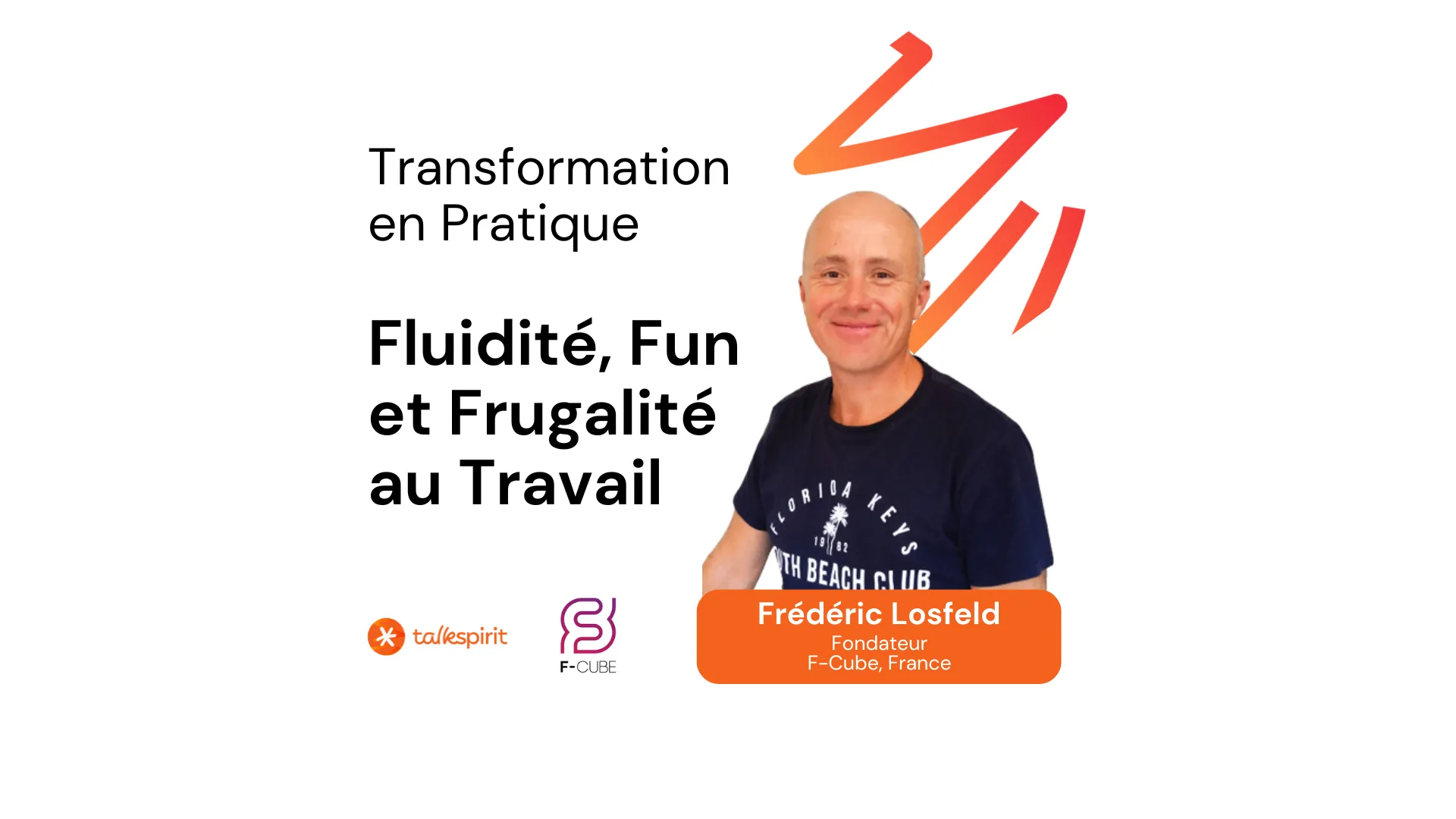
In this new episode of Transformations in Practice, we speak with Frédéric Losfeld, founder of F-Cube, organisational transformation consultant and former industrial executive. Together, we explore the challenges companies face today, the question of complexity, the role of managers, new forms of organisation, and the place of technology in this ever-shifting landscape.
Hello Frédéric, could you introduce yourself and tell us what F-Cube is?
I've been a transformation consultant for nearly twenty years, after a first career in industry. Having held operational roles has deeply shaped the way I accompany organisations: I always look to transform concrete, visible practices that make a difference in everyday work.
I founded F-Cube almost eighteen years ago. The name reflects the vision I hold for today's organisations: they need to become more fluid, more fun and more frugal.
More fluid in their internal organisation, their information flows and their decision-making.
More fun because engagement comes from pleasure, desire and wellbeing.
More frugal because our resources — energy, material, human — are finite, and doing more with less is becoming a strategic competency.
What do you see as the main challenges organisations face today?
The first is the relationship with time. Many leaders and managers no longer have the space to fulfil their real role: thinking about the future, innovating, anticipating. They are consumed by meetings, urgency and day-to-day management.
Then comes complexity. We operate in a globalised, unstable world, crossed by economic, political and social tensions. This level of uncertainty is unlike anything we have experienced before.
The central challenge, as I see it, is:
How do you find a form of organisation and a leadership style suited to this complexity?
Today, we see a clash between an increasingly complex world that demands agility and adaptability, and organisations that are still very rigid and very hierarchical. The real question is: how do you make the company itself capable of absorbing complexity rather than being overwhelmed by it?
Concretely, how do you accompany organisations through transformation?
First and foremost, I try to stay humble: I have no magic model or universal recipe.
I always start from where the company stands:
– its culture,
– its level of maturity,
– its internal tensions,
– its real ambitions.
Not every organisation can — or should — become fully autonomous, networked or self-directed. The path depends on the starting point.
To work on this transformation, I use three main frameworks:
1. A systemic reading of the organisation
I cross-reference three levels (organisation, teams, individuals) against three themes (vision, people, process). This helps identify where to act for lasting impact.
2. Patrick Lencioni's model on team dysfunctions
Trust is the foundation: without trust, there is no constructive conflict; without conflict, no commitment; without commitment, no accountability; without accountability, no performance.
3. The Enneagram
It's the most powerful tool I know for understanding deep motivations, internal dynamics and individual reactions. It's indispensable when you're working with managers' professional identity.
When you talk about the "form" of an organisation, what exactly do you mean?
The classic form is the pyramidal org chart — stable, hierarchical, and highly effective… in a stable world. That's no longer our reality.
Today, more adaptive forms include:
– network organisations,
– cellular structures,
– models inspired by sociocracy or holacracy,
– autonomous interconnected teams.
These forms allow for greater transversality, fluidity and responsiveness.
And the Enneagram — how would you describe it to someone unfamiliar with it?
Unlike other personality models focused on visible behaviours, the Enneagram is concerned with deep motivations. Two people can act in the same way but for entirely different reasons.
It's a dynamic model that helps you know yourself better, understand others better, and create the conditions for more mature leadership.
How do you find the balance between trust and performance?
Lencioni's model describes this link perfectly.
When trust is low, people don't say what they really think. They avoid confrontation. Decisions don't get made clearly. People disengage. Accountability becomes blurred. And collective performance collapses.
Trust is therefore not a "nice-to-have" — it's a prerequisite for performance.
The real challenge is balancing high standards with genuine care.
Managers often think they have to choose. They don't: you need both.
What mindset shifts are needed to support these transformations?
For managers, the key shift is:
moving from the expert who provides answers to the leader who asks the right questions.
That's a profound shift — almost one of identity.
For leaders, it's about letting go.
Trusting. Accepting that decisions are made elsewhere. Supporting autonomy without abandoning high expectations. W. L. Gore's "waterline" principle illustrates this very well.
What role does technology play in all of this?
An essential one.
First, to provide visibility on roles, responsibilities and processes, especially as organisations grow more complex.
Then, to make information accessible to everyone, at the right moment, so that each person can make better decisions.
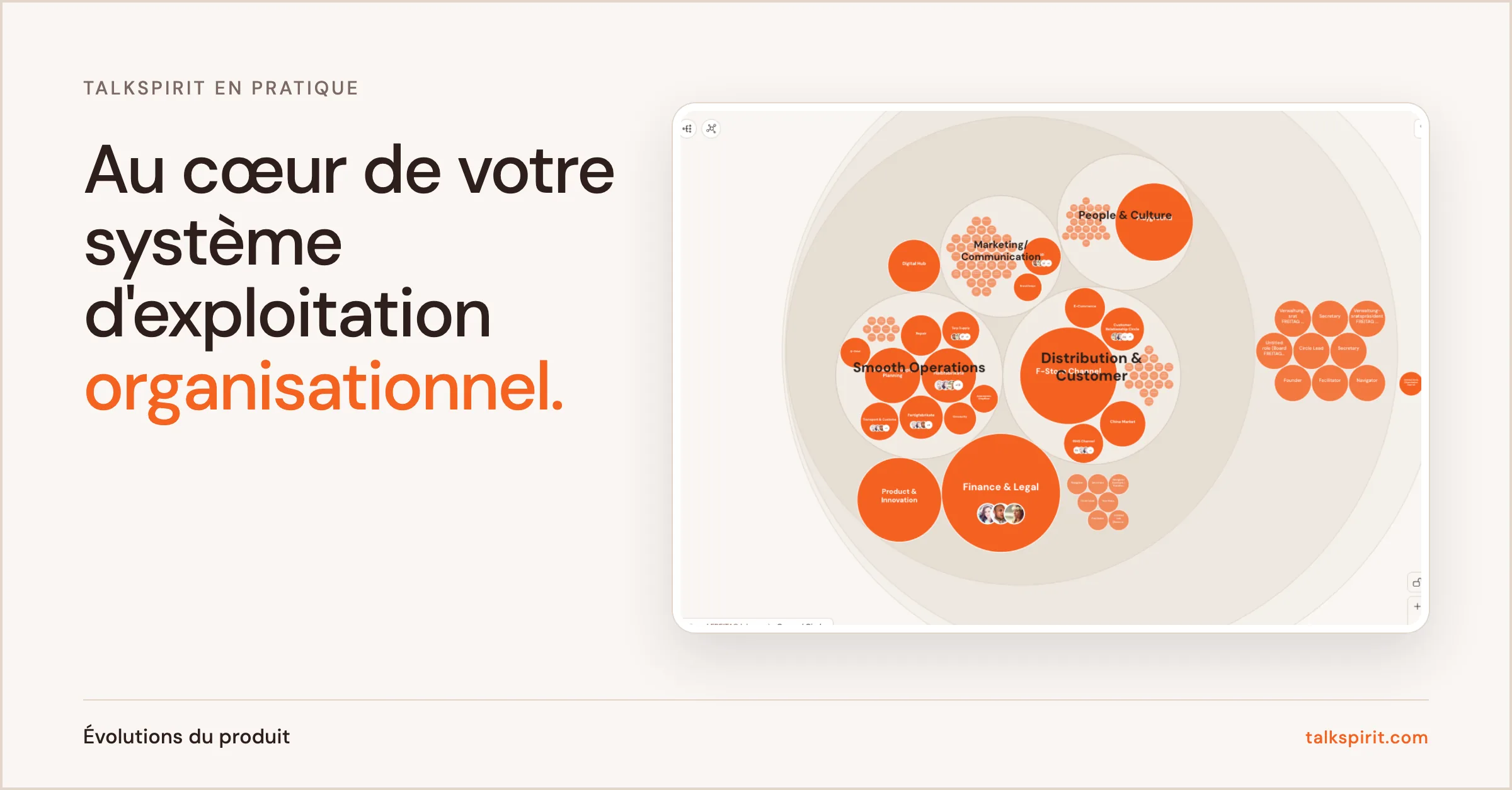
That's why I connected with Talkspirit: without a tool to structure, anchor and circulate information, human transformations don't land.
Speaking specifically about AI, how do you see its role in organisational transformation?
AI will first remove repetitive, administrative and structural tasks. That's valuable if it frees up time for relationships, innovation and complex thinking.
It's also a useful tool for challenging an idea, simulating scenarios, and synthesising data. In some contexts, it has become indispensable.
The real impact of AI is still hard to measure, but it will radically transform jobs, practices and organisations.
Can you share a concrete story that illustrates the type of transformation you accompany?
Yes. A team I worked with recently was going through a lot of suffering: misunderstandings, tensions, departures.
We ran a two-day seminar, following individual interviews. Gradually, carefully, something opened up: mutual understanding, recognition, emotions, a desire to talk to each other differently.
At the end, several people said:
"This team is not the same anymore."
Moments like that are why I do this work.
What advice would you give to leaders who want to evolve their organisation?
Very simple: start with yourself.
If leaders don't transform themselves first, nothing will change in any lasting way. The company will always push back against the person who decides to grant more autonomy.
And personally, what questions do you keep asking yourself?
Many.
How do we give teams more time and breathing room?
How do we put informality back at the heart of organisational life?
What will the real impact of AI be on our jobs, roles and structures?
How do we seize the opportunities of this period of disruption rather than be overwhelmed by its dangers?
I remain deeply optimistic: we are living through a difficult time, but also a vast field of possibility. A period of intense creation is opening up — it's ours to embrace.
Conclusion
Listening to Frédéric Losfeld, one conviction stands out: transforming an organisation is neither a question of finding the perfect model nor a theoretical exercise. It is a profoundly human journey that requires time, clear-sightedness and above all courage — the courage to start with yourself, to rethink your own posture, and to give freedom while providing a clear framework.
Fluidity, fun, frugality: three simple words to describe an ambitious transformation. In a world where complexity grows faster than the structures designed to contain it, his message is clear. A company only becomes fit for the 21st century if it learns to absorb that complexity rather than deny it, to trust rather than control, and to create meaning rather than pile on meetings.
And while technology — including AI — can support this movement, it never replaces what remains at the heart of change: the quality of human relationships, collective clarity and a shared will to evolve.