
Skills Management: Unleash Your Employees’ Full Potential

.svg)
- Skills management means identifying, documenting, assessing and developing employees’ skills, to meet the organization’s current and future needs and to support career development.
- According to McKinsey, 87% of companies worldwide are facing an internal skills shortage, or will do so within the next few years.
- Skills management is narrower than talent management, and different from workforce planning: it works on skills, not on headcount or on the full employee lifecycle.
- Five steps structure the work: understand the business challenges, map and assess skills, build an action plan, communicate, then track the ROI.
- Skills mapping is the foundation: without it, there is no way to measure the gap between the skills you need and the skills you have.
- Reasoning in skills rather than job titles is what makes internal mobility, and a skills-based organization, possible.
According to McKinsey, 87% of companies worldwide are facing an internal skills shortage, or will do so within the next few years. To overcome this shortage, HR managers need to deploy an effective skills management strategy.
Skills management is one of human resources’ key priorities. But which skills does this include? And for what reason? And above all, how can you effectively manage your organization’s skills? Here you’ll find everything you need to know on the subject.
Contents
- What is skills management?
- Skills management, talent management or workforce planning?
- Why is this important?
- How can you effectively manage your employees’ skills?
- 1. Understanding the company’s challenges
- 2. Mapping and assessing skills
- 3. Create an action plan
- 4. Communicate
- 5. Track the ROI of your actions
- From skills management to the skills-based organization
What is skills management?
Skills management involves identifying, documenting, assessing, and developing employees‘ skills.
By “skills,” we mean all the knowledge, experience, and both soft and hard skills acquired individually or collectively.
Skills management should fulfill two goals:
- meet the organization’s current and future skills needs
- support employees in their career development
Skills management, talent management or workforce planning?
The three terms are often used as synonyms. They cover different scopes, and confusing them is the quickest way to build a strategy that answers the wrong question.
- Skills management works on the skills themselves: what your teams know how to do today, what they will need to know how to do, and how to close the distance between the two.
- Talent management is wider. It covers the whole employee lifecycle, from attraction and recruitment to onboarding, development and retention. Skills management is one of its building blocks: see our guide to talent management strategy.
- Workforce planning reasons in headcount and roles: how many people, in which teams, over which horizon. It answers “how many”, where skills management answers “able to do what”.
In practice, you need all three, and they feed one another. Workforce planning sets the volume, skills management sets the content, and talent management turns both into recruitment, mobility and training decisions.
Why is this important?
In addition to being a must for both medium-sized and large companies, skills management brings many benefits to the organization. In particular, it enables:
- promote employee skills development
- continuously adapt to changing skills requirements
- better allocate resources among various teams
- boost team and company performance
- improve internal mobility
- refine your employer brand
- facilitate the recruitment of new talent
- motivate and retain employees
Most employers consider skills development essential for attracting and retaining talent. With good reason: 82% of employees would quit their job because of a lack of progression in their job.
In addition to limiting turnover, skills management can also save you recruitment costs! A study by RH Online shows that internal recruitment costs 50% less than external recruitment.
How can you effectively manage your employees’ skills?
Want to implement a skills management strategy, but don’t know where to start? Here are 5 key steps that should help.
1. Understanding the company’s challenges
To manage your organization’s skills effectively, you first need to carry out an HR diagnosis. To do this, you can use the SWOT matrix. This methodology will enable you to identify the strengths, weaknesses, opportunities, and threats linked to your human resources, and more specifically to skills management. In it, you can address topics such as compensation, training, integration, employer brand, and much, much more.
In addition to this analysis, we also recommend that you map:
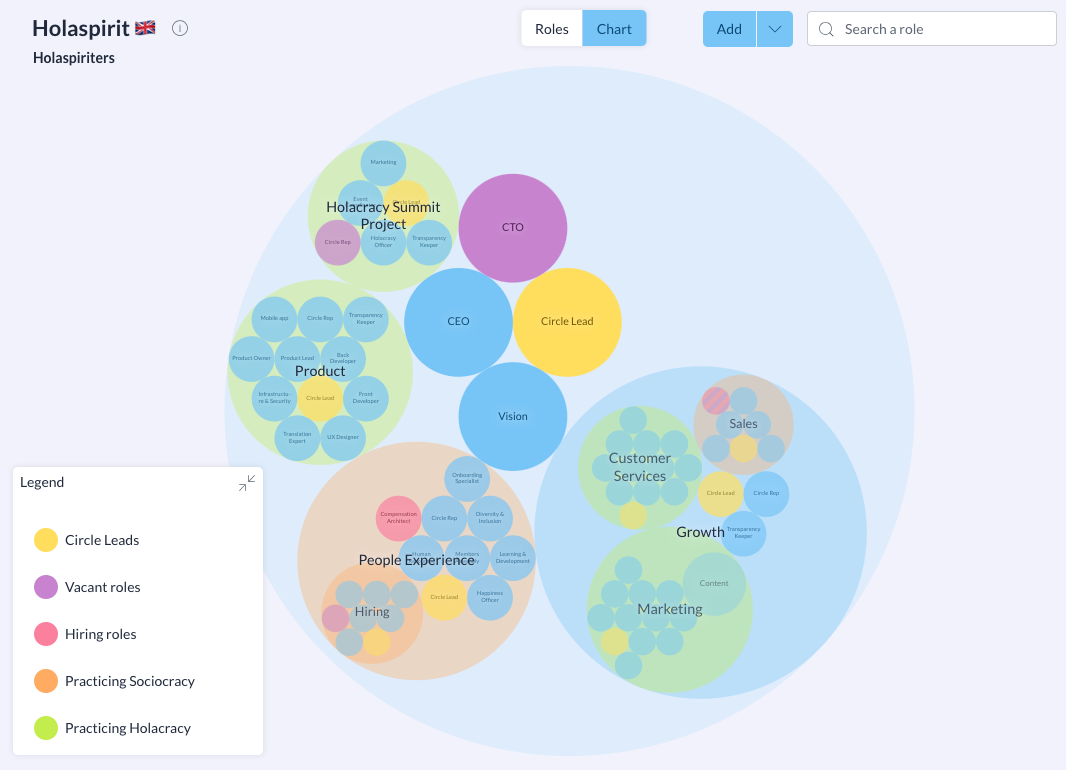
- Your internal stakeholders. Identify the roles, responsibilities, and power of influence of each person, in order to identify opinion leaders. You can use Talkspirit’s dynamic org chart to help you achieve this.
- Your current and future skill needs. According to a Dell study, 85% of jobs that will exist in 2030 don’t yet exist today. That’s why it’s important to identify the skills each team needs today, and those it will need in the short, medium, and long terms.
To anticipate your skills needs, you need to maintain an ongoing dialogue with the business lines and management, and regularly monitor trends in your sector. This will help you identify the best candidates and/or training in the months and years ahead.
2. Mapping and assessing skills
Now that you’ve understood your needs, you need to map and assess your skills to identify potential gaps that need to be filled. Here’s how to do it:
- List your employees’ skills. Then classify them by type (know-how or interpersonal skills), job and level of responsibility (junior, intermediate, senior, manager, etc.). The best way to do this is to set up working groups of employees and managers you can support along the way.
- Define the skills assessment methods (such as self-evaluation, 360 evaluation, or annual interview) and the scale you will use (from 0 to 10, from 0 to 100, from poor to excellent, or other).
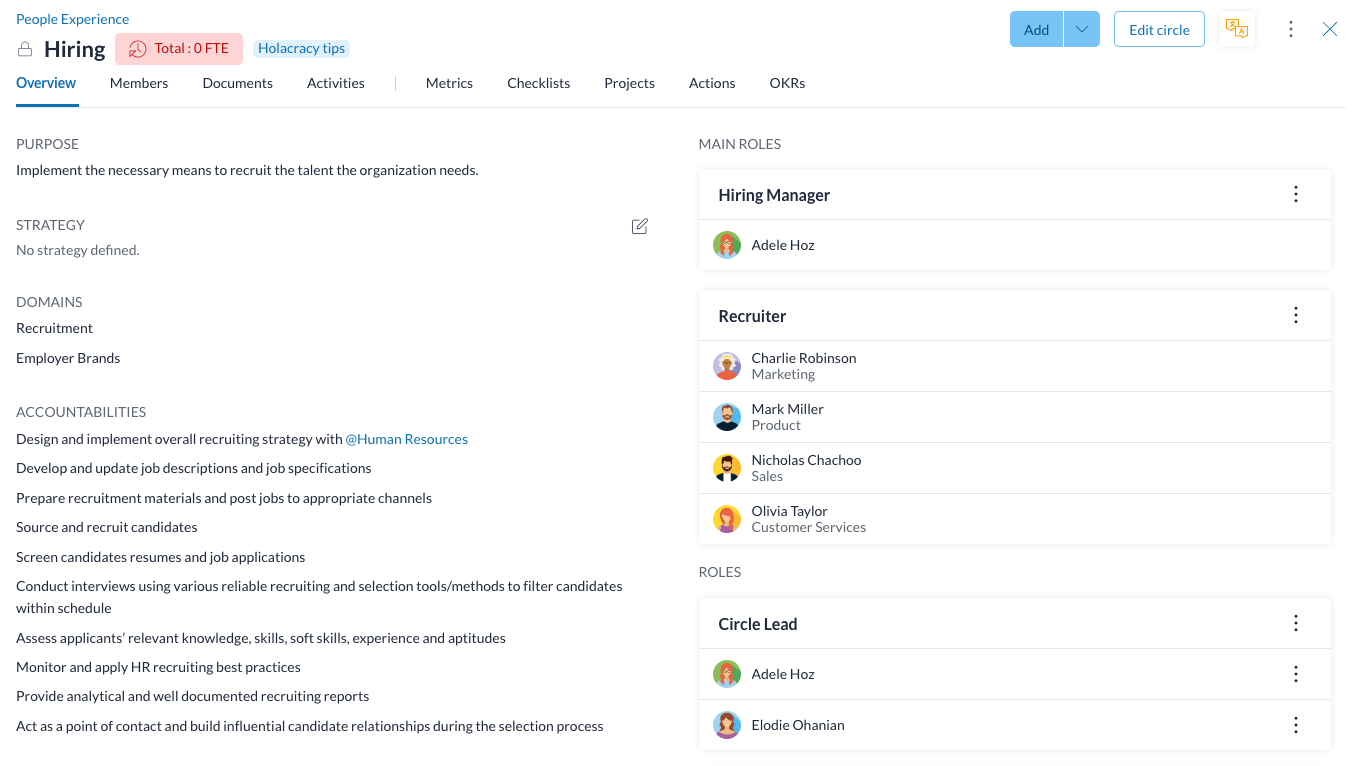
- Map out your organization’s roles and skills and compile a skills repository adapted to each job using the tool of your choice. You can achieve this with Talkspirit’s Structure module, which describes every role and its accountabilities, and with its office suite to create the repository.
- Evaluate the skills of each employee according to the pre-established reference framework and evaluation methods. To save time, you can create an evaluation form template that is relevant to each job. Each employee being assessed can fill it out (along with the manager, colleagues, and others who work directly with that employee, all anonymously).
- Identify skills gaps by comparing expressed skill needs with the existing team skills.
3. Create an action plan
Your skills gaps are now clearly identified. Now all you need to do is draw up an action plan to recruit the profiles you’re missing, and then develop your employees’ skills.
This roadmap will enable you to define:
- Objectives and key results to be achieved in each area of skills management (recruitment, training, internal mobility, and more). The OKR (Objectives and Key Results) method is particularly useful for this exercise, as it will enable you to set objectives that are quantifiable, ambitious, and time-bound.
- Key actions to be launched along with their respective levels of priority
- The person(s) responsible for each action
- Project milestones and deadlines
- The budget and resources to be allocated
- The tools and working methods to use
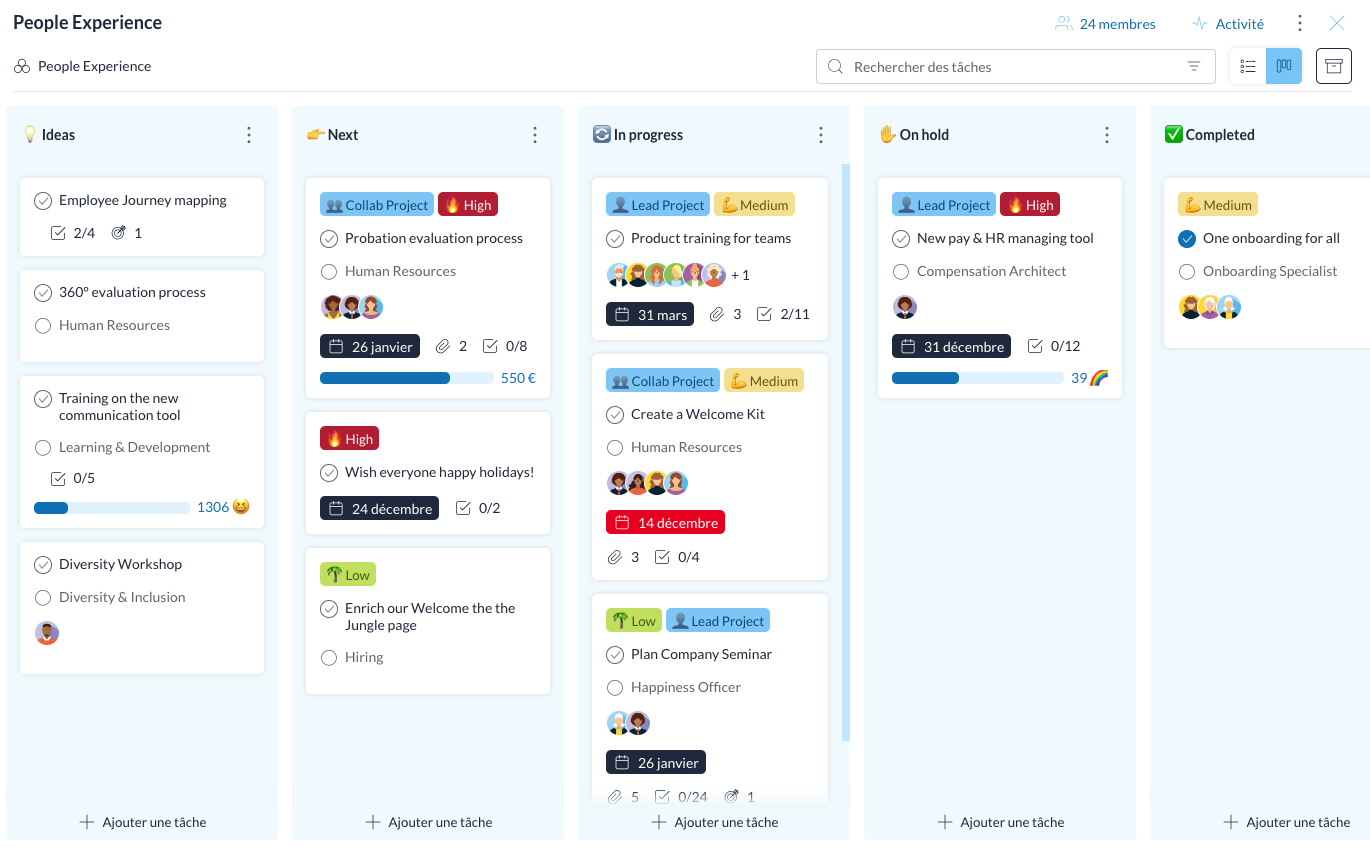
To keep track of your various actions, you can then enter them on a kanban board, organizing them by state of progress.
4. Communicate
To roll out your action plan, you’ll of course need to communicate your skills management strategy. Good internal communication will not only align all your internal stakeholders, but also involve them in the implementation of your skills development plan.
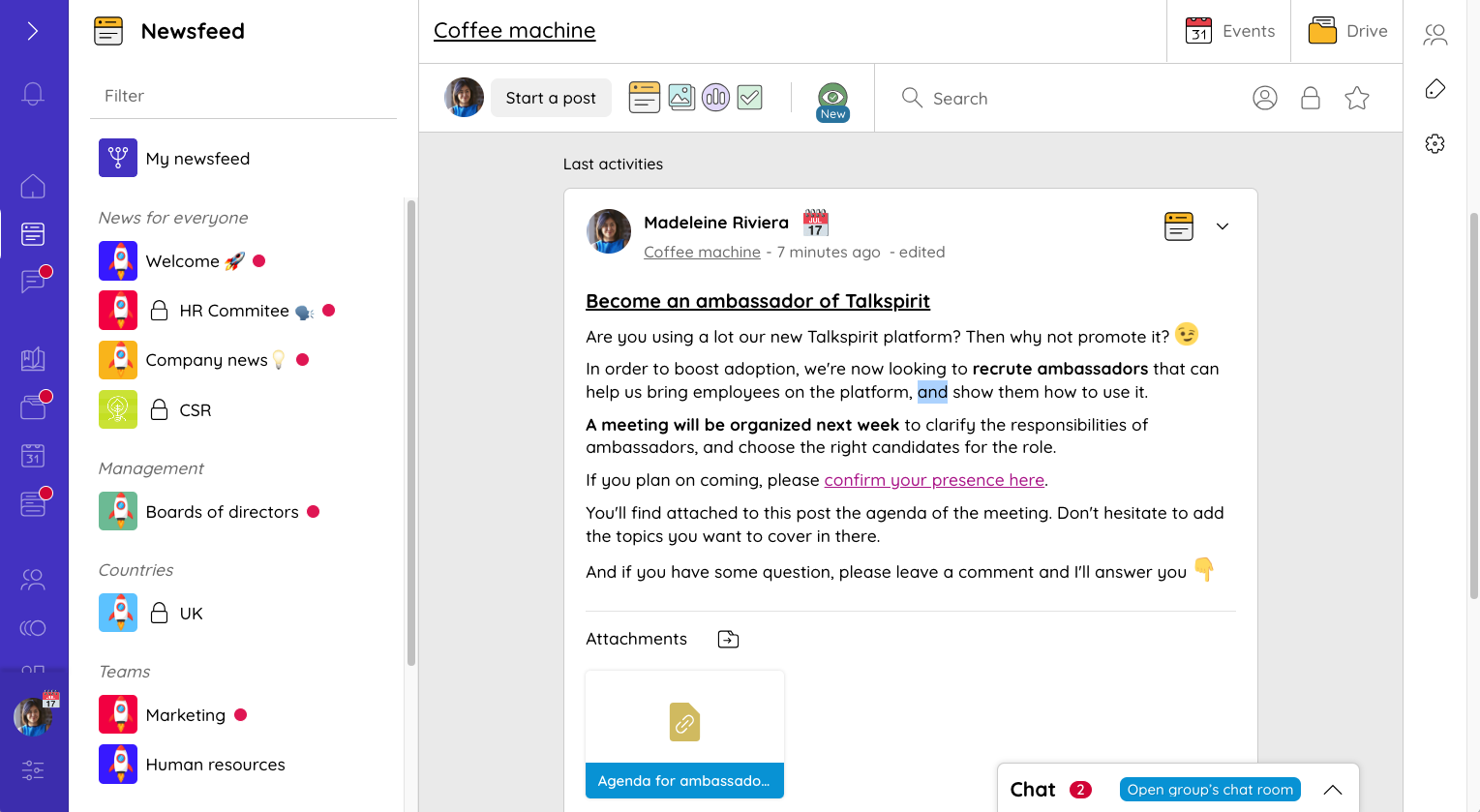
For successful internal communication, we recommend recruiting ambassadors who can relay your messages internally and help you implement your action plan.
Use an internal communication tool to explain why you’re doing this, to set up working groups, share project-related information with your employees, and answer any questions they may have.
Our Talkspirit platform is equipped with a number of features to help streamline internal communication and collaborative working. These include:
- a chat and videoconferencing module
- a news feed for validating, sharing and reacting to publications
- a customizable home portal
- a library for all your content
- an online office suite
5. Track the ROI of your actions
Once you’ve set up your first actions, it’s important to keep the objectives you want to achieve in mind. For example, if one of your objectives is to train your employees on a new collaborative tool in less than six months, don’t wait six months before checking where you stand.
In addition to monitoring your indicators, you should also think about the return on investment of your actions. Let’s say you’ve achieved 100% of your training objectives, yet after looking more closely, have you noticed teams using your collaborative tool more frequently? Are your employees wasting less time searching for information? Are they being more productive? All these underlying questions will enable you to assess your return on investment (ROI) more accurately, all the while demonstrating the positive impact of your skills management strategy.
| Step | What you produce | Who to involve |
|---|---|---|
| Step1. Understand the business challenges | What you produceAn HR diagnosis (SWOT matrix) and the list of your current and future skills needs | Who to involveLeadership, business line managers |
| Step2. Map and assess skills | What you produceA skills repository per job, a map of roles, and the actual level of each employee | Who to involveManagers, employees, working groups |
| Step3. Build an action plan | What you produceA roadmap: objectives, prioritized actions, owners, milestones, budget | Who to involveHR, leadership, managers |
| Step4. Communicate | What you produceAn internal communication plan, and ambassadors who relay it | Who to involveInternal communication, ambassadors |
| Step5. Track the ROI | What you produceIndicators followed along the way, and a reading of the real impact on the ground | Who to involveHR, leadership |
From skills management to the skills-based organization
Managing skills already means stepping out of the job description logic. The next step is to reason in roles and skills rather than job titles: an employee no longer fills a box, but holds several roles, each described by its accountabilities and by the skills it requires.
This change of unit has three concrete effects:
- Internal mobility becomes readable. An open position breaks down into skills, which you can look for inside the organization before recruiting outside.
- Training gets targeted. Rather than training a whole population, you close the gaps identified role by role. That is the whole point of a training plan built from the map.
- Responsibilities stop being implicit. Writing down who decides what, and with which skills, removes the grey areas that stall projects. That is the principle behind role clarity.
This shift cannot be decreed. It rests on a skills map kept up to date, and on a talent management strategy that connects recruitment, mobility and training. Managers are on the front line, since they are the ones who spot the gaps day to day, which supposes an agreement on the key skills expected from them.
A final word
Today, skills management is no longer just about planning a company’s staffing needs. It’s also about creating career plans and developing employee skills. To support such upskilling, companies need to map out their organization’s skills to identify gaps between needs and existing skills. Only then can they start to implement appropriate actions.
Training is one of the key actions your HR needs to implement, and most proactive companies are well aware of this. Along with improving productivity and internal mobility, it helps attract and retain top talent. Of course, it’s far from the only way to retain talent. In this white paper, you’ll discover a number of best practices for retaining employees and reducing quiet quitting. 👇
Access the White Paper
In our white paper entitled “How to Build Employee Loyalty and Prevent Quiet Quitting,” you’ll find: the origins of the quiet quitting phenomenon, the main causes of disengagement at work, and which levers to pull to improve talent retention and squelch quiet quitting.
FAQ
It involves identifying, documenting, assessing, and developing employees' skills, meaning all the knowledge, experience, and both soft and hard skills acquired individually or collectively. It should meet the organization's current and future skills needs and support employees in their career development.
According to McKinsey, 87% of companies worldwide are facing an internal skills shortage, or will do so within the next few years.
Most employers consider skills development essential for attracting and retaining talent, and 82% of employees would quit their job because of a lack of progression in their job. It also saves recruitment costs: a study by RH Online shows that internal recruitment costs 50% less than external recruitment.
By mapping internal stakeholders and your current and future skill needs, maintaining an ongoing dialogue with the business lines and management, and regularly monitoring trends in your sector. According to a Dell study, 85% of jobs that will exist in 2030 do not yet exist today.
List employees' skills and classify them by type, job and level of responsibility; define the assessment methods, such as self-evaluation, 360 evaluation or annual interview, and the scale; map the organization's roles and compile a skills repository per job; assess each employee against that framework; then identify skills gaps by comparing expressed skill needs with the existing team skills.
Keep the objectives in view rather than waiting for the deadline: if the aim is to train employees on a new collaborative tool in less than six months, check progress before the six months are up. Then look past the indicators themselves and ask whether teams use the tool more often, waste less time searching for information, and are more productive.