
Key Employee Engagement Data from Gallup's 2024 Study

.svg)
- Only 23% of employees are genuinely engaged at work according to Gallup's 2024 study: 62% are not engaged (quiet quitting) and 15% are actively disengaged.
- That disengagement costs the world economy around US$8.9 trillion, or 9% of global GDP.
- Europe is the least engaged region, with 13% of employees engaged against 33% in the US and Canada.
- Managers account for 70% of the variance in team engagement, yet they report more daily anger than non-managers (24% against 19%).
- Organisations that develop their managers, make engagement a strategic priority and invest in wellbeing reach an engagement rate eleven times the global average.
- Gallup's newer 2026 edition puts global engagement at 20% and the cost at US$10 trillion.
Employee disengagement is an issue that organizations can’t ignore. Besides lowering productivity, it can also have a significant impact on employee morale, profitability and turnover. Indeed, disengaged employees’ negative emotions often affect their colleagues, creating a bad atmosphere that can, in the long run, drive the best talent away from the company. And that's certainly not what you want, right?
Gallup’s 2024 State of the Global Workplace study provides key employee engagement data emphasizing the importance of addressing this problem and its effects on employee wellbeing and mental health. Here’s a quick recap of Gallup’s report, along with our tips to improve employee engagement in your organization👇
This article recaps the 2024 edition of the study. Gallup has since published a 2026 edition: we cover its figures, and what has moved since 2024, just before the conclusion.
How Employee Engagement Impacts Business Success
Employee engagement data from Gallup’s study shows that companies with highly engaged teams experience numerous benefits that directly impact their bottom line:
- 78% less absenteeism
- up to 51% less turnover (in low-turnover organizations)
- 10% more customer loyalty and engagement
- 17% greater productivity in sales
- 23% greater profitability
- 68% higher wellbeing
Engaged employees are not just more productive and loyal; they also contribute to a positive workplace culture where everyone supports and motivates each other to keep moving forward. This, in turn, fuels innovation and teamwork, driving positive business outcomes.
Employees are struggling rather than thriving
The study reveals that 58% of employees worldwide are struggling both in their personal and professional life, while only 34% are thriving. This data varies from region to region: while 60% of employees in Australia and New Zealand are thriving, only 15% of South Asian employees say the same.
How negative emotions impact employees’ perceptions
These perceptions are highly influences by employees’ daily experiences and emotions, including:
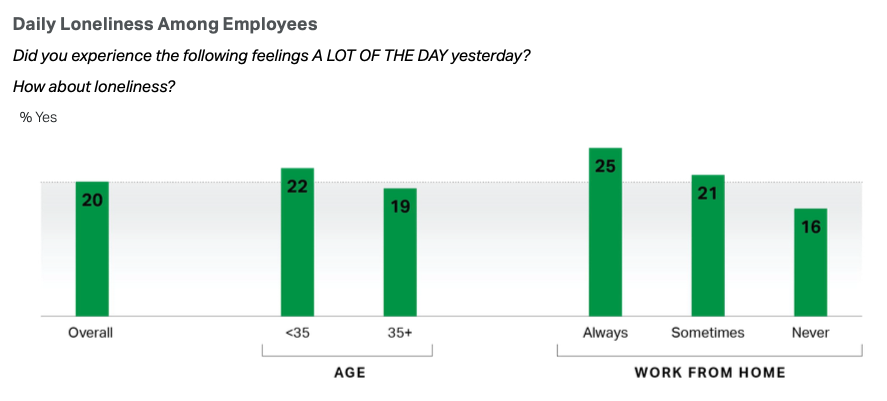
- Loneliness: 20% of employees reported experiencing significant loneliness the previous day. Certain groups, such as fully remote employees, gen Z and millennials, experienced this feeling more intensely.
- Sadness: 22% felt a lot of sadness the previous day, with South Asians reporting the highest levels, and Europeans and Australians reporting the lowest.
- Anger: 21% said they felt a lot of anger the previous day.
- Stress: A substantial 41% of employees said they experienced a lot of stress the previous day. This stress is most prevalent among employees in the Middle East, North Africa, the US, and Canada.
Young generations’ wellbeing is dropping
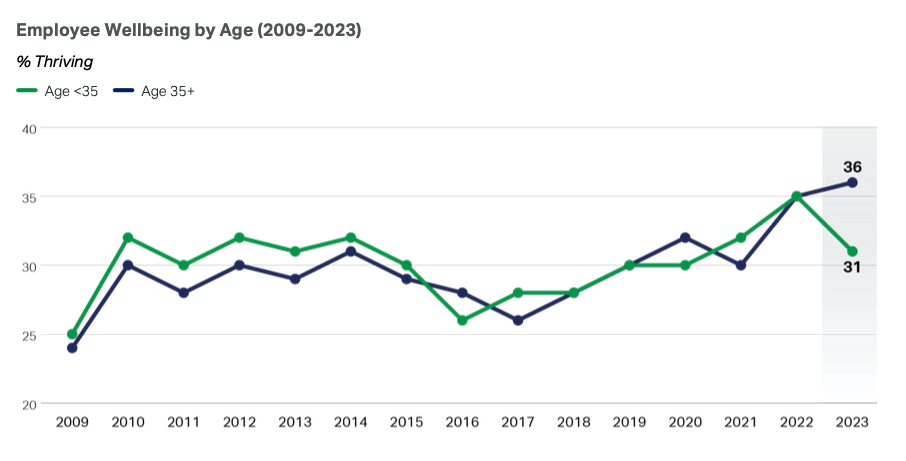
Stress, loneliness, sadness and anger also have an impact on employees' wellbeing, and particularly younger generations which often report a higher level of those negative emotions. For example, Millenials and Gen Z’s wellbeing has dropped from 35 to 31% in 2023. This is in stark contrast to other generations, whose overall global wellbeing slightly increased from 35 to 36%.
Employee engagement is stagnating
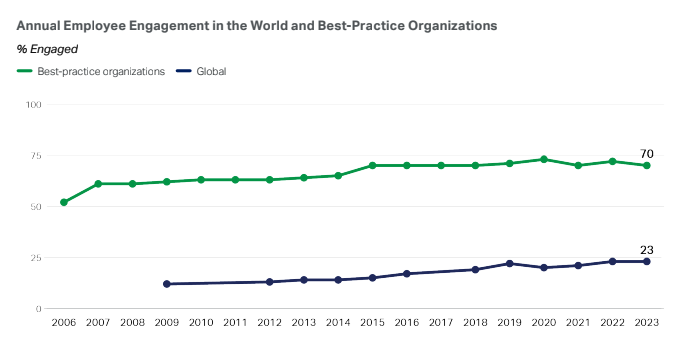
Employee engagement remains a critical issue, with 62% of employees not engaged, often referred to as "quiet quitting," and 15% actively disengaged, known as "loud quitting." According to Gallup’s employee engagement data, only 23% of employees are truly engaged in their work.
Also read: Why are Employees Quiet Quitting?
These low engagement levels cost the global economy approximately US$8.9 trillion, i.e. 9% of global GDP!
The impact of job level and location
So what exactly has an impact on employee engagement data? Well, first the region people work in. For example, we see that 33% of employees in the US and Canada are engaged, whereas only 13% of European employees feel the same. France has the lowest engagement rate in Europe, with a mere 7% of employees engaged.
Several other factors impact employee engagement, including:
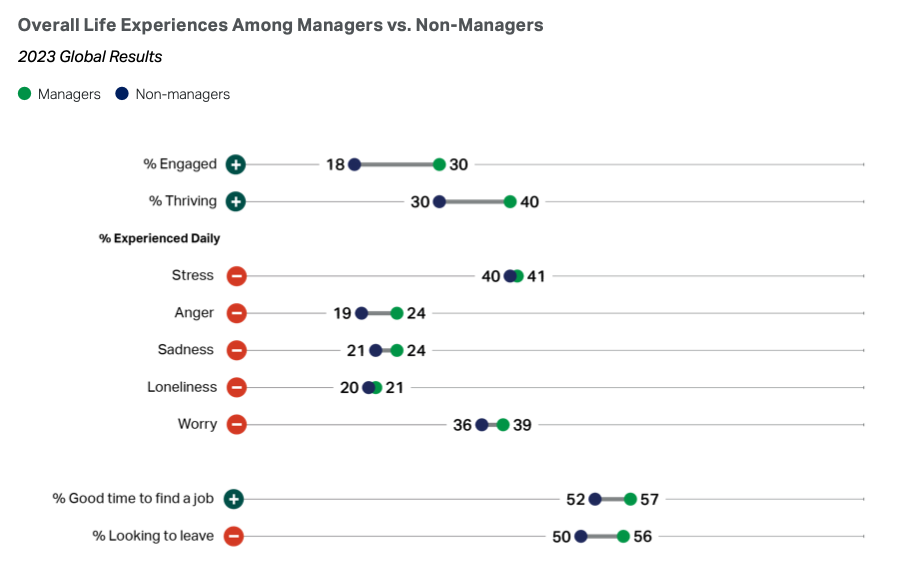
- Job level: About 30% of managers are engaged compared to just 18% of individual contributors. This suggests that increased responsibilities and leadership roles contribute to a greater sense of engagement.
- Work location: About 29% of fully remote workers are engaged, compared to 20% of employees who work on-site all the time. This indicates that flexibility and remote work options can enhance employee engagement.
The impact of negative experiences
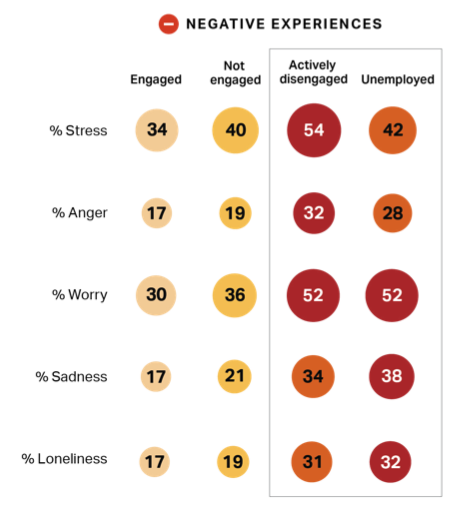
Negative experiences in the workplace have a profound impact on employee engagement. Employees who dislike their jobs tend to experience higher levels of daily stress and worry, which not only affects their performance but also their overall wellbeing. In comparison, engaged employees are significantly less likely to feel these negative emotions than their disengaged counterparts.
For instance, 54% of actively disengaged employees feel stressed at work, compared to only 38% of engaged employees. This stark difference highlights the importance of fostering positive emotions and experiences to improve the overall wellbeing and mental health of the workforce.
The impact of management
The role of management is crucial in shaping employee engagement. When managers are engaged, employees are more likely to be engaged. In fact, employee engagement data show that 70% of team engagement is influenced by the manager!
However, managers themselves often face higher levels of negative emotions compared to non-managers. For instance, 24% of managers report experiencing daily anger, compared to 19% of non-managers. This underscores the importance of providing support to managers to help them manage their own emotional wellbeing.
The impact of organizational practices
Organizational practices and culture significantly impact employee engagement. For example, engagement rates are notably higher in organizations that:
- Prioritize manager hiring and development
- Make engagement a focus of their business strategy
- Invest in employee wellbeing
In these best-practice organizations, three-fourths of managers are engaged, along with 7 in 10 non-managers. This engagement rate is 11 times higher than the global average, demonstrating the positive impact of effective management and support for leaders.
Employees are still on the lookout for new opportunities
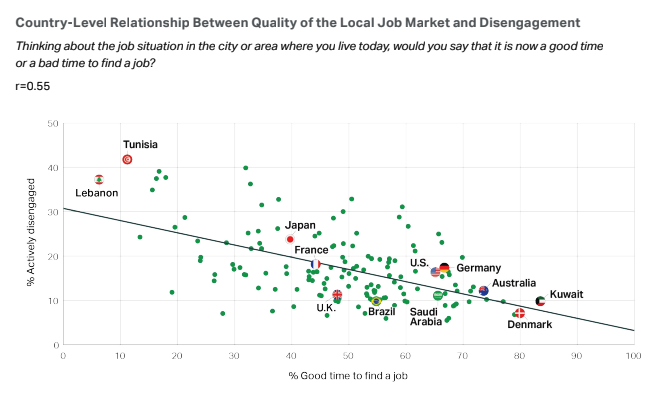
Investing in employee engagement is more crucial than ever, as dissatisfied employees can now find new opportunities with greater ease. In 2023, 54% of employees believe it's a good time to find a job where they live. Countries like Australia and New Zealand, where people feel optimistic about job prospects, tend to have lower active disengagement because unhappy employees can easily switch jobs.
Furthermore, 52% of employees are either watching for or actively seeking new job opportunities. Europeans are the least likely to leave their companies, with only 32% considering a job change. In contrast, Generation Z and millennials are the most likely to seek new opportunities, with 60% looking for new jobs.
This trend highlights the critical need to prioritize employee engagement to retain talent and maintain a stable workforce.
Also read: [Gartner study] HR Trends to Track in 2024
Best practices for increasing employee engagement
All this data highlights one thing: organizations MUST invest in employee engagement. But how exactly should they go about it, you might ask? Well, here’s what we recommend you to do:
- Define a clear purpose, mission, and values: Inspire your team with a compelling purpose, mission, and set of values that give their work meaning and direction, and make them feel like they belong.
- Clarify roles, responsibilities, and objectives: Make sure every employee knows their specific roles and responsibilities. Align their objectives with the company’s goals to create a sense of contribution and accountability.
- Prioritize wellbeing and psychological safety: Keep your team healthy and motivated by emphasizing wellbeing and work-life balance, and creating a safe space for them to express their ideas. For example, offer flexible working hours, remote work options, and wellness programs.
- Empower managers to lead, not micromanage: Foster a management style that empowers employees with autonomy and decision-making authority. Trust your team to innovate and excel without stifling oversight.
- Adopt a governance model: Implement a flexible framework (such as holacracy, sociocracy, agile…) that brings structure to your organization, while allowing it to swiftly adapt to changes.
PS: want to learn more about governance models, how to choose and implement them? Download our latest white paper to get expert insights 👇

- Find your operating system: Leverage a platform like Holaspirit to bring transparency to your organization. Use the organizational chart to visualize roles and responsibilities clearly, the OKR app to create aligned goals for your teams and the Projects app to track the progress of your employee engagement initiatives.
.png)
Want to know more about Holaspirit? Schedule a demo with our team 👇

Also read: 50 Effective Employee Engagement Ideas
Update: what Gallup's 2026 edition changes
Gallup has since published a new edition of the report. The 2026 State of the Global Workplace covers the year 2025, and the picture has not improved: global engagement has fallen back to 20%, its lowest level since 2020, after peaking at 23% in 2022. The cost to the world economy is now put at US$10 trillion, still 9% of global GDP.
Two figures deserve a board's attention. First, manager engagement, down to 22% in 2025, a drop of 9 points since 2022: the population that drives 70% of a team's engagement is the one slipping first, which makes leadership practices all the more decisive. Second, Europe, still the least engaged region in the world at 12% of employees engaged, against 31% in the US and Canada. For organisations in the Benelux, the European figure, not the global average, is the relevant benchmark.
One less gloomy signal: the share of employees who say they are thriving in life rose from 33 to 34% in 2025. Wellbeing and engagement do not move on the same curve, which argues for working on both, and for watching the early signs of burnout rather than waiting for an annual survey.
| Indicator | 2024 edition (2023 data) | 2026 edition (2025 data) |
|---|---|---|
| IndicatorEmployees engaged worldwide | 2024 edition (2023 data)23% | 2026 edition (2025 data)20% |
| IndicatorManagers engaged | 2024 edition (2023 data)30% | 2026 edition (2025 data)22% |
| IndicatorEmployees engaged in Europe | 2024 edition (2023 data)13% | 2026 edition (2025 data)12% |
| IndicatorEmployees engaged in the US and Canada | 2024 edition (2023 data)33% | 2026 edition (2025 data)31% |
| IndicatorCost of disengagement to the world economy | 2024 edition (2023 data)US$8.9 trillion | 2026 edition (2025 data)US$10 trillion |
| Indicator“A good time to find a job” | 2024 edition (2023 data)54% | 2026 edition (2025 data)52% |
To conclude
Despite some progress, there are still significant improvements needed to enhance employee engagement. Gallup’s employee engagement data clearly shows that engagement is crucial for retention. So if organizations want to prevent their employees from leaving, they need to actively find ways to tackle disengagement.
Addressing issues such as wellbeing, clarity of roles, and supportive work environments can make a substantial difference. Organizations that implement the right tools and best practices will not only retain their top talent but also create a more motivated and productive workforce. So start making the necessary changes today to ensure your employees feel valued and engaged.
Want to learn more about how to build employee loyalty and prevent quiet quitting? Download our white paper on this topic by clicking on the banner below 👇

FAQ
Only 23%, according to Gallup's 2024 employee engagement data. 62% of employees are not engaged, often referred to as quiet quitting, and 15% are actively disengaged. Gallup's 2026 edition puts the global figure at 20%, its lowest level since 2020.
Companies with highly engaged teams see 78% less absenteeism, up to 51% less turnover in low-turnover organisations, 10% more customer loyalty and engagement, 17% greater productivity in sales, 23% greater profitability, and 68% higher wellbeing.
Badly. 33% of employees in the US and Canada are engaged, whereas only 13% of European employees feel the same, and the 2026 edition puts Europe at 12%. France records the lowest rate in Europe, with a mere 7% of employees engaged.
Enormously: 70% of team engagement is influenced by the manager. Managers themselves report more negative emotions than others (24% report experiencing daily anger, compared to 19% of non-managers), which is why supporting them is part of the work.
Yes. Millennials' and Gen Z's wellbeing has dropped from 35 to 31% in 2023, in stark contrast to other generations, whose overall global wellbeing slightly increased from 35 to 36%. Loneliness in particular hits fully remote employees, Gen Z and millennials harder.
Three: prioritise manager hiring and development, make engagement a focus of the business strategy, and invest in employee wellbeing. In organisations that do all three, three-fourths of managers are engaged along with 7 in 10 non-managers, eleven times the global average.