
What are the Best Practices for Digital Maturity Assessment?

.svg)
- Digital maturity measures how far an organization makes use of digital technologies, across five dimensions: strategy, processes, skills, technologies, and culture.
- Assessing it takes six steps: define what the term covers in your organization, choose your KPIs, collect data, run the assessment, identify the technologies you need, then measure progress regularly.
- The most telling indicators are tool adoption, team productivity, customer lifetime value, the Customer Satisfaction Score (CSAT), and the Net Promoter Score (NPS).
- Two routes to the assessment: consulting-firm models (Deloitte Digital Maturity Model, Digital Quotient) for larger organizations, free online self-assessments such as Bain & Company’s Digital Readiness Survey for smaller ones.
- AI governance is the dimension to add to the assessment: which tools, on which data, decided by whom.
- Digital maturity is not a state you reach once, but a cycle: measure, adjust, measure again.
With the ever-more-rapid rise and proliferation of digital technologies, businesses can quickly get overwhelmed. Among all the social networks, artificial intelligence plugins and updates, big data, the cloud, IoT and on and on, it’s easy to fall off the wagon. According to a study by the Boston Consulting Group, some 65% of companies surveyed throughout the world are planning to increase their investment in digital transformation.
Digital transformation has become an unavoidable challenge for organizations of all sizes and in all sectors. But how do you stay in the peloton in the digital race? Organizations need to stay informed and up to date in order to maintain their competitiveness and sustainability. To achieve this, they need to conduct a digital maturity assessment.
In this article, we reveal the best practices for assessing your organization’s digital maturity, so that you can succeed in your digital transformation.
Why you should conduct a digital maturity assessment
First off, what’s “digital maturity?”
Before getting to the core of the matter, let’s define digital maturity. Digital maturity is a concept that reflects an organization’s ability to make full use of digital technologies to improve performance, achieve strategic objectives, and remain competitive in the marketplace.
It dials in several dimensions, including strategy, processes, skills, technologies, and culture, and then harmonizes all this to innovate, quickly evolve with market changes, deliver quality customer experience, and achieve optimal performance.
The plusses of digital maturity
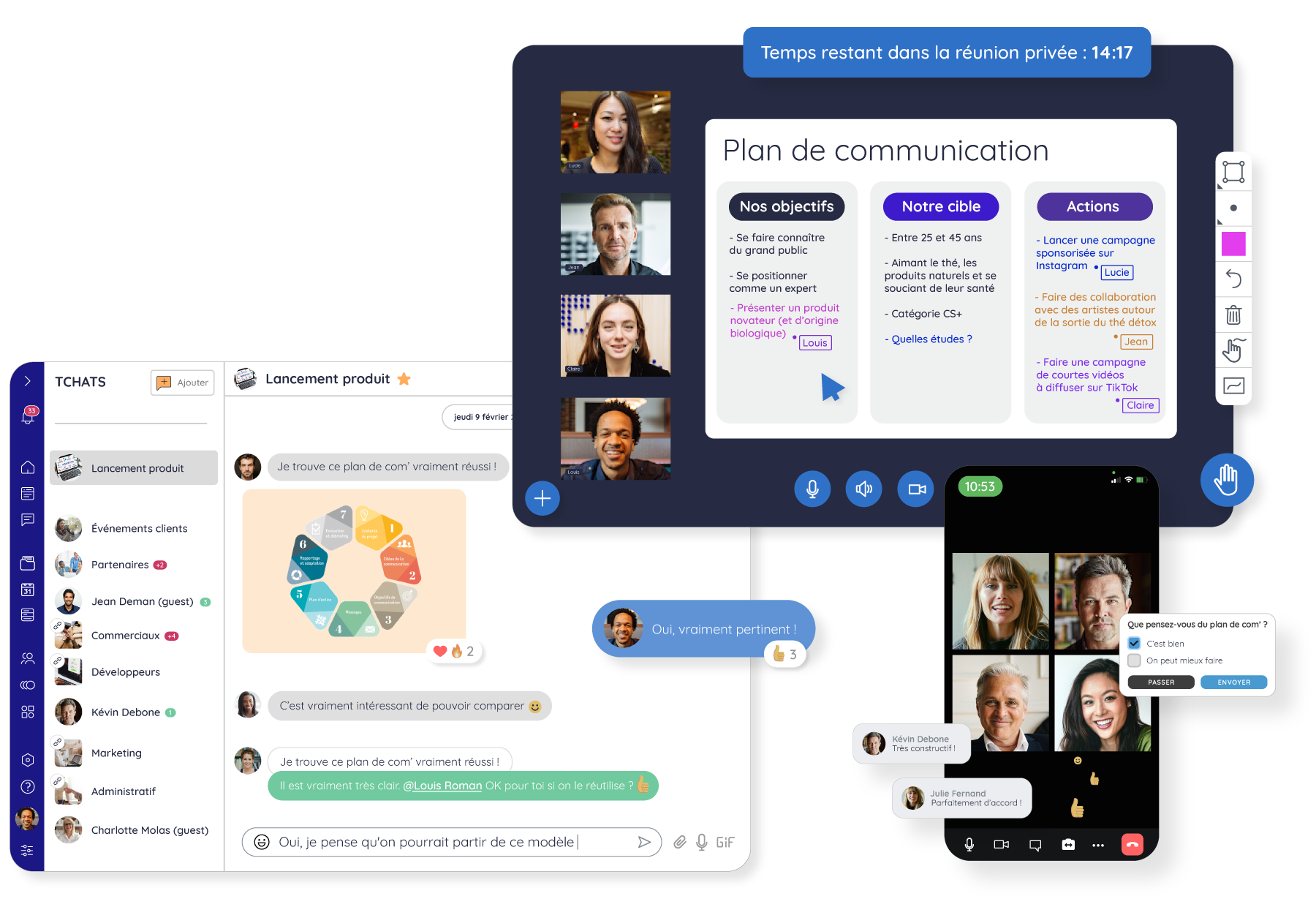
Good digital maturity can bring many benefits to companies to increase productivity such as automating business processes, improving operational efficiency, and reducing errors. With this in mind, digital maturity often involves collaborative tools such as Talkspirit. This kind of technology enables fluid communication between team members, promoting collaboration and the exchange of ideas.
Via Talkspirit, for example, it’s possible to create a digital workplace where employees can share information, documents, comments, and updates in real time. This facilitates knowledge-sharing and the explosion of new ways of working.
Discover Talkspirit
- Better understand your customers through solid data analysis. By using data collection tools such as CRM software, a company can track its customers’ purchasing behaviors and adapt its offering accordingly.
- Stand out from the competition. A company that succeeds in its digital transformation can offer a more pleasant and innovative customer experience. This helps to attract new customers and retain existing ones.

- Stay agile, and adapt quickly to market changes. With the use of advanced technologies, a company can be faster and more flexible in making strategic decisions.
- Leverage ERP (Enterprise resource planning) or other software to centralize your task management. This enables you to control all your company’s operational processes and facilitate the management of your day-to-day operations (accounting and finance, payroll and human resources, inventory management, GPS time clock, supply chain, and so on). Custom software development solutions can be tailored to meet the unique needs of your business, providing more precise and efficient management tools.
Best practices for assessing digital maturity
Now that you understand the importance of a digital maturity assessment, you’re probably wondering: how do you do it?? Here are six best practices.
1. Define what digital maturity means for your organization
Before starting the assessment, it’s important to understand how your company perceives digital maturity. What digital skills and technologies are essential to your business? What determines your company’s success in a digital context?
This may vary according to the specific business objectives and needs of each organization. It’s important to understand that digital maturity is not a destination, but rather an ongoing journey. It can evolve and transform with the arrival of each new technology and business need and challenge.
2. Identify your key performance indicators (KPIs)
Once you’ve understood what digital maturity means for your organization, you need to identify the key performance indicators (KPIs) you need to track to assess your progress. These KPIs can be financial or non-financial, but they should always remain specific, measurable, achievable, relevant, and time-bound (also known as SMART objectives). And of course, they must be adapted to your digital transformation goals. Here are a few examples of indicators to track:
- The level of adoption of your digital tools, in other words, the percentage of users who are comfortable with the tools in place and use them regularly.
- Increase the productivity of your employees as well as your company’s overall performance.
- Customer lifetime value: this KPI measures the average profit generated by customers over their entire lifetime.
- Customer Satisfaction Score (CSAT) and Net Promoter Score (NPS): the former measures the percentage of your customers who are satisfied or very satisfied, and the latter the likelihood that they will recommend your products or services.
3. Collect data
There are many ways to gather data on your company’s digital maturity. These can include employee surveys, interviews with managers from different departments, data analysis, and third-party assessments. By incorporating a variety of methods, you can gain a more complete picture of your digital maturity.

4. Assess your digital maturity
Once you’ve collected all the data, it’s time to build an assessment of your company’s digital maturity. This assessment will allow you to understand your position in relation to your competitors and uncover areas that need improvement. Once you’ve analyzed your weaknesses, you can then select the tools and technologies best suited to your needs.
There are two main steps to generating this assessment:
- Evaluation by consulting firms
Several diagnostic tools have been developed by consulting firms to conduct a digital maturity assessment. Examples include the Deloitte Digital Maturity Model (DDM) and the Digital Quotient. This option may be a good choice for larger companies that can afford the costs associated with using these tools, which often require consultant services.
- Online self-assessment
This’s another way of assessing digital maturity that is more accessible to smaller structures. In fact, several self-diagnostics have been developed by organizations that enable a fairly rapid assessment of your company’s maturity. For example, Bain & Company’s “Digital Readiness Survey” is free and available online. Although this assessment is not as in-depth as the first one, it can be very useful for companies that can’t afford a consulting firm’s fees.
5. Identify the technologies you need
Technology evolves evermore rapidly, so it’s important to keep abreast of emerging trends and identify their potential for your business. This helps you stay ahead of the competition and respond quickly to customer needs.
Collaborative software such as Talkspirit is essential to facilitate communication and teamwork. It’s therefore an indispensable basis for assessing and improving your digital maturity and ensuring the success of your digital transformation projects.
Many software packages can also take care of tedious tasks, allowing you to concentrate fully on developing your business. Sage payroll software, for example, can greatly facilitate payment management by automating and simplifying administrative processes, freeing up time and resources to concentrate on more strategic tasks.
You can also use a CRM tool that adapts to your needs and integrates with your organization’s information system. It enables you to manage your customer relations and build customer loyalty by offering professional, personalized support.
One dimension now deserves its own place in the assessment: artificial intelligence. The question is not only which AI tools your teams use, but who decides how they are used, which data they rely on, and where that data is hosted. Reviewing this alongside collaboration or customer relations avoids discovering ungoverned usage once it is already entrenched, a point that weighs heavily for European organizations working under the AI Act. Our practical guide to AI governance sets out the questions to ask.
6. Measure your progress regularly
Once you’ve done your digital maturity assessment, you’ll want to regularly measure your company’s progress. This will enable you to understand whether the efforts you are making to improve your company’s digital maturity are bearing fruit. It’s also a good way of ensuring that you remain competitive in an ever-changing digital environment.
As mentioned above, it’s important to use KPIs aligned with your business objectives to measure your progress. For example, if one of your objectives is to improve customer satisfaction, you need to track a KPI such as Customer Satisfaction Score or Net Promoter Score.
The five dimensions to review
Digital maturity does not boil down to a single score. It reads dimension by dimension, the ones listed earlier: strategy, processes, skills, technologies, and culture. The table below sets out, for each one, what to look at and what separates an organization that is just starting from one that is well advanced.
| Dimension | What to look at | Sign of low maturity | Sign of advanced maturity |
|---|---|---|---|
| DimensionStrategy | What to look atExplicit digital objectives, and KPIs to track them | Sign of low maturityNo measurable target, digital projects move forward case by case | Sign of advanced maturitySMART objectives, tracked through KPIs such as tool adoption or NPS |
| DimensionProcesses | What to look atHow far repetitive tasks are automated | Sign of low maturityBusiness processes stay manual, and the same errors keep coming back | Sign of advanced maturityProcesses are automated and operational efficiency is measured |
| DimensionSkills | What to look atHow comfortable teams actually are with the tools in place | Sign of low maturityTools are rolled out but barely used | Sign of advanced maturityAdoption is tracked, and practices spread from one team to the next |
| DimensionTechnologies | What to look atHow coherent the tool stack is (collaboration, CRM, ERP) | Sign of low maturityTools sit side by side, with no integration into the information system | Sign of advanced maturityAn integrated stack, from team communication to customer relations |
| DimensionCulture | What to look atThe ability to share information and adapt | Sign of low maturityInformation circulates poorly, change is endured rather than led | Sign of advanced maturityKnowledge sharing is a habit, and the organization stays agile |
One dimension can be mature while another lags behind, and that gap is exactly what an assessment is meant to reveal. To see what this looks like in practice, read 5 examples that show how different organizations can leverage a collaborative platform. And once priorities are set, Bring employees along with change management covers what comes next.
To conclude
Now you know the steps to follow to conduct a digital maturity assessment! But don’t forget that this process is not linear, and that it’s important to remain agile in order to adapt to market changes.
In short, digital maturity should not be seen as an end in itself, but rather as an ongoing process of adaptation and innovation. Companies that embark on this path with determination and agility will be better equipped to meet tomorrow’s challenges and thrive in an ever-changing digital environment.
Would you like to discover more tools and best practices to improve your digital maturity? Talk to our team today for personalized advice!
Talk to an expert
FAQ
Digital maturity reflects an organization's ability to make full use of digital technologies to improve performance, achieve strategic objectives, and remain competitive in the marketplace. It covers strategy, processes, skills, technologies and culture.
According to a study by the Boston Consulting Group, some 65% of companies surveyed throughout the world are planning to increase their investment in digital transformation.
There are six: define what digital maturity means for your organization, identify your key performance indicators, collect data, assess your digital maturity, identify the technologies you need, then measure your progress regularly.
Four families of indicators come up: the level of adoption of your digital tools, in other words the percentage of users who are comfortable with the tools in place and use them regularly, employee productivity, customer lifetime value, and customer satisfaction measured through the Customer Satisfaction Score and the Net Promoter Score.
Both routes exist. Consulting-firm diagnostics such as the Deloitte Digital Maturity Model or the Digital Quotient suit larger companies that can afford consultant fees. For smaller structures, Bain & Company’s Digital Readiness Survey is free and available online, less in-depth but still useful.
No. Digital maturity is not a destination, but an ongoing journey that evolves and transforms with each new technology, business need and challenge.