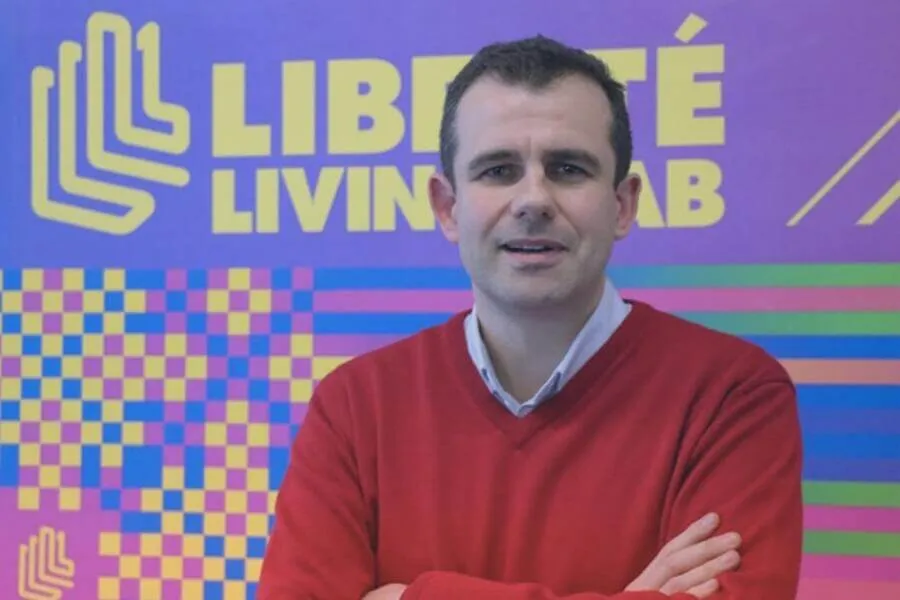
Thomas Cottinet, Liberté Living-Lab: “Tech for Good Is the Future of Tech”
.svg)
Do you know Liberté Living Lab ? This place is like no other. Associations, entrepreneurs, startups, large corporations and schools have all made it their home, forming a virtuous ecosystem that works every day to put technology at the service of the common good, of society, of the environment. We met Thomas Cottinet, its founder. His keyword for digital transformation ? Tech for Good, of course!
You chose "tech for good" to talk to us about digital transformation. Why that choice?
Thomas Cottinet. Digital transformation is often treated as an end in itself. Tech for Good embodies a positive contribution of digital transformation to society's challenges: a contribution that creates meaning, serving positive social or environmental impact. As co-director of Liberté Living-Lab, which carries a clear and ambitious vision of Tech for Good, I am also a member of the Entrepreneurs d'Avenirs network, which advocates for "Humanising Progress". This cause is close to my heart.
Is "tech for good" the future of tech in your view?
Thomas Cottinet. Yes — both because of its potential, such as the application of blockchain and artificial intelligence to the public interest, and because of society's expectations. Those expectations are gradually shifting toward large-scale solutions to societal challenges: the ecological emergency, quality education for all, sustainable and accessible mobility, housing, water and energy, solidarity, gender parity, facilitated participation in democratic life, media free from fake news… And on all of these challenges, Tech for Good delivers undeniably — it makes fast, massive, scalable impact possible.
Isn't there a buzzword effect, reflecting a trend that could prove fleeting?
Thomas Cottinet. I am convinced this is not just a trend. The aspirations of tech talent — their will, even their demand, to put their skills to work for social, environmental and public-interest impact — will remain important drivers in the rise of Tech for Good.
Citizens' expectations regarding the transformation of public services will continue to generate projects at the heart of which Tech for Good will feature.
Consumer demand for sustainable products that uphold social, environmental and ethical standards is also expanding the markets that Tech for Good can partly address.
Society as a whole is not standing still: the Pacte Law, with its "mission-driven company" clause, opens a new avenue for companies willing to pivot toward the common good. This evolution of the Civil Code — and the way French companies can embrace it, following the lead of those already B Corp certified — will help Tech for Good thrive. The "10 pour cent" initiative by Christophe Itier also points in the same direction, calling for an acceleration of the corporate transition toward missions serving the common good. The risk is that this may partly amount to greenwashing rather than a genuine shift: in my view, the risk of backlash from demanding consumers and the challenges of recruiting and retaining talent in search of purpose should motivate companies to truly make that transition.
Who are the players in tech for good, and how do you rally the greatest number behind this banner?
Thomas Cottinet. The players are start-ups, companies, public authorities, associations, researchers and experts. In 2018, a first group of French Tech for Good actors — including Liberté Living-Lab — created FEST, standing for France Eco Sociale Tech. FEST brings together and structures the French Tech for Good sector. Chaired in its first year by Frédéric Bardeau (Simplon), then by Eva Sadoun (Lita.co) and Jean Moreau (Phénix), FEST has mapped the sector and supports its development by promoting it, connecting it and providing advice on funding and legal structuring. More than 400 organisations, mainly start-ups, are already listed by FEST, of which 150 have become members. Public authorities support this rally — as shown by the Élysée, which gave a strong boost to the visibility of Tech for Good with its summit held concurrently with Vivatech.
You run Liberté Living Lab, a venue already described as the HQ of tech for good. Tell us about this ecosystem — how is it representative of building a society oriented toward the common good?
Thomas Cottinet. I am co-director alongside Marylène Vicari, the founder, Rudy Cambier and Nathanaël Valero. From its inception, Liberté Living-Lab built an ecosystem dedicated to Tech for Good, well before the term became popular in France. That is why Forbes had already called us the HQ of Tech for Good. The matrix of the LLL ecosystem rests on three criteria: "entrepreneurship — tech — public interest". Start-ups develop tech solutions in the public interest — for job seekers (Bayes Impact), autistic school children (Learn Enjoy), institutions (Open Source Politics), ethical artificial intelligence (Jalgos), media fighting fake news (Climate Science Feedback), micro home ownership (Qlay – Coalescent), attractive career guidance (Impala), educational tracking (Lalilo), learning augmented by virtual reality (Wonda VR), health data updating (Arkhn), language disorders (Mila)… and these start-ups work alongside intrapreneurs from large corporations. Finally, public-sector actors and researchers are also active members of the ecosystem, reflecting our privileged and historic relationship with the public interest: the French Impact team, the Entrepreneurs d'Intérêt Général programme, and the Public Innovation Chair of the ENA, ENSCI, École Polytechnique and Sciences Po. In step with its ecosystem, Liberté Living-Lab also develops its own products to support companies and public authorities: a new business unit, the "Tech Factory", was recently set up to accelerate the integration of AI, blockchain and big data into solutions and organisations.
If you had only one piece of advice to give to companies, what would it be?
Thomas Cottinet. Take an interest in the dynamics that allow you to regularly meet players from outside your own world: public authorities, researchers, experts, citizens… Hybridise and organise permeability with these other ecosystems.