
How Do I Set Up My Internal Communication on Corporate Social Responsibility (CSR)?

.svg)
- Six steps for communicating CSR internally: involve stakeholders, define the strategy, take concrete action, communicate the projects, involve employees, share the results.
- CSR communication runs on two fronts, external (customers, investors, candidates) and internal (employees, managers, employee representatives), and the internal one is what makes the external one believable.
- In a 2021 Cegos study, 57% of employees saw their company’s CSR approach as primarily a communication initiative, and only 29% knew exactly what CSR covers.
- Communicating heavily on limited action backfires: Viererbl and Koch (2022) found that audiences then rate the company as less socially responsible than before the campaign.
- The CSRD has applied to the first companies concerned since financial year 2024, and its scope is still being settled through the Omnibus simplification package, which is worth explaining to employees.
- The rule internally: three actions actually delivered beat one ambition nobody sees on the ground.
According to a 2021 study by Cegos, 57% of employees believe that their company’s approach to Corporate Social Responsibility (CSR) is primarily a communication initiative rather than a firm commitment. This figure can be explained by a lack of concrete initiatives, but also by a lack of internal communication on CSR-related issues.
Quite often, CSR communication is limited to external communication, aimed at the company’s shareholders, clients, and prospects. However, internal communication should not be neglected, as this is what will enable the company to engage its employees and establish a relationship of trust.
Communicating internally on your CSR approach will give visibility to your commitments to sustainability and the environment, all the while raising employee awareness of CSR issues. This is beneficial in terms of employer brand, employee engagement, and talent retention.
How can you integrate CSR communication into your business strategy and internal communication plan? What are the best practices for communicating CSR actions internally? Follow our step-by-step guide to promoting social and environmental responsibility among your employees.
What CSR communication actually covers
CSR communication is everything a company says about its corporate social responsibility: the environmental, social and governance commitments it makes, the actions it takes, and the results it reports. It plays out on two fronts:
- externally, towards customers, investors, candidates, media and public authorities;
- internally, towards employees, who are both the people who carry the approach and its first judges.
The two feed on each other. An employee who discovers their company’s commitments in an ad campaign before hearing about them at work will struggle to believe them. Closing that gap is what internal communication is for, and the six steps below show how.
1. Involve your internal stakeholders
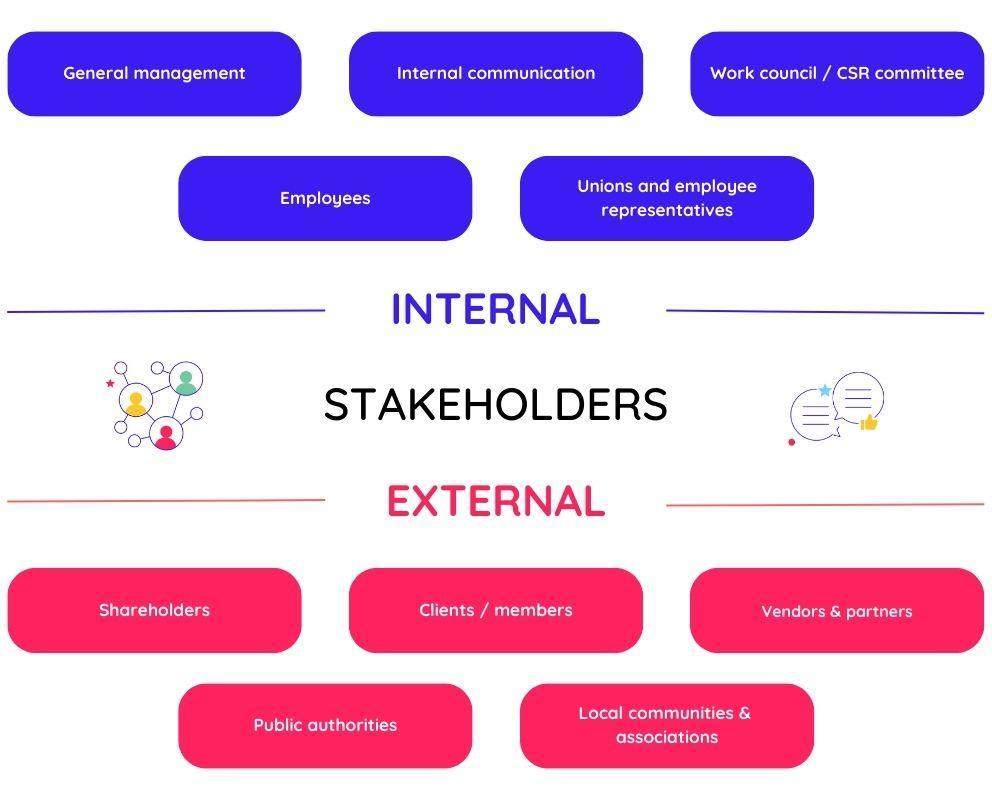
To ensure the success of your internal CSR communication, the first step is to identify the stakeholders you need to mobilize when developing your communication strategy:
- the internal communication manager(s) responsible for communicating your CSR projects internally
- general management
- CSR committee and/or works council members
- unions and employee representatives
- employees
According to a study conducted jointly for Ekodev and Paris-based strategy and change management consultants Des enjeux et des hommes, just 15% of employees feel involved in their company’s CSR strategy. Mapping all these internal players is therefore an essential step in determining the issues at stake and the level of involvement of each.
2. Define your CSR strategy
The CSR strategy is what will enable you to define the actions to be taken to have a positive impact on the environment and society as well as the local economy. Here are a few best practices for implementing it:
- Audit the CSR actions already in place within your organization. To do this, ask the stakeholders concerned about the strengths and weaknesses of your strategy. This will give you a good idea of the areas for improvement and possible obstacles to overcome.
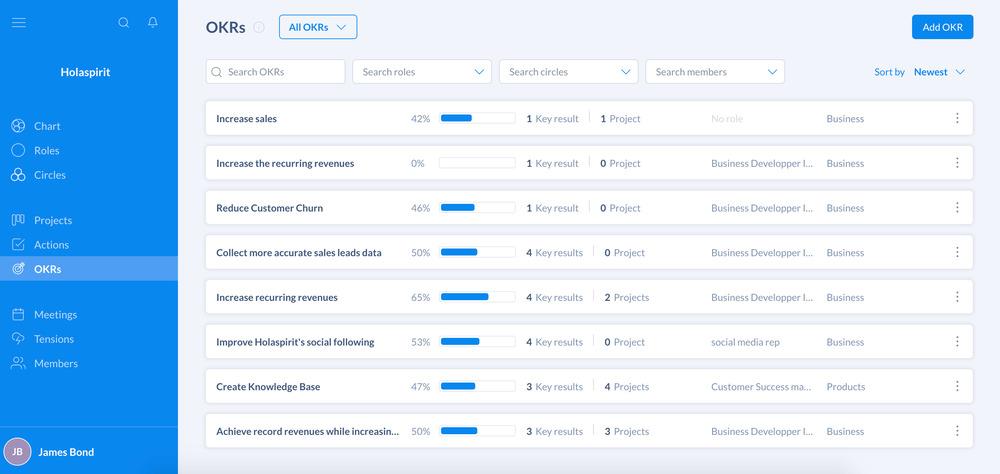
- Using the OKR (Objectives and Key Results) methodology, define the objectives you wish to achieve. This method will enable you to align your teams on common objectives, which you can measure by setting yourself key results to achieve. For example, if your objective is to raise your employees’ awareness of CSR issues, one of your key results could be to ensure that 80% of your employees have received CSR training within the next six months.
See also: 3 sustainability trends to watch
- Prioritize the CSR topics you wish to address based on your defined objectives. Then, integrate them into your company’s overall strategy.
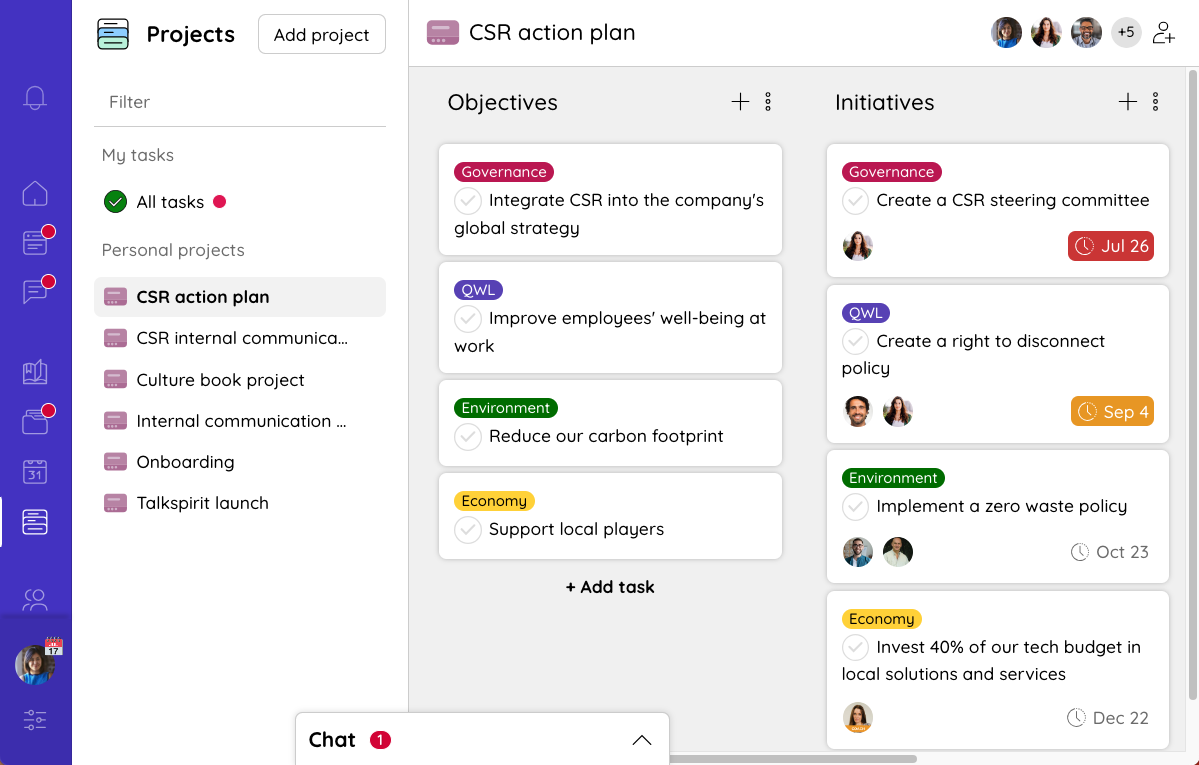
- Create an action plan to formalize your corporate social responsibility strategy, including:
- the project’s purpose (why you want to launch your CSR initiative)
- the objectives set and the topics to be prioritized
- the actions to be taken over the next six months (or one year) to achieve these objectives
- the individuals responsible for each action, in particular for defining the internal communication plan
- deadlines to be met
- the key messages to include in your internal CSR communication plan
- the channels you’ll use to get those messages out
- Identify ambassadors capable of conveying your messages to all employees, and train them in their role.
- Draw up a CSR charter highlighting the responsible commitments you are going to make, and explaining why and how you are going to put them into practice.
3. Implement concrete actions
Now it’s time to take action! Our advice: define at least one project leader for each CSR action to be implemented. This will enable you to manage your various projects more easily and distribute the workload more evenly.
But what actions can add the most value to your business? Here are a few examples to inspire you:
- raise employees’ awareness of CSR issues and the eco-friendly practices they should adopt at work through training and/or team-building activities (CSR seminar, treasure hunt, escape game)
- encourage hybrid work whenever the workstation allows it
- introduce waste recycling in the office
- repair existing equipment or buy second-hand equipment rather than new equipment
- Implement actions to improve your employees’ well-being at work
- donate a portion of your sales to associations and encourage employees to volunteer
- reduce paper consumption by keeping printing to a minimum
- partner with local companies when looking for suppliers, services, or software
- Improve parity and reduce the gender pay gap, based on the gender equality index
- extend the approach to your use of AI, using our guidance on promoting sustainable AI in the workplace
- Implement a digital sobriety approach to reduce the carbon impact of your digital uses
4. Communicate your CSR projects
Implementing CSR initiatives is all well and good, but let’s not forget to spread the word throughout your organization. Start by defining the very notion of corporate social responsibility. True, most employees are aware of it, but only 29% of them know “exactly what it is,”¹ so it wouldn’t hurt to set out a few definitions and organize a training session!
You should also think about the channels you’re going to use for your internal CSR communication strategy. These communication media can be 100% digital (as in the case of the enterprise social network, the intranet and the internal newsletter), but can also mobilize your employees in person (via a dynamic display in your offices, or the organization of an event to launch your CSR project).
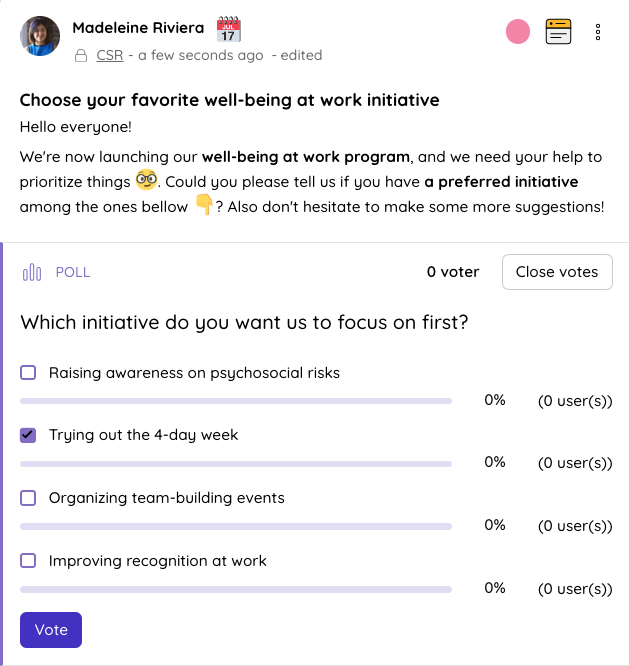
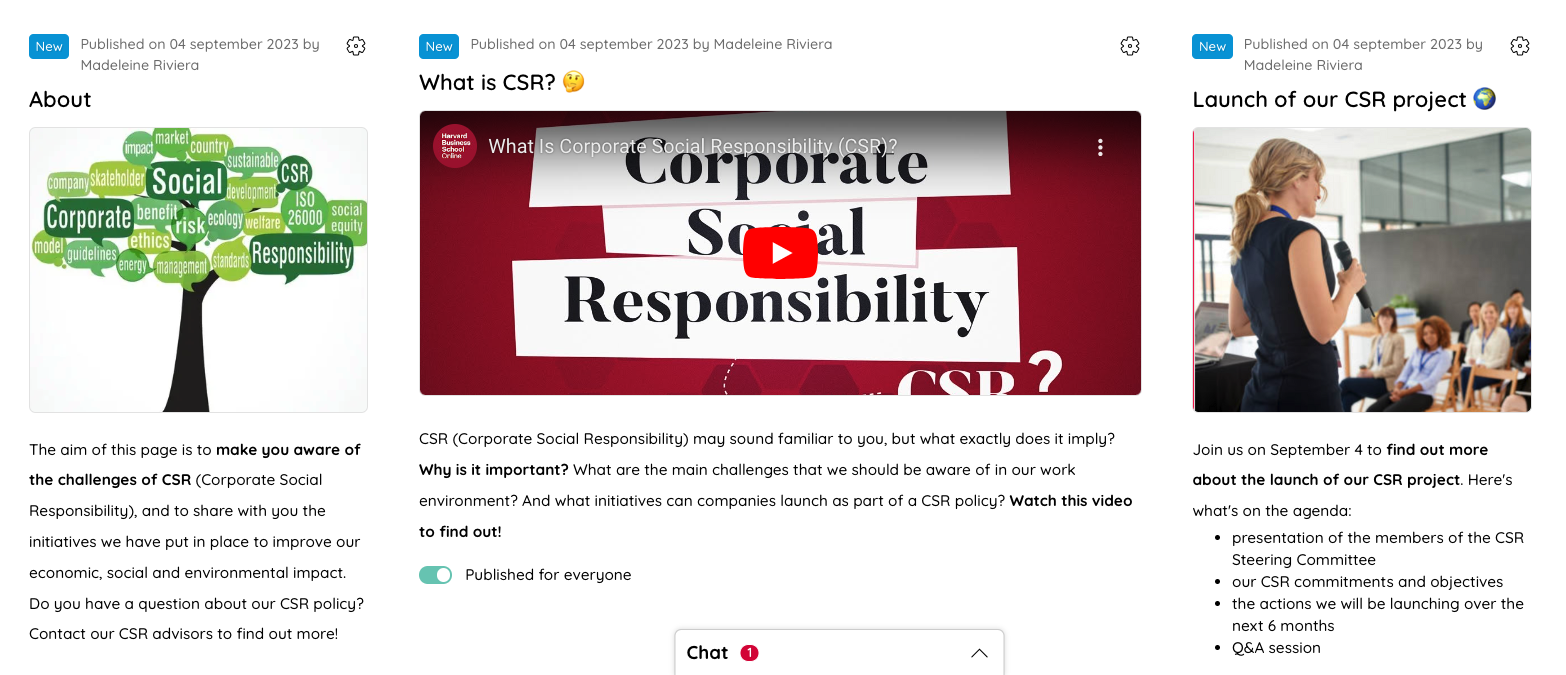
You should also take the time to create an internal communication strategy dedicated to your CSR projects and identify the most appropriate communication formats. On a versatile enterprise social network such as Talkspirit, you can share your actions:
- via a post on your news feed
- on your home portal
- in your content library, by creating a dedicated CSR page
- at a dedicated event, shared in the calendar
See also: 5 examples of posts for your internal social network
Finally, don’t hesitate to use your internal communication tools to ask your employees for feedback and get them involved in your CSR projects.
5. Involve employees in CSR
72% of employees believe that the company should involve them more in its CSR reflections.¹ For your CSR communication to bear fruit internally, it’s therefore important to get your employees involved!
Your enterprise social network can serve as a benchmark internal communication tool for building commitment to CSR. On the Talkspirit platform, you can:
- create and manage communities linked to CSR topics (the environment, well-being in the workplace, inclusion, diversity, and more)
- feature employees who participate in your CSR projects via a video interview or other medium
- share a weekly CSR best practice to steadily raise awareness among employees
- launch a CSR challenge (for example, ask employees to propose the initiative that will most reduce the company’s carbon footprint)
- share a quiz to evaluate their knowledge of CSR
- organize a climate change activity
6. Share your results
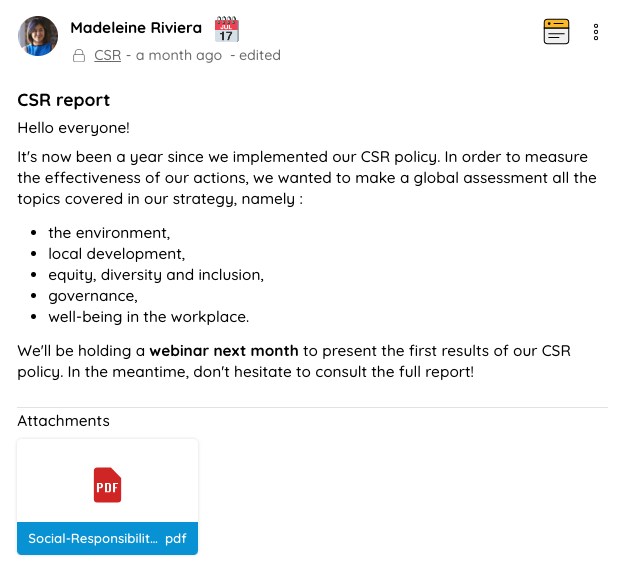
CSR communication also means being transparent with your internal stakeholders. This will enable you to avoid greenwashing (the practice of communicating your CSR commitments without actually putting them into practice), but also to show employees that your approach is sincere and not just a publicity stunt.
Beware of the opposite excess. A study published in Public Relations Review (Viererbl and Koch, 2022) documents a paradoxical effect: when a company communicates heavily on limited CSR actions, its audience mainly perceives a persuasive intent, pushes back, and ends up rating the company as less socially responsible than before the campaign. Internally, the rule is the same: three actions actually delivered beat one ambition nobody sees on the ground.
The best way to communicate your results is to create a CSR report. With this report, you’ll be able to give visibility to:
- the actions implemented on each theme
- the impact (positive or negative) they may have had
- and the people who took part in the various projects
Finally, this support is a good way of measuring the performance of your CSR action plan and reinforcing the legitimacy of your approach.
That report no longer sits in a regulatory vacuum, and your employees hear about it. According to the European Commission, the CSRD applies to the first companies concerned from financial year 2024, for reports published in 2025, and two delegated acts simplifying the ESRS standards were adopted on 3 July 2026. The scope, however, is still being settled: the Omnibus simplification package, presented in February 2025, proposes to limit the obligation to companies with more than 1,000 employees, and Parliament and Council reached a political agreement on 9 December 2025 without the text being finally adopted yet. Explaining where your company stands is better than letting your teams work it out from the press.
If the report is fairly long, don’t hesitate to summarize its content to make it more accessible. Why not create an infographic, carousel, or video with the key takeaways, for example? Or simply present the results at a dedicated event? These formats work very well on enterprise social networks, so don’t limit yourself!
| Criterion | External CSR communication | Internal CSR communication |
|---|---|---|
| CriterionAudience | External CSR communicationCustomers, investors, candidates, media | Internal CSR communicationEmployees, managers, employee representatives |
| CriterionObjective | External CSR communicationBuild brand credibility and attract | Internal CSR communicationRaise awareness, engage, get people involved |
| CriterionChannels | External CSR communicationWebsite, annual report, press, social media | Internal CSR communicationEnterprise social network, intranet, internal newsletter, events |
| CriterionExpected proof | External CSR communicationConsolidated indicators and dated commitments | Internal CSR communicationActions visible day to day, and results explained |
| CriterionMain risk | External CSR communicationGreenwashing, as seen from outside | Internal CSR communicationA gap between the message and what teams experience |
To conclude
To be effective, your CSR communication must factor in your external AND internal stakeholders. Only by communicating your responsible projects internally will you be able to demonstrate the importance of CSR and engage your employees around the project. So, the next time you launch a sustainable project, don’t forget to keep your employees informed!
If you’re not used to doing this, never fear. Our team is at your disposal to help you with your CSR communication. Contact us today to discuss your project!
Talk to an expert
FAQ
Because CSR communication is often limited to shareholders, clients and prospects, while it is internal communication that engages employees and builds a relationship of trust. In a 2021 Cegos study, 57% of employees saw their company’s CSR approach as primarily a communication initiative rather than a firm commitment.
The internal communication manager or managers, general management, CSR committee and works council members, unions and employee representatives, and employees themselves. A study conducted for Ekodev and Des enjeux et des hommes found that just 15% of employees feel involved in their company's CSR strategy.
It is everything a company says about its corporate social responsibility: the environmental, social and governance commitments it makes, the actions it takes and the results it reports. It addresses external audiences (customers, investors, candidates, media) and internal ones (employees, managers, employee representatives) alike.
Awareness training and team-building activities, hybrid work where the workstation allows, waste recycling in the office, repairing or buying second-hand equipment, donating part of sales to associations, reducing paper consumption, partnering with local companies, improving parity, and adopting digital sobriety.
Most are aware of it, but only 29% know exactly what it is, according to the 2021 Cegos study. Setting out a few definitions and organizing a training session is worth the effort before communicating further.
72% of employees believe the company should involve them more in its CSR reflections. On the Talkspirit platform you can run communities on CSR topics, feature employees who take part, share a weekly CSR best practice, launch a CSR challenge, share a quiz, or organize a climate change activity.