Clarity Enables Faster Decisions
.svg)
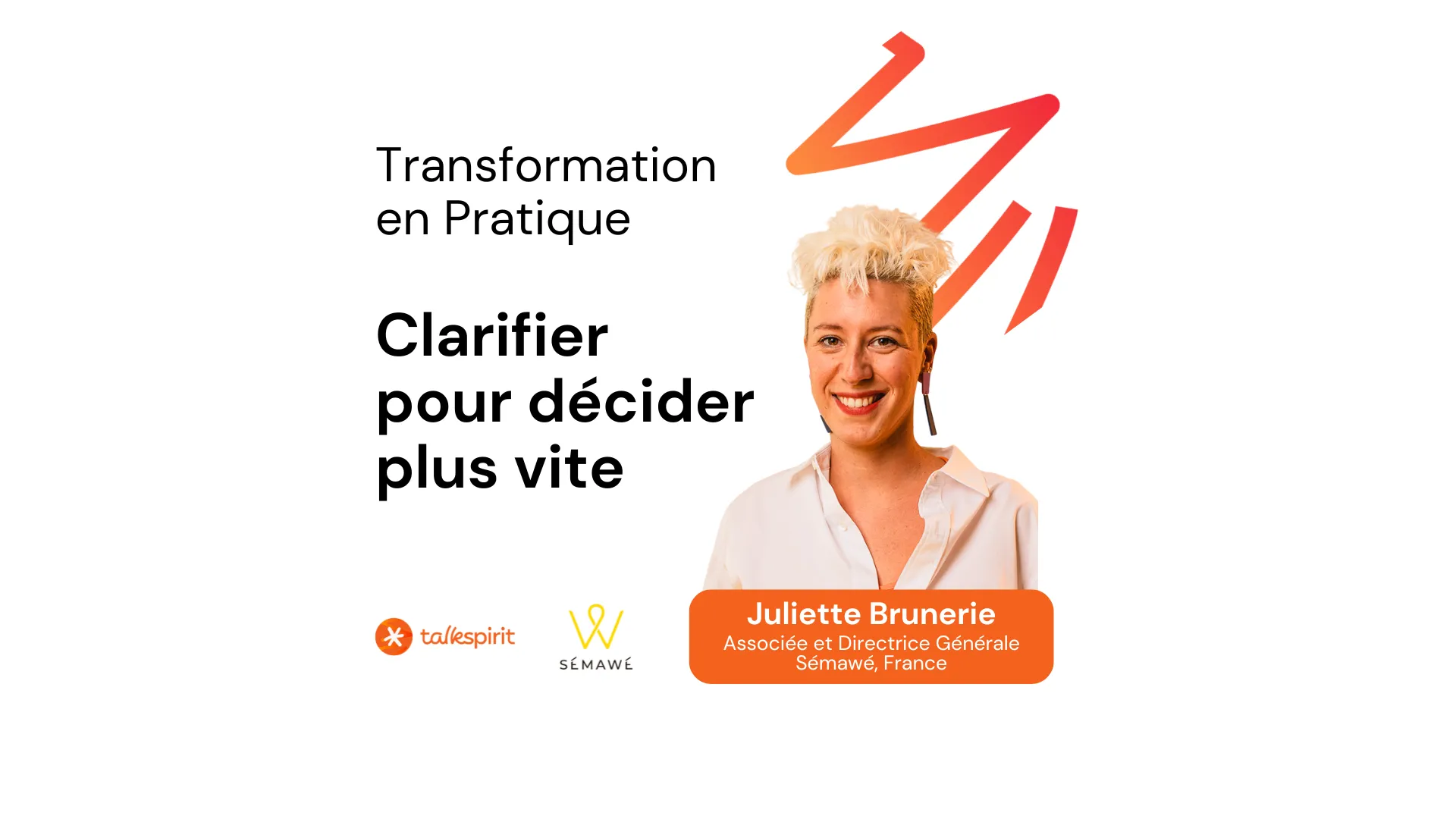
In this new installment of the Transformation in Practice series by Talkspirit, Gregory Pepper speaks with Juliette Brunerie, managing partner and CEO of Sémawé, an agency based in Grenoble. Juliette supports organizations through their transformations, including through holacracy, and shares here what she observes in the field, the challenges leaders face, and what it concretely takes to make autonomy sustainable over time.
Hi Juliette. Can you introduce yourself and tell us about Sémawé?
My name is Juliette Brunerie, I'm 39, and I took over as CEO of Sémawé two years ago. My work is supporting organizational transformations using a system called holacracy — a distributed governance system.
I'm not the only one doing this at Sémawé; we have four people supporting this type of transformation.
We also offer team seminars, work around team dynamics, mediation, and general management training. Today, we are a team of seven.
Sémawé is a cooperative, B Corp certified and ISO certified. What does that mean in practice?
People often find it a bit unusual to be both B Corp and ISO certified, but they're not incompatible. We became a cooperative about eight years ago. That's when we chose to adopt holacracy for ourselves, because we were all becoming partners and didn't want to decide everything collectively.
Today, we are all employee-partners, and we have distributed power by clarifying who does what through defined roles.
The B Corp certification was a way for us to communicate to our network what we aspire to embody every day. It makes visible what we already do, and also helps identify areas for improvement — particularly around employee wellbeing.
The ISO certification serves a different purpose. It's about credibility. It demonstrates that holacracy is not a disorganized system, but one that can support highly qualitative services with robust processes. Since we are also a training organization, it went hand in hand with Qualiopi certification. These are important credentials for certain companies.
What are the main challenges organizations face today?
What I encounter most regularly are organizations that need to remain adaptable in an uncertain world. This can mean dealing with a drop in activity, rapid growth, or adapting their organizational model to become more agile.
The main reason they call on us is this need for robustness and adaptability in the face of the unexpected, whatever the nature of the challenge. Things move faster, contexts shift more quickly, and this is strongly felt by the leaders we support.
Concretely, what do leaders tell you? What are they asking for?
A very common example involves economic uncertainty. It's difficult to manage when teams struggle to be autonomous.
There are people in the field who pick up on weak signals but can't quickly turn them into decisions or actions with their clients.
We work a lot in B2B, with companies that are themselves in B2B, in services or industry. In these environments, when an opportunity arises, you need to be able to react fast and feel legitimate in seizing it. Yet in some organizations, employees don't dare, because they think it's not their role, it's too risky, or that the decision isn't theirs to make.
Leaders want their teams to feel empowered to make ambitious decisions that commit the organization. A central rule in holacracy keeps coming up in these conversations: whatever is not forbidden is permitted.
How do you concretely support organizations at Sémawé?
There are several levels of support. We offer full holacracy implementations, but not only that. We also draw on holacracy for more targeted needs.
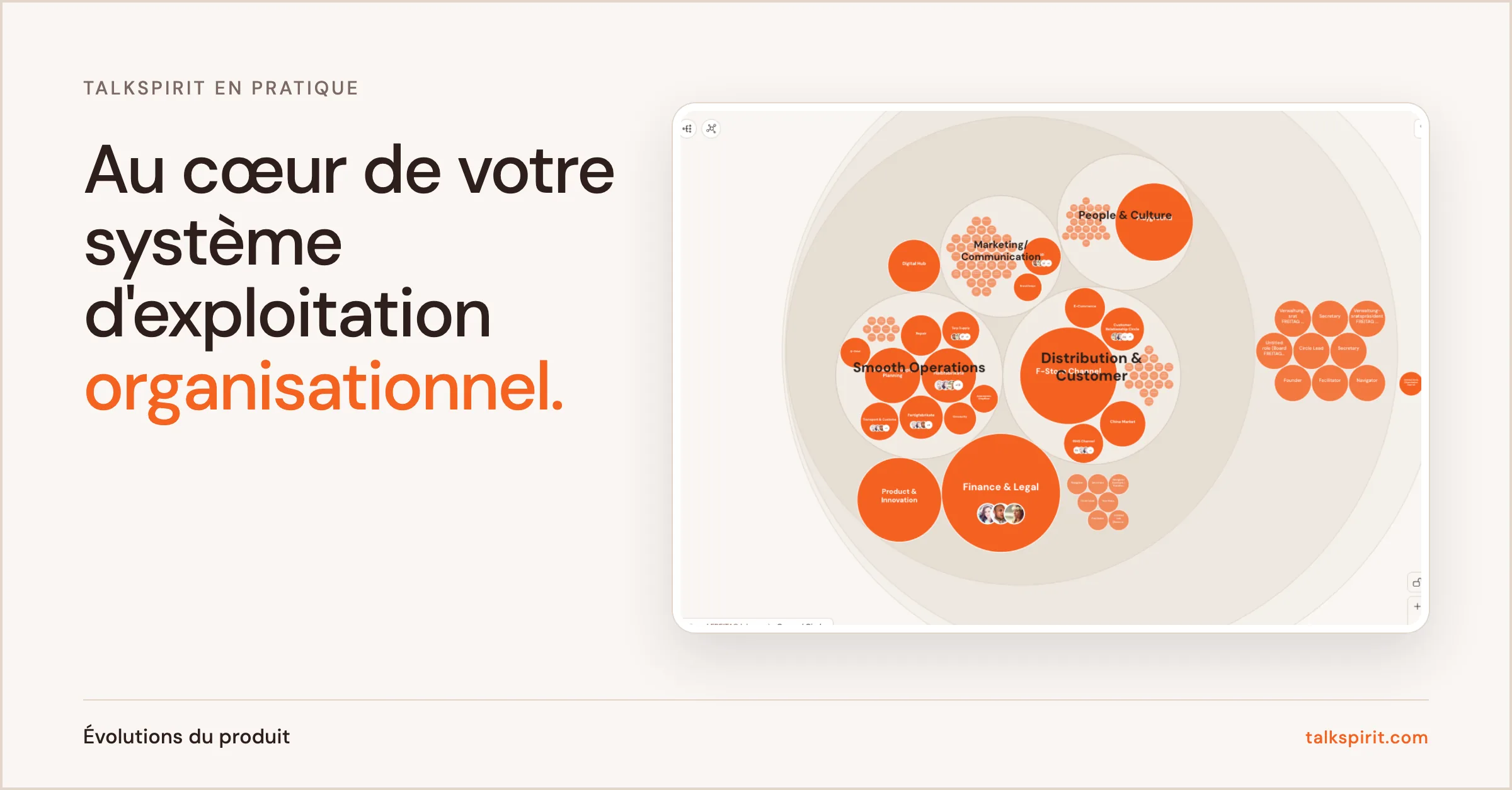
Some companies first ask us to help them map roles and clarify who does what. In these situations, tools like Talkspirit are very useful, because they allow you to represent a functional org chart rather than a hierarchical one.
We also work extensively on meeting processes. The meeting is a central space where power, decisions, postures of maturity, autonomy, and next steps all converge.
When a company wants to go further, we work on management postures and governance — that is, on how the power structure is modified.
We also coach so that the rule "whatever is not forbidden is permitted" can actually be embodied. It's simple in theory, but difficult in practice if the boundaries aren't made explicit. Our role is to help the organization clarify what is sensitive, what needs to be structured, and what is free and can be tested without authorization. We generally start with senior leaders and executive committees, then work with teams.
How would you explain holacracy to someone who's never heard of it?
For me, holacracy is a work philosophy backed by a concrete toolkit. It's not just an intention or aspiration. It's formalized in a text — a constitution — that defines rules and practices.
This philosophy aims to support individual autonomy through a clear, embodied distribution of power.
We speak of integrative management, as it combines horizontal and vertical dimensions. There are spaces of free action and spaces where decisions are centralized, because the organization needs it.
Holacracy makes it possible to clarify who does what and to map the actual functioning of the organization. The constitution describes how we cooperate, how operational meetings run, how we take initiative, how we set rules, and how we modify the power structure through governance.
Some organizations choose to symbolically sign this constitution — as a shared set of rules, applied by everyone, including leadership. You move from implicit to explicit rules, shared by all, with genuine room for freedom.
Why distinguish functional roles from job titles and hierarchy?
When supporting an organization, the first reaction often comes from middle managers. They wonder what will become of them if teams are given more autonomy. They question their role, one-on-ones, leave approvals.
We explain that hierarchy still exists. Labor law, levels of responsibility, HR roles don't disappear. Instead, we add another layer of reading: the functional org chart. It's about understanding what each person concretely contributes to the organization.
A manager often has strong technical expertise. With holacracy, their managerial role is clearly distinguished from their operational or technical roles. These are two different visualization systems, serving different purposes. One helps us understand how we cooperate day to day; the other, how the organization is managed.
What are the main shifts in posture required?
The first shift is learning to ask questions before offering advice. It's about developing genuine curiosity about what the other person is experiencing, rather than immediately proposing a solution.
When someone comes to a manager to validate a decision, taking the time to ask a few questions and find out what they would do themselves changes a lot. Often, the person already has a solution in mind. The manager's role becomes more coaching-oriented.
The second shift is about rigor.
If everything not forbidden is permitted, then it is essential to make the prohibitions explicit.
In holacracy, whatever is not explicit is deemed not to exist. This requires ongoing work to clarify roles and authorities.
How do you prevent autonomy from undermining quality or standards?
Holacracy has two main safeguards. The first is purpose. Every circle and every role has a purpose. This allows you to check whether an initiative is consistent with the scope of the role and the organization's needs.
The second safeguard is prioritization. Circle leads have specific authority to set priorities. This makes it possible to say no, or not yet, to certain ideas — without undermining autonomy.
Autonomy does not mean independence, but the capacity for decision-making within an explicit framework.
What role does technology play in embedding these new behaviors?
For me, technology is essential. Having a clear, up-to-date role map, accessible to everyone, ensures a shared level of information and transparency. Connecting this to a meeting system where decisions and actions are tracked greatly reinforces coherence.
Technology prevents the emergence of a shadow governance.
If an activity exists but is written nowhere, it will eventually surface. Technology allows us to recognize the energy people actually invest and to clarify the corresponding roles. Without a tool, it's very difficult to maintain over time.
How do you ensure that these new practices actually take root?
From the outset, we clarify that transformation requires training a sufficient number of people. Below around 30% of staff trained, it rarely works.
We also offer supervision sessions, where we regularly return to observe real meetings and help teams adjust their postures. Ideally, we also support the emergence of internal coaches.
Finally, facilitation roles play a key part outside of meetings, in informal moments. They help turn complaints into actions, remind people of their agency, and support the evolution of habits.
Do you have a concrete example of observed impact?
A recent example involves a logistics center of the Swiss army. Their executive committee used to meet for an entire morning each week. Today, the meeting lasts an hour and a half. That represents a saving of more than two hours per week, with more effective decision-making.
Another example, in industry, involves a technician who, during an operational meeting, identified a problem on a machine by ear, avoiding a very costly repair. The meeting gave him a platform to speak, to make his expertise visible, and to be entrusted with a specific monitoring role. It's a very concrete illustration of recognition and leadership.
What advice would you give to leaders who want to evolve their organization?
I would advise them not to think alone. To discuss with members of the organization what they would want instead of what currently exists, and to draw on other ways of thinking. Thinking alone often leads back to the same answers.
What questions do you still ask yourself today?
I think a lot about the compatibility between certain institutional frameworks and systems like holacracy, particularly in local authorities or public administrations. There is sometimes a potential that gets constrained by existing structures.
I also think about pay transparency. It's a sensitive topic, but one I find very interesting. Bringing awareness to costs, value produced, and economic reality seems to me an important step in organizational maturity.
A final word?
I wish everyone who wants to change something: take one small step toward something a little better than what you currently aspire to. Being agile, taking small steps — that's already a lot.