.webp)
Gartner’s 12 Strategic Technology Trends for 2022

.svg)
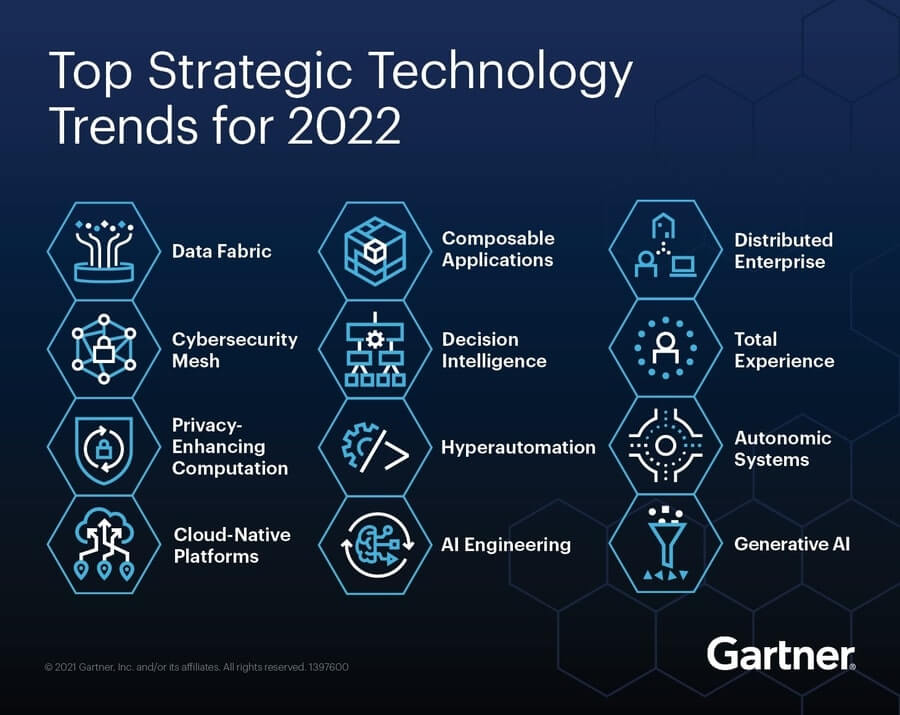
Today a fully strategic function, the IT department must now drive innovation to boost business growth and accelerate its digital transformation. Which technologies should organizations bet on over the coming years? And what ROI can they expect? That is the subject of this new Gartner report, which has identified 12 strategic technology trends for 2022:
- 1. Data Fabric
- 2. Cybersecurity Mesh
- 3. Privacy-Enhancing Computation
- 4. Cloud-Native Platforms
- 5. Composable Applications
- 6. Decision Intelligence
- 7. Hyperautomation
- 8. AI Engineering
- 9. Distributed Enterprise
- 10. Total Experience (TX)
- 11. Autonomic Systems
- 12. Generative AI
Here is an overview of each of these technology trends.
Read also: Deloitte’s 9 Technology Trends for 2021
1. Data Fabric
Even today, data often remains siloed within applications and is not leveraged as effectively as it could be. A new trend is emerging to address this challenge: data fabric.
Also known as a data mesh, data fabric is an architecture that simplifies access to and use of data across a wide range of environments, thereby maximizing its added value. According to Gartner, it can reduce data management efforts by up to 70 %.
By 2024, the institute estimates that deploying a data fabric will make data exploitation four times more efficient and cut human data management tasks in half.
2. Cybersecurity Mesh
Since the rise of remote work, cyberattacks on organizations have skyrocketed. In 2020, ANSSI estimated that they had even quadrupled!
Read also: [Expert Perspective] SMB Cybersecurity Challenges in 2021
To mitigate cyber risks, Gartner recommends that companies adopt a cybersecurity mesh: a distributed architectural approach that defines individual security perimeters around each access point of an IT asset, rather than a single “fortress” perimeter. The goal is to strengthen the security of all access points, preventing attackers from exploiting one vulnerability to compromise the entire network.
According to Gartner, adopting a cybersecurity mesh architecture could reduce the cost of cyber incidents by approximately 90% by 2024.
3. Privacy-Enhancing Computation
To guarantee the security and confidentiality of all their data, companies must also invest in privacy-enhancing computation. This allows them to share sensitive data without compromising its confidentiality (for example, through encryption, data splitting, or preprocessing).
By 2025, 60 % of large enterprises are expected to use this approach for data analytics, business intelligence, or cloud computing.
4. Cloud-Native Platforms
When a company migrates to the cloud, it often moves legacy applications that were not designed for the cloud and therefore require more maintenance. To fully benefit from cloud migration, organizations must move away from these inherited monolithic applications and shift toward cloud-native applications built on a microservices architecture.
Unlike traditional applications, cloud-native platforms are built and deployed directly in the cloud. They are therefore more flexible and scalable. This makes them less dependent on infrastructure and enables them to create value faster. Gartner estimates that more than 95 % of new digital initiatives planned by 2025 will be built on cloud-native platforms.
5. Composable Applications
To accelerate transformations within their organizations, CIOs need to equip cross-functional teams, including those made up of employees from sales and IT departments. These teams often face numerous challenges, such as limited coding skills, inadequate tools, and tight deadlines.
Composable applications can address these challenges: applications built from : packaged business capabilitiespackaged business capabilities (also known as packaged business capabilities or PBCs), which are software components each representing a specific business capability. By assembling these modules, cross-functional teams can build applications quickly without needing advanced programming skills.
6. Decision Intelligence
By 2023, more than one-third of large enterprises will use decision intelligence to make strategic decisions. Decision intelligence — which emerged a few years ago — encompasses all the methods used to design, model, execute, evaluate, and adjust decision-making processes and models. The goal: make smarter, faster decisions by leveraging artificial intelligence, machine learning, deep learning, and predictive analytics.
Decision intelligence can be applied in many ways — for example, to analyze consumer behavior, study a competitor’s strategy, or predict the risks associated with a strategic decision.
7. Hyperautomation
The growing focus on digitalization and operational excellence is highlighting the need to expand automation across organizations and extend it to more domains. This is the premise behind hyperautomation.
This approach aims to identify, evaluate, and automate as many business and IT processes as possible using multiple tools and technologies — including artificial intelligence, robotic process automation (RPA), business process management suites, iPaaS platforms (integration platform as a service), and low-code/no-code tools.
Hyperautomation helps boost organizational performance, reduce the risk of errors, and improve employee well-being — freeing teams from repetitive, low-value tasks.
8. AI Engineering
Due to issues of viability, scalability, and governance, only 53 % of AI projects successfully move from prototype to production.
To address this challenge, companies need to invest in AI engineering: an integrated approach that accelerates the operationalization of AI models. Through AI engineering, AI projects are integrated into the DevOps process, enabling faster deployment and optimizing their business value.
“By 2025, the 10 % of companies that adopt AI engineering practices will generate at least three times more value than the 90% that do not follow the trend,” estimates David Groombridge, VP Analyst at Gartner.
9. Distributed Enterprise
While still far from the norm, the distributed enterprise is steadily gaining ground. In this office-free model, all employees work remotely 100% of the time — offering greater flexibility for workers and reducing real estate costs.
According to Gartner, this approach can also be extended to a company’s customers and prospects to deliver a more digitalized experience tailored to their new ways of working and consuming. One example is the American investment bank Merrill Lynch, which enables clients to find a nearby financial advisor through a geolocation system.
By 2023, three-quarters of organizations following this trend are expected to grow their revenues 25% faster than their competitors.
10. Total Experience (TX)
Among the technology trends for 2022, total experience (TX) also has a key role to play. Its goal: interconnect and improve all the experiences a company delivers to its customers, users, and employees. By 2026, Gartner estimates that 60 % of large enterprises will adopt this 360° approach to transform their business model and optimize both customer experience and employee experience.
Some organizations have already started pursuing this trend. For example, the investment app Fidelity Spire uses data analytics and AI to anticipate client behavior and create training simulations for its employees. The result: this unified experience helps both streamline user onboarding on the app and simplify the work of advisors.
11. Autonomic Systems
Autonomic systems also make the list of technology trends to watch in 2022. According to Gartner, these are self-managing physical systems or software that learn from their environment. Unlike automated systems, they can modify their own algorithms without any software update, enabling them to adapt to change more quickly.
Autonomic systems can leverage various technologies. For example, Ericsson uses autonomic systems that apply reinforcement learning and digital twins to optimize the performance of its 5G networks.
12. Generative AI
Generative artificial intelligence will also gain momentum in the coming years: by 2025, it will account for 10% of all data generated worldwide (compared to less than 1 % today).
This new form of AI is capable of learning from existing content (text, audio, images, etc.) from data samples to generate original new content. It therefore represents a powerful innovation engine for organizations.
In the pharmaceutical sector, generative AI is accelerating the discovery of new drugs and reducing associated costs. Gartner estimates that 30 % of new drugs and materials will be discovered using this technology by 2025.
 end HubSpot Call-to-Action Code
 *
* *
Cybersecurity, artificial intelligence, automation, hybrid work… In 2022, CIOs must anticipate numerous technology trends. Of course, not all of them will be equally relevant. Their role will be to prioritize the ones that are most applicable to their industry and the size of their organization.
Want to learn more about the challenges facing CIOs in 2022? Download our ebook “Hybrid Work: New Challenges for IT Leaders”:
Download the White Paper
In our White Paper “Hybrid Work: New Challenges for IT Leaders”, you will discover: the 3 major challenges for CIOs in the era of hybrid work; concrete advice for accelerating your digital transformation, securing your workstations, and improving the employee experience, as well as testimonials from 10 CIOs working in companies, public administrations, and associations.