
Accelerate your company’s digital transformation with 8 best practices!

.svg)
- A digital transformation strategy connects a business ambition to the tools, processes, skills and indicators that make it possible.
- McKinsey puts the failure rate of digital transformation projects at 70%, usually for lack of method rather than lack of tools.
- Eight practices structure the project: involve the right people, set a strategy, leverage technology, adapt and automate processes, communicate, train teams, build a digital culture, stay agile.
- AI is handled like the rest: inventory what your tools already do, write down the rules of use, keep a human check on anything that commits the company.
- A summary table gives, for each practice, where to start and how to tell it is taking hold.
- Talkspirit brings news feed, project management, chat, video meetings and a content library together on one platform, 100% made in France.
Digital transformation is no longer a one-off programme: it is how organisations run day to day. Done well, it boosts team productivity, centralises data, improves the customer and employee experience, advances agility, and supports growth. Since generative AI landed in everyday tools, the question is no longer whether to start, but how to start without spreading yourself thin.
More and more companies are making the digital dive, but not all of them have the skills, the methodology, and the tools necessary to succeed with the transition. And the results show it: 70% of digital transformation projects fail, according to McKinsey.
If you fall in that 70% (or simply prefer not to fall there at all), you may be wondering:
- How can I ensure a successful digitization?
- Which mistakes should I look out for?
- What best practices and tools should I put in place to accelerate this transformation?
This article offers you our eight pro tips to succeed in your digital project from A to Z, and thus accelerate the digital transformation of your company.
1. Involve the right people
To help your company make this transition, you must first involve the right stakeholders, and in particular those leaders capable of taking this change by the reins. These leaders play a key role in the success of your project, as they’re the ones who’ll engage and support the entire team throughout this process. They must therefore be exemplary in this area and have thorough knowledge of digital technologies.
If these leaders are not available internally, it may be a good idea to recruit them before starting your project. Why? As an example, organizations that recruit a chief digital officer (CDO) are on average 1.6 times more likely to succeed in their digital transformation, according to McKinsey.
In addition to these leaders, the entire management team needs to be involved, as well as the employees the change will directly affect. Thus, remember to consult all these stakeholders as early as possible, both to gather their opinions and to prepare them for the changes to come. The end goal? Make your employees real actors of change.
2. Implement a transformation strategy
So what is a digital transformation strategy? It is the plan that connects a business ambition (serve customers better, decide faster, cut administrative work) to the digital means that make it possible: the tools to roll out, the processes to rethink, the skills to build and the indicators that will tell you whether it works. Without that plan, digitisation is just a pile of tools nobody uses.
Defining a transformation strategy is one of the most important steps in a digital transformation project. Thanks to this roadmap, you’ll be able to identify what changes to make and how to implement them within your organization.
Here’s an overview of key actions to incorporate into your roadmap:
- Conduct a diagnostic to assess the digital maturity of your company and identify your strengths and weaknesses in this area.
- Define the vision and objectives of the transformation using the SMART method. These should be:
- Specific (target a specific area for improvement)
- Measurable (quantify or at least suggest an indicator of progress)
- Achievable (ambitious, but also reachable)
- Realistic (state what results can realistically be achieved given the available resources)
- Time-related (specify when the result(s) can be achieved)
- Research the market by learning about the initiatives and tools other actors in your sector have implemented (particularly your competitors).
- Identify the elements that need to be transformed within your organization (this is your business model, your modes of collaboration, your employer brand, your product and service offering, your business processes, and more).
- Organize your transformation by prioritizing the projects to be undertaken and listing the actions needed for your most important projects.
3. Leverage technology
Whatever your digital transformation project, one thing is certain: you’ll need to rely on digital tools to carry it out and accelerate the process. According to McKinsey, using this type of tool can even increase your chances of success! Let’s see how in the graph below.
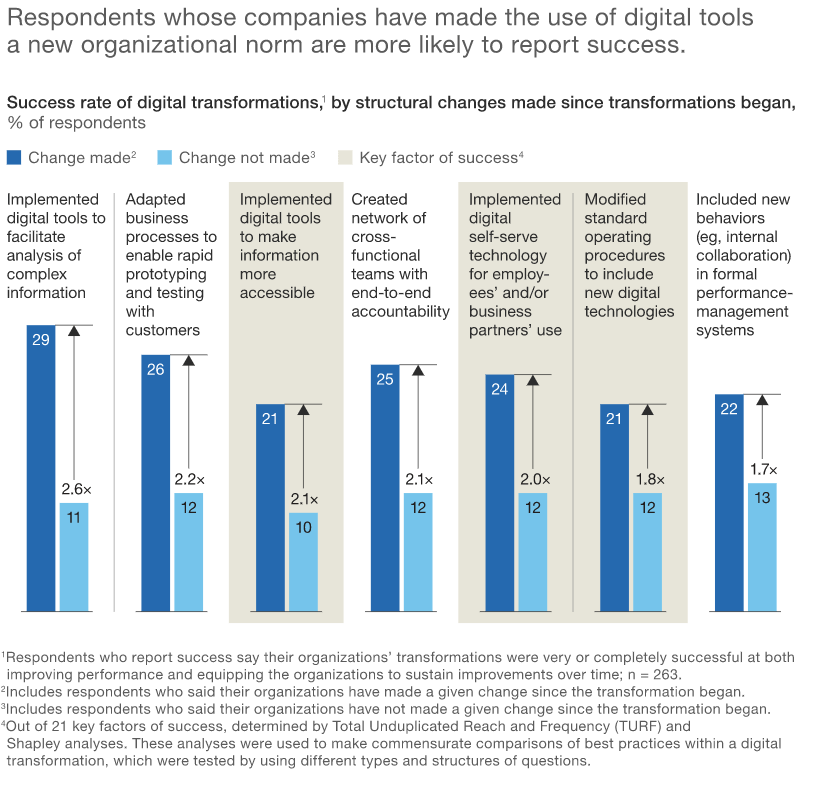
Depending on the nature of your project, you may have to set up any or all of the following:
- a collaborative tool to facilitate teamwork and collaboration
- an intranet or an enterprise social network, to better share information with your employees
- a project management software, to manage and track your projects more efficiently.
Also read: CIO: how to successfully deploy collaborative tools
100% made in France, Talkspirit integrates on the same platform all the features offered by these three tools. Indeed, you can find:
- a news feed and a welcome portal to boost your internal communication,
- a project management module to organize the work of your team,
- an office suite to facilitate the sharing and co-editing of documents,
- videoconferencing and chat, to exchange in real time,
- a content library to centralize all your knowledge,
- and much more!
Schedule a Talkspirit demo today
And where does AI fit? It has slipped into most of these tools already: assisted writing, meeting summaries, plain-language search across your documents. The useful reflex is not to buy one more AI tool, but to look at what your current tools already offer, then decide which uses you allow, on which data and under whose responsibility. A well-kept knowledge base usually matters more than the model you pick: AI can only give back what it is given to read.
Other tools that may be helpful include:
- an electronic signature tool, to electronically sign all your important documents,
- a CRM (Customer Relationship Management), to better manage the relationship with your customers and prospects,
- an automation platform, to automate your workflows and business processes, and better connect your applications to each other,
- a payroll software, to simplify your administrative procedures and the management of your human resources,
- a file storage tool, to centralize all your documents in one place,
- etc.
When choosing such tools, make sure they meet your needs and are as easy to use as possible. You have a doubt? Ask your employees to test these solutions with you! You will then be able to choose the software you need with more confidence.
4. Adapt and automate processes
New digital tools also mean new work processes. For example, setting up an enterprise social network means reviewing the way your teams communicate and share information on a daily basis. Similarly, if you deploy an electronic signature software to dematerialize your administrative processes, you will have to think about updating your document signature processes so that your employees can follow suit.
Thanks to your new tools, you’ll be able to automate certain tasks that were previously done manually (including payroll, expense report management, vacation requests, and customer email reminders.). To take advantage of these benefits, take the time to define which processes you want to automate or improve, and how each team will have to adapt to these new processes.
Two safeguards before automating. Start with the processes that are most repetitive and best documented: that is where the gain is immediate and a mistake is cheap. And keep a human check on anything that commits the company, a contract, a payroll run, an answer to a customer. An ill-defined process that gets automated becomes an ill-defined process, only faster.
5. Communicate
If you want to accelerate the digital transformation of your company, you’ll want to communicate these changes internally first. Our advice: draw up an action plan specifying the format, date, target, objective, and content of each of your communications, ensuring that they are as clear and transparent as possible.
Need some inspiration? Here are some examples of communication actions to plan:
- Launch a survey to collect everyone’s opinion on your digital transformation project.
- Post a call for volunteers on your enterprise social network to identify employees who want to become ambassadors for the project (in other words, those who want to promote it to their colleagues).
- Announce the launch of your project at a dedicated event (via webinar, seminar, or monthly meeting).
- Create a video to explain to your employees why you are implementing this project, what its objectives are, and the benefits that everyone will gain from it.
- Inform employees of the progress of your project in your internal newsletter, or via publications on your intranet.
- Create a rewards system for employees who are most involved in the project (by awarding points for each positive action, for example).
Now it’s your turn: what initiatives will you launch to communicate your transformation? Creativity’s the key!
Also read: 4 steps to build a successful internal communications strategy
6. Train and support teams
Any change requires specific training and support, and digital transformation projects are no exception to this rule. As soon as your project launches, think about planning training sessions for your new tools and work processes. If needed, organize dedicated sessions for each team and/or department (for example, if some changes don’t affect the same people).
These trainings allow you to:
- explain the changes that have been implemented
- develop your employees’ skills
- make them aware of best practices in the use of digital tools
- answer all their questions
We also encourage you to provide your employees with training materials that they can consult at any time, such as recordings of your training sessions, video tutorials, and best practice guides for using each tool, methodological sheets summarizing the new processes to be followed, and more.
A final reminder: change takes time! Stay patient and support your employees on an ongoing basis, not just during the first month or two.
7. Develop a digital culture
You know it all too well: not all your employees are comfortable with digital technologies. In addition to training, you need to create a real digital culture within your company. The objective is twofold: to change rigid ways and develop the proper use of digital tools, especially those that enable fluid communication and collaboration within teams.
This culture can be formalized in writing (for example, in a charter or a dedicated guide), but above all employees must adopt it on a daily basis. And this requires a certain exemplary attitude on the part of management.
Creating such a culture also means involving all your stakeholders in the process. For example, the company can set up a survey and/or suggestion box to allow everyone to participate and share ideas.
In 2026 that culture carries one more strand: using AI without handing it just anything. Say plainly which tools are allowed, which data never leaves the company, and remind everyone that whatever a model produces is checked before it goes out. One page of rules people actually read beats a blanket ban nobody follows.
8. Stay agile
Finally, find ways to remain agile in order to continuously improve your work processes and tools. The best way to do this? Test, learn, and repeat. Used today by many companies, this method consists in testing several ideas, then analyzing the results obtained in order to improve your practices and propose ever more efficient and innovative solutions.
The results obtained can then be capitalized on in a knowledge base to allow everyone to benefit from them and work more intelligently.
This method allows you not only to anticipate future changes but also to involve your employees in the process. This will facilitate change management and accelerate your digital transformation.
| Practice | Where to start | Sign it is working |
|---|---|---|
| Practice1. Involve the right people | Where to startName an executive sponsor and two business-side relays | Sign it is workingDecisions get made without chasing |
| Practice2. Implement a transformation strategy | Where to startWrite the ambition, targets and indicators on one page | Sign it is workingEveryone can state the goal of the project |
| Practice3. Leverage technology | Where to startInventory the tools you already pay for before buying another | Sign it is workingThe number of tools goes down, not up |
| Practice4. Adapt and automate processes | Where to startMap one repetitive process and rewrite it | Sign it is workingTime spent on the task drops, and you measured it |
| Practice5. Communicate | Where to startA dated action plan, with a format and an audience per message | Sign it is workingQuestions shift from why to how |
| Practice6. Train and support teams | Where to startOne session per role, plus materials available at any time | Sign it is workingSupport requests fall after six weeks |
| Practice7. Develop a digital culture | Where to startOne page of usage rules, AI included | Sign it is workingNew joiners find it without asking |
| Practice8. Stay agile | Where to startOne time-boxed test, with a stopping rule agreed upfront | Sign it is workingA use case gets dropped without drama when it does not pay off |
You now know all the best practices to follow in order to accelerate your digital transformation, and thus improve your company’s performance.
Seeking still more advice? Explore more concrete practices? Contact our team to receive personalized support throughout your digital transformation process:
FAQ
70% of digital transformation projects fail, according to McKinsey. More companies are making the digital dive, but not all of them have the skills, the methodology, and the tools necessary to succeed with the transition.
The leaders capable of taking the change by the reins, who must be exemplary and have thorough knowledge of digital technologies, plus the entire management team and the employees the change will directly affect. Organizations that recruit a chief digital officer are on average 1.6 times more likely to succeed in their digital transformation, according to McKinsey.
A diagnostic of the company's digital maturity, a vision and objectives defined with the SMART method, market research on what other players in the sector have implemented, the identification of the elements to transform such as the business model or business processes, and a prioritized list of projects and actions.
Depending on the project: a collaborative tool to facilitate teamwork, an intranet or enterprise social network to share information with employees, and project management software. Talkspirit brings the three together on one platform. On AI, start with what your existing tools already include before buying one more.
By drawing up an action plan specifying the format, date, target, objective, and content of each communication. Examples include a survey to collect opinions, a call for volunteers to become project ambassadors, a launch event, an explanatory video, progress updates in the internal newsletter, and a rewards system for the most involved employees.
Test, learn, and repeat: testing several ideas, then analyzing the results obtained in order to improve your practices and propose more efficient and innovative solutions. The results can then be capitalized on in a knowledge base so everyone benefits from them.