
How to Clearly Define Roles and Responsibilities in Your Team

.svg)
- Unclear roles cost you duplicated work: two colleagues can spend a week on the same report without knowing it.
- A role is not a job description: it is a purpose, a set of clear responsibilities and the skills they call for, all aligned with precise objectives.
- The method has seven steps: align the strategy, break objectives into tasks, create the roles, assign them, map them, define who decides what, then keep them up to date.
- Roles are assigned starting from people, their skills and their aspirations, not from the existing org chart.
- For one-off work, the RACI matrix complements roles: one accountable person per task, or the bottleneck comes straight back.
- The principles hold for a traditional organisation as much as for Holacracy or Sociocracy.
Picture the scene: it is Monday morning and you are sitting in your weekly team meeting. As the discussion unfolds, you realise that two colleagues spent the whole of last week working on the same report, with no coordination between them. The result? Precious time lost, frustration, and confusion across the team. That situation is as common as it is counterproductive, and it shows why it matters to define roles and responsibilities clearly within a team.
Why does this clarity matter so much? Because when everyone knows exactly which task is theirs, overlaps shrink, productivity rises and the health of your organisation improves. Clear roles align everyone’s effort with your company strategy, so you reach your objectives faster.
In this article, we share concrete strategies and tools to define your team’s roles and responsibilities, and to avoid those costly losses of time. The principles apply just as well to a so-called traditional organisation as to one running a more flexible governance model such as Holacracy or Sociocracy. Follow the steps below to improve information transparency within your team.

1. Define your strategy and objectives
Before defining anyone’s roles and responsibilities, you need to align your team’s strategy with the ambitions and the purpose of your organisation. That alignment makes sure every action contributes directly to the company mission, and stops teams pulling in different directions.
Start by clarifying your company’s main objectives. Whether you want to expand your market presence, improve customer engagement or innovate on your offer, defining the mission properly comes first. Every team strategy should feed that mission, so that all departments move in the same direction.
To formalise your strategic objectives, you can adopt the OKR method (Objectives and Key Results) with a tool such as Talkspirit. This approach lets you set clear, measurable and reachable objectives at organisation level and at department level, and keeps your team focused on what matters.
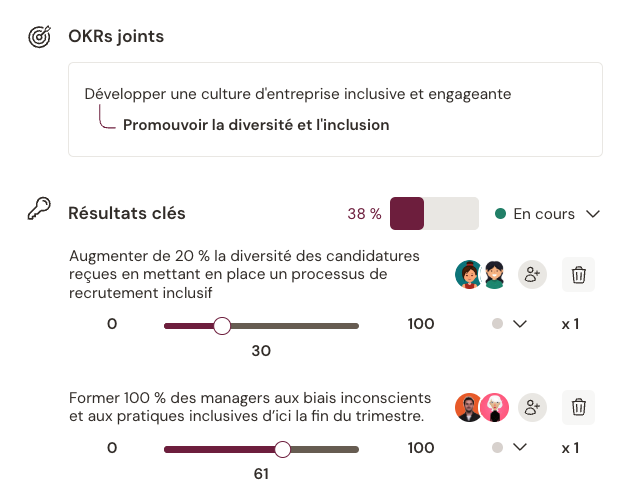
Finally, do not forget to communicate with your team. Regular, open dialogue is what keeps everyone moving in the same direction.
2. Identify the tasks to be completed
Once your team objectives are aligned with those of your organisation, the next step is to identify the tasks and responsibilities that will get you there.
Start by breaking each objective down into actionable tasks. That breakdown should be clear and detailed, so that each task is directly linked to a key result. Involving your team in the exercise is essential: they see aspects of the work you will miss, and it is how you build employee buy-in.
To structure this step and leave nothing out, you can build a responsibility checklist covering:
- a description of the task,
- the objectives and key results it serves, at team level and at organisation level,
- the skills required to carry it out,
- and the resources and tools needed to complete it.
3. Create roles aligned with your objectives
Now that your objectives are broken down into specific tasks, it is time to define the roles and responsibilities that will help you reach them. The point is to design roles that match what the organisation needs, while also empowering your employees and supporting their professional development.
First, let us be clear about what a role is. Unlike a traditional job description, which lists general duties once and for all, a role is a set of responsibilities aligned with precise objectives. A role should include:
- a purpose explaining why the role exists,
- clear responsibilities,
- the skills required to fulfil those responsibilities,
- and any other information the team needs (related policies, performance criteria, pay level, and so on).
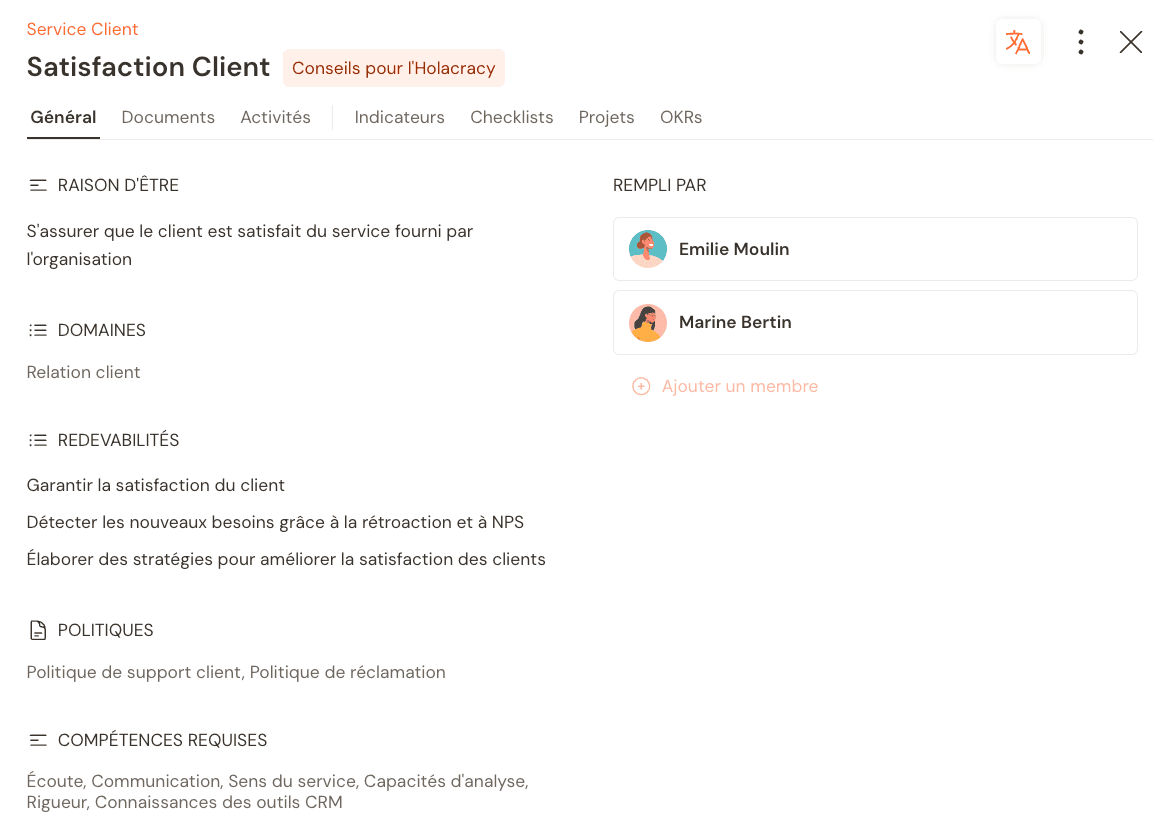
To make sure roles are well defined and well understood, run collaborative workshops with your team. These sessions let everyone co-build, refine and clarify the roles, while taking each person’s skills and career aspirations into account.
During the workshop, use the responsibility checklist to attach every task to a specific role. Avoid overlapping tasks between roles, unless the overlap is genuinely there to support collaboration.
4. Assign roles and responsibilities
A clear split of roles is what drives both performance and satisfaction inside the team. Here is how Talkspirit helps you define your teams’ roles and responsibilities, and give them visibility across the company.
Start by assessing the skills, experience and career aspirations of each person, so you can see who is best placed to energise the roles your organisation needs. That is how you give people a role they can grow into, and through which they contribute fully to the mission.
Encourage your team members to volunteer for the roles that interest them. Talkspirit makes this simple: employees can apply for a role, or nominate a colleague they believe fits it. The proposal then goes to the rest of the team through a consent-based decision process: if everyone votes in favour or abstains, the proposal passes. If one person objects, it has to be amended before going back to the vote.
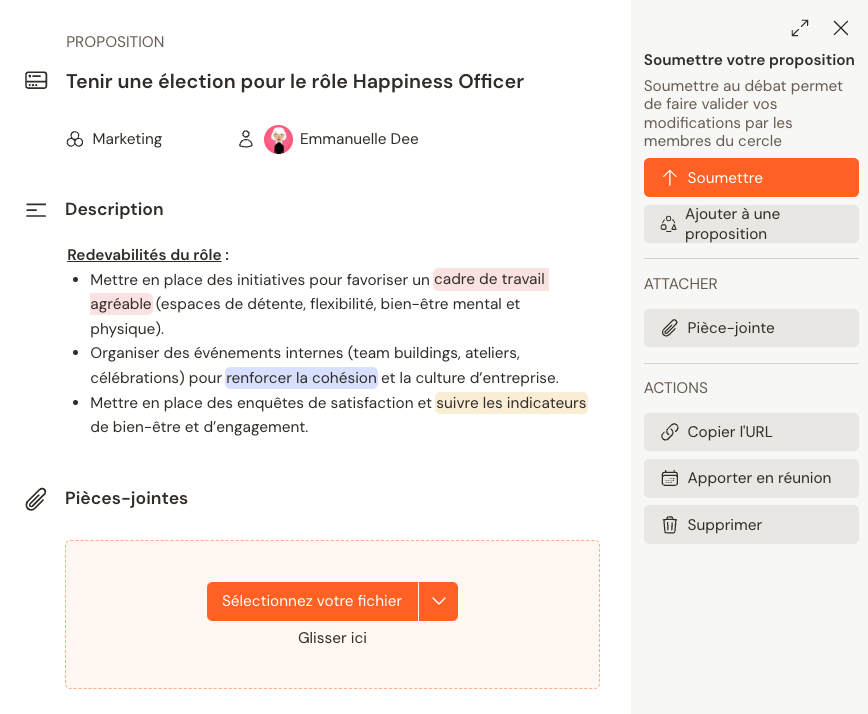
If some roles cannot be filled internally, consider hiring externally. Just make sure new joiners bring the specific skills needed to keep the team strategically aligned.
And when a role is complex, you can assign several people to it. In that case, spell out who is responsible for what, so tasks do not overlap.
Clarify who does what on a task with the RACI matrix
Assigning a role settles the question for the long run. What remains are the one-off pieces of work: a project, a single decision, a file that crosses several teams. The RACI matrix is a useful complement there. Where a role carries standing responsibilities, RACI splits a given task into four ways of being involved.
| Letter | Who it is | The question it answers |
|---|---|---|
| LetterR, responsible | Who it isThe person, or people, who carry out the task. | The question it answersWho does the work? |
| LetterA, accountable | Who it isThe one who decides and answers for the outcome. Only one per task. | The question it answersWho decides, and who answers for it? |
| LetterC, consulted | Who it isThose whose input is gathered before the decision is made. | The question it answersWhose opinion is sought? |
| LetterI, informed | Who it isThose kept up to date on the outcome, without taking part in the decision. | The question it answersWho needs to know? |
The rule that makes the difference: one accountable person per task. As soon as there are two, nobody decides and the bottleneck comes back. And a RACI matrix does not replace roles: it says who does what on one subject, not what each person is responsible for day to day.
5. Map roles and responsibilities in a dedicated tool
Once roles and responsibilities are defined and assigned to the right people, map them clearly onto your organisational structure. That map lets everyone understand their place in the whole, and it strengthens the accountability of team members. Leaders are the first ones concerned by that shift, which is the subject of our article Blind Spots: The CEO and the Team’s Accountability.
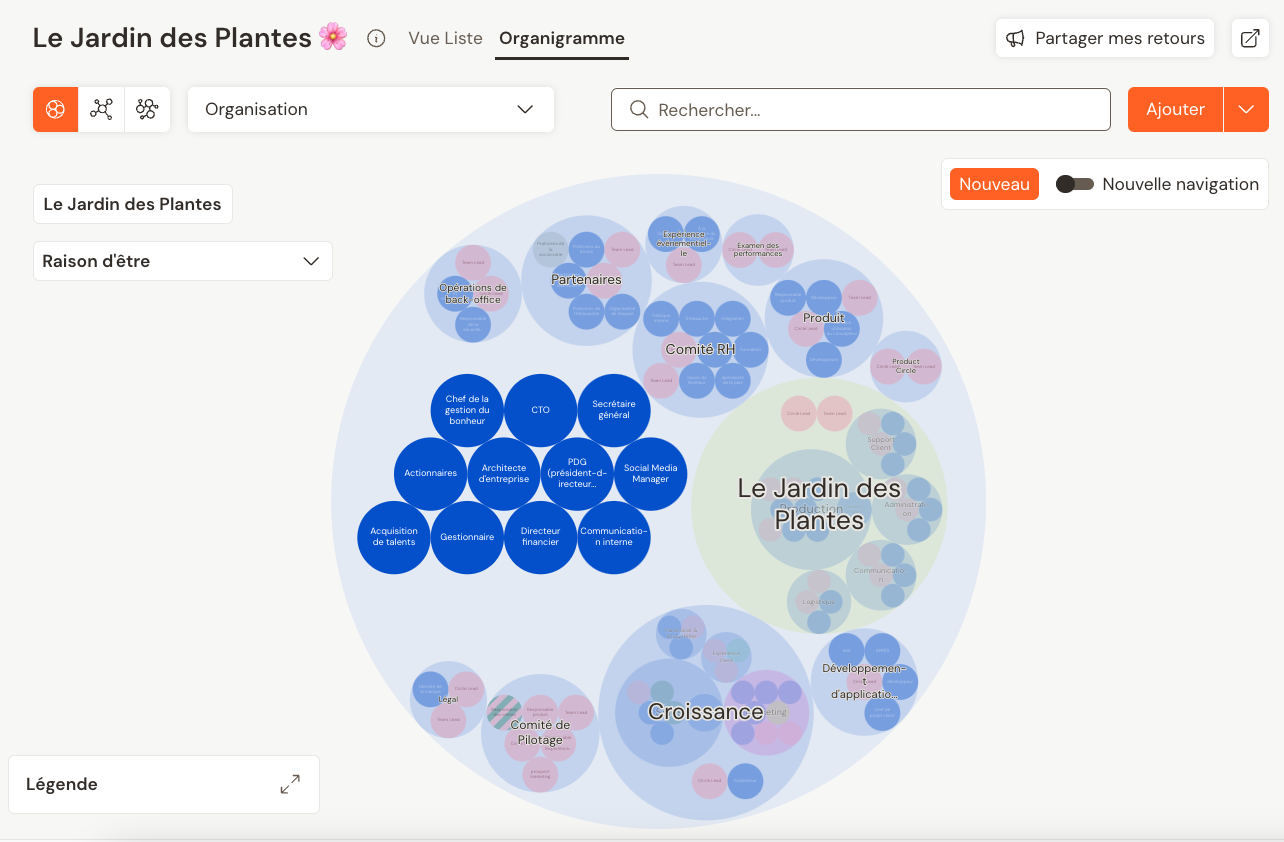
Build an org chart to show visually how each role and its responsibilities fit into your organisation. You will then be able to see who is responsible for what, who depends on whom, and how roles interact.
Talkspirit’s dynamic org chart does more than record roles and responsibilities: it shows how they are spread across the company. Several views are available:
- Holarchy: nested circles. Each circle is a team, itself made of sub-circles for the team’s roles. This view is the one used by companies running Holacracy or Sociocracy.
- Team network: the main circles sit at the centre, surrounded by satellite teams. Ideal for networked organisations, or for flat and horizontal structures.
- Role relationships: this view maps the internal relationships between roles. It is particularly useful for visualising workflows and cross-team interactions.

6. Set up clear collaborative processes
Roles and responsibilities are now defined and mapped. Your work does not stop there. To keep your team’s actions properly coordinated, you need transparent collaboration and decision-making processes.
Deciding who holds the authority to decide in each area of the organisation is what removes bottlenecks and speeds decisions up. So spell out the decision-making power each role holds, and the subjects it can rule on. Concentrate that authority on a handful of people and you end up producing decision fatigue: distributing decision-making power is also a way of protecting the ability to decide.
Involve the right people in the decision process: not only those who will implement the decision, but also those it directly affects. Then choose the decision-making process you want to apply, for example:
- consensus, which requires the agreement of every stakeholder,
- or consent, which lets a decision pass as long as no major objection is raised.
Hold regular triage meetings to keep teams aligned, and governance meetings to keep your structure and your ways of working evolving. Set a suitable frequency and precise goals for each session, so the time is well spent.
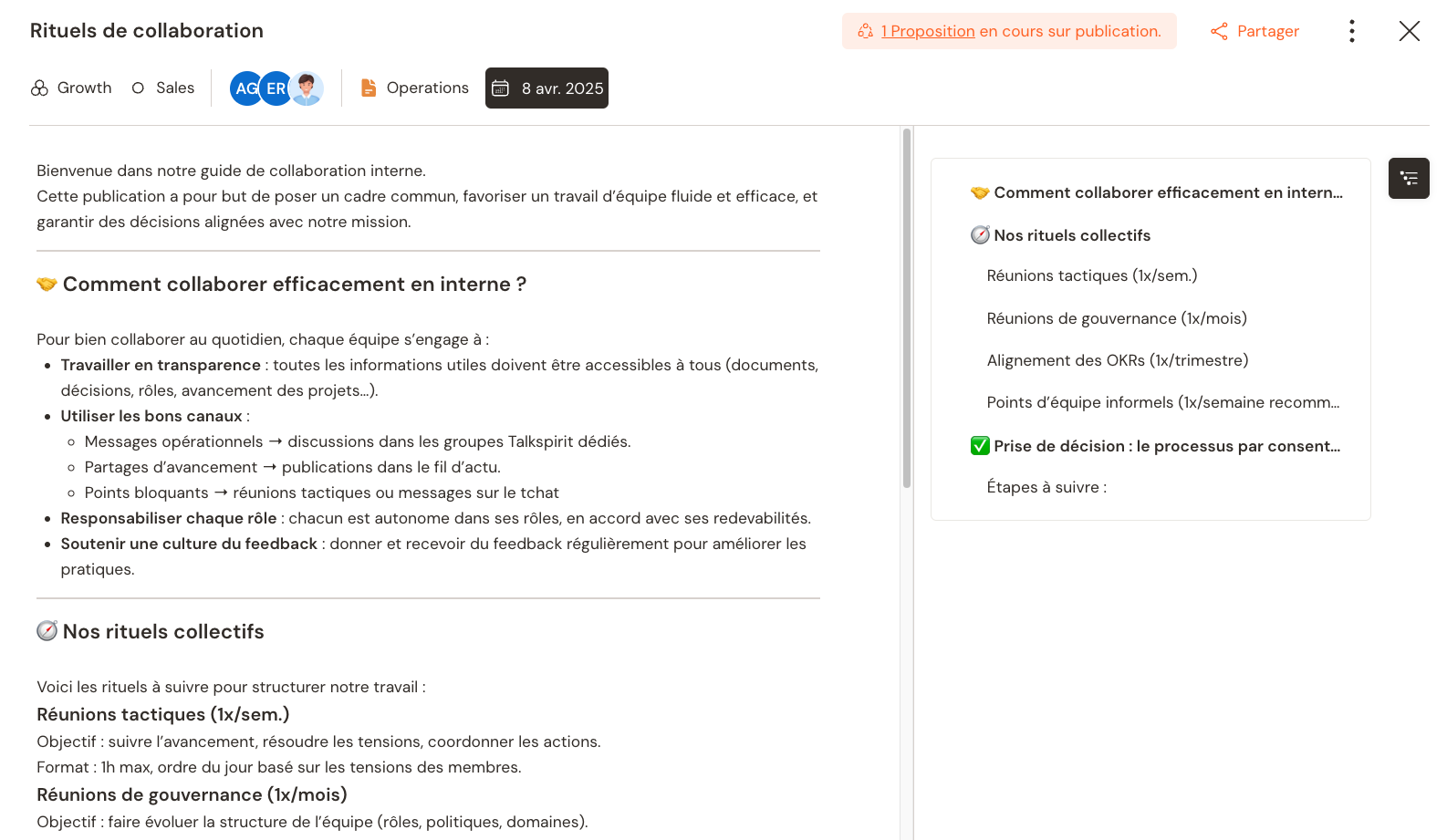
Use Talkspirit to document your collaboration rituals and decision-making processes. Our governance platform lets you create rich posts and organise them by category, so you clearly separate types of content (processes, internal policies, standards, strategy) from the themes they belong to (HR, governance, operations, and so on).
7. Keep roles updated regularly
To keep your organisation agile as strategic objectives shift, you need to update and redefine roles and responsibilities regularly.
Draw on performance reviews, team feedback, and the OKRs and KPIs you have set, to judge whether each role still answers the needs of the organisation and, where it does not, identify the adjustments to make.
Involve your team members in that review. It keeps the changes relevant, and it brings people into the change management process instead of leaving them on the receiving end.
With Talkspirit, you can update roles and responsibilities in real time and give your team instant access to the latest version. That continuous record is also a serious asset for onboarding new employees, who find their feet far more quickly with it.
Conclusion
We have gone through the best practices for defining your team’s roles and responsibilities. From strategic alignment to keeping roles up to date, every step counts if you want effective and agile teams.
Managers play a decisive part in this: by leading through example and fostering a culture of transparency and accountability, they help their teams understand their roles and thrive in their work.
At Talkspirit, we know how hard it is to define roles and responsibilities when teams operate in a constantly shifting environment. That is why we built an agile platform that takes that reality into account. Whether you are laying the foundations or optimising an existing structure, our experts are here to help. Get in touch to discuss your project and identify the right solutions for your needs.
One last thing: defining roles and responsibilities is often the first step towards a transparent organisation. Going further means clarifying your management and governance models too, which usually means adopting a framework that fits, such as Holacracy, Agile or the Teal organisation.
How do you choose the right model for your company? And above all, how do you make it last? Download our white paper to discover 8 organisational models, and how they can help you define roles and responsibilities in your company 👇
Access the White Paper
In “The Ultimate Guide to Organisational Models”, you will discover:
- Innovative organisational models (Agile, the Teal organisation, Holacracy and Constitutional Management),
- Testimonials from organisations that adopted them successfully,
- Advice on choosing, implementing and measuring the effectiveness of your model,
- The best tools to lead change smoothly.

FAQ
Duplicated work, first of all: two colleagues can spend a whole week on the same report with no coordination. The result is precious time lost, frustration, and confusion across the team.
A role is a set of responsibilities aligned with precise objectives, where a job description lists general duties once and for all. A role carries a purpose, clear responsibilities and the skills they require; it changes as objectives change, and one person can hold several roles at once.
With strategy. Before defining anyone’s roles and responsibilities, align your team’s strategy with the ambitions and the purpose of your organisation. That alignment makes sure every action feeds the company mission instead of scattering effort.
Start from the people, not from the org chart. Assess each person’s skills, experience and career aspirations to see who can energise the roles your organisation needs, and let team members volunteer for the roles that interest them.
It splits a single task into four ways of being involved: responsible (does the work), accountable (decides and answers for the outcome), consulted (gives input beforehand) and informed (is kept up to date). It complements roles on one-off work, and it only holds if there is exactly one accountable person per task.
Regularly, and on tangible evidence: use performance reviews, team feedback, and the OKRs and KPIs you have set to judge whether each role still answers the needs of the organisation. Involve the people concerned in that review.


.webp)