Définir les rôles au sein de votre organisation
.svg)
L’ancienne hiérarchie nous a appris (moi y compris) que les intitulés de poste ronflants et pompeux sont une marque de pouvoir. Mais que se passerait-il si nous supprimions les intitulés de poste pour les transformer en rôles, et si nous en clarifiions les responsabilités ?
Dans cet article, nous vous donnons de précieux conseils pour définir des rôles et clarifier les responsabilités de chaque membre d’une organisation :
Nous verrons :
- Ce que sont les titres de poste et comment ils freinent la croissance
- Ce que sont les rôles, les responsabilités et la raison d’être
- Un guide pour clarifier/définir les rôles au sein de l’organisation

Que sont les titres de poste et entravent-ils la croissance ?
Si nous cherchons la signification d’un intitulé de poste, nous trouvons : « désignation spécifique d’un poste au sein d’une organisation, normalement associée à une description de poste qui détaille les tâches et les responsabilités qui l’accompagnent. » Une fois posé ce qui caractérise un intitulé de poste et sa description, combien d’entre vous ont accepté un poste pour son intitulé, et non pour son salaire ou parce qu’il apporterait de la satisfaction à votre évolution professionnelle ?
Moi, oui : je plaide coupable ! J’ai accepté des postes aux intitulés grandiloquents uniquement pour l’apparence et pour l’ego, en pensant que cela m’ouvrirait des portes et des possibilités en chemin. Mais est-ce que je faisais vraiment mon travail et ce qu’il exigeait ? Pas vraiment. La plupart du temps, je jonglais entre plusieurs tâches pour mener une mission à bien. Les intitulés de poste peuvent devenir flous si l’organisation n’est pas claire et proactive dans la clarification des rôles et des responsabilités dès le début.
%252520(1).jpeg)
Selon un article, les intitulés de poste ne sont que des cartes de validation de qui nous sommes, « sans avoir à expliquer ce que nous faisons ». Une enquête menée auprès de 1 500 travailleurs a conclu que 70 % d’entre eux préféreraient un meilleur intitulé de poste à une augmentation de salaire. Et qu’est-ce que cela révèle de notre culture du travail et de notre ancienne hiérarchie ? Cela montre à quel point nous accordons de l’importance aux apparences plutôt qu’à l’épanouissement personnel et professionnel. Nous nous concentrons sur la façon dont nous serons perçus dans notre secteur, plutôt que sur ce que nous apportons réellement, avec nos compétences et nos connaissances, pour mener la mission à bien.
Anne-Laure Le Cunff raconte son expérience dans un article sur ce que représentait le fait de travailler chez Google et sur les attentes qui y régnaient, et elle explique comment les intitulés de poste peuvent devenir un signe de vanité et d’apparence. Elle déclare : « Quand j’ai commencé à travailler chez Google, on m’a rapidement présenté l’échelle des postes qui s’est depuis généralisée dans le secteur de la tech. Selon le premier poste que vous y occupez, vous êtes affecté à une échelle particulière, avec des accomplissements fixes à démontrer pour grimper au niveau suivant. » Le Cunff poursuit : « Elles sont comme une liste de contrôle des accomplissements que vous devez démontrer à votre manager et à vos pairs. Le problème avec les grilles d’évaluation (outre le fait que beaucoup sont mal conçues), c’est qu’elles encouragent à entrer dans un moule qui n’évolue pas avec les exigences sans cesse changeantes de l’entreprise. Les gens finissent par faire ce qui aura l’air bien plutôt que ce qui est réellement bien. »
Alors, les intitulés de poste limitent-ils notre développement et bloquent-ils notre potentiel, c’est-à-dire tout ce que nous pourrions faire au sein d’une organisation ? Peut-être que oui, peut-être que non. Mais si vous pensez que les intitulés de poste bloquent effectivement la croissance et le potentiel, vous êtes au bon endroit : nous allons maintenant vous expliquer comment passer des intitulés de poste aux rôles, et comment les clarifier.
Que sont les rôles, les responsabilités et la raison d’être ?
Les rôles représentent, dit-on, les activités exercées au sein d’une organisation. Ils sont les briques de base d’une entreprise, et chaque rôle est attribué à une personne de l’organisation.
Par exemple :
- Spécialiste Contenu
- Spécialiste Web
- Relations publiques
Les responsabilités sont l’ensemble des attentes qui accompagnent chaque rôle.
Par exemple :
- Organiser un webinaire chaque mois
- Produire du contenu de haute qualité chaque semaine
- Interagir avec les bons médias pour un résultat percutant
La raison d’être est l’objectif poursuivi et/ou le potentiel du rôle à réaliser au sein de l’organisation.
Par exemple :
- Améliorer la visibilité du contenu
- Attirer/augmenter le nombre de nouveaux prospects sur le site
- Contenu bien rédigé en deux langues
Et comment cela fonctionne-t-il dans l’Holacracy?
Une même personne peut occuper plusieurs rôles, et un même rôle peut être occupé par plusieurs membres de l’équipe.
Cependant, voici des points à garder à l’esprit lorsqu’on occupe des rôles assortis d’un ensemble d’autorités :
- Autorité pour exécuter toute action que le membre juge appropriée au regard de la raison d’être et de la mission du ou des rôles
- Droit de contrôler/réguler toute question concernant votre ou vos rôle(s)
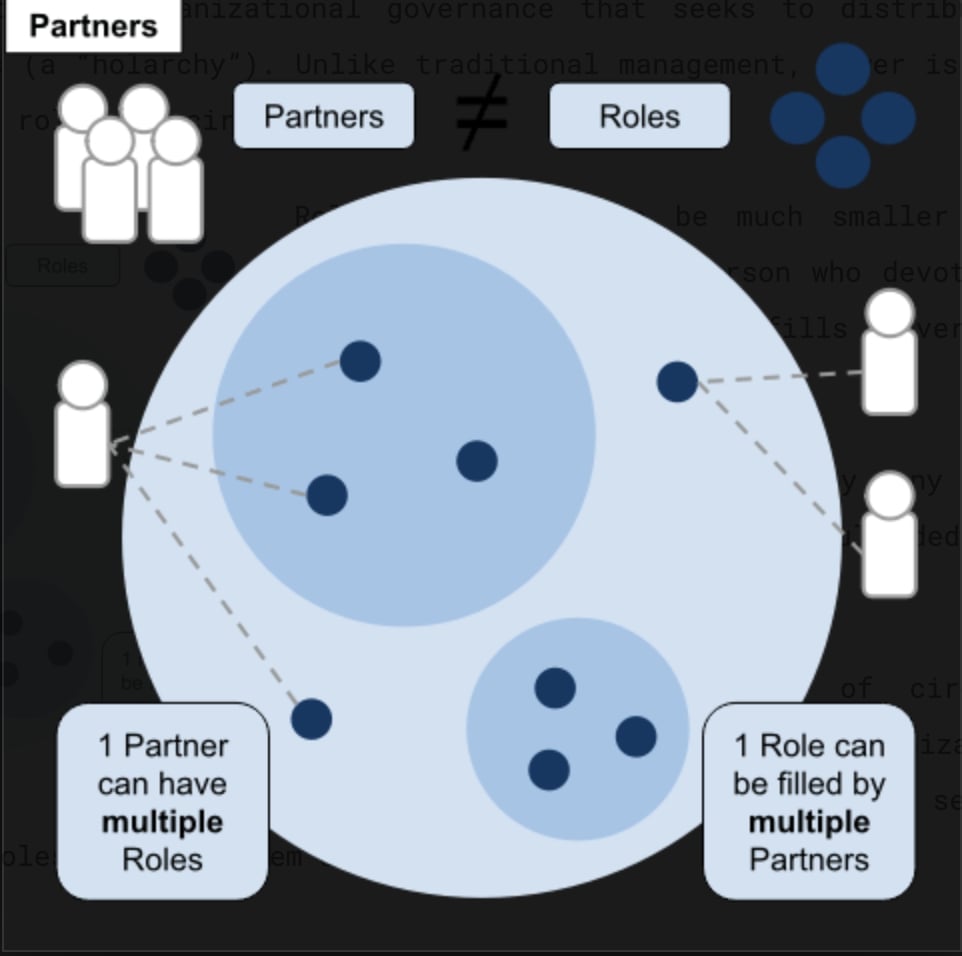
image tirée de Target Teal
Comment définir des rôles efficaces au sein de votre organisation ?
Clarifier les rôles et définir les responsabilités est essentiel dès le départ pour le membre de l’équipe concerné. Non seulement cela améliore la communication au sein de l’organisation, mais cela trace aussi une voie claire pour votre collègue sur ce qu’il devra accomplir à l’avenir. Cela renforce également le niveau de productivité et la performance de l’équipe.
1. Clarifier le rôle
On pourrait croire qu’il suffit de distribuer des rôles et des descriptions de rôles, mais ce n’est vraiment pas si simple. Lorsque vous attribuez un rôle ou une tâche à un membre de l’équipe, assurez-vous que la formulation est claire et facile à comprendre pour toute personne concernée par ce rôle.
2. Expliquer la raison d’être du rôle
Donner une brève explication sur l’importance du rôle peut apporter de la clarté et une prise de conscience à la personne assignée à ce rôle spécifique. Offrir un aperçu rapide de pourquoi et comment ce rôle spécifique joue une part vitale dans l’ensemble du processus et/ou de l’organisation peut également aider vos collègues à mieux comprendre pour de meilleures performances.
3. Vérifier la compréhension du rôle
Nous pensons parfois que nos explications et notre manière de les transmettre sont claires pour tout le monde. Erreur ! Nous avons tous des façons différentes de comprendre une tâche, un rôle ou un objectif : assurez-vous donc que chacun est sur la bonne voie en matière de compréhension du rôle. Et comment faire ? Faites un point de suivi avec le membre de l’équipe, laissez-le vous montrer comment il procède, ou faites-lui savoir que vous restez disponible pour répondre à ses questions si besoin.
4. Expliquer les priorités et les responsabilités du rôle
Comme nous l’avons dit plus haut, les rôles s’accompagnent d’un ensemble de responsabilités, d’objectifs, de buts et bien plus encore. Lorsque vous les attribuez à un ou plusieurs collègues, veillez à ce que tout soit clair et transparent. La transparence est la clé d’une meilleure performance d’équipe. Énoncez clairement les priorités et discutez-en avec la personne concernée, afin qu’elle comprenne quel est l’objectif final du rôle et tout ce qu’il implique.
Comment garder vos rôles visibles et structurés avec Holaspirit?
Chaque organisation a sa propre manière de clarifier les rôles et de gérer la transparence et la visibilité au sein de l’équipe. Cela dit, tenir à jour un tableau visible et visuel de la place de chaque membre de l’équipe dans les cercles et les responsabilités ne peut qu’aider l’organisation à rester structurée, autogérée et dotée d’une bonne communication.
La clarification des rôles doit permettre de déterminer assez précisément qui peut prendre quelle décision, et qui est responsable lorsqu’une décision n’est pas suivie ou lorsque des actions ne sont pas mises en œuvre.
La page d’accueil Chart vous donne une structure de votre organisation basée sur les rôles et les cercles. Votre organisation affiche plus ou moins de cercles et de rôles selon sa complexité.
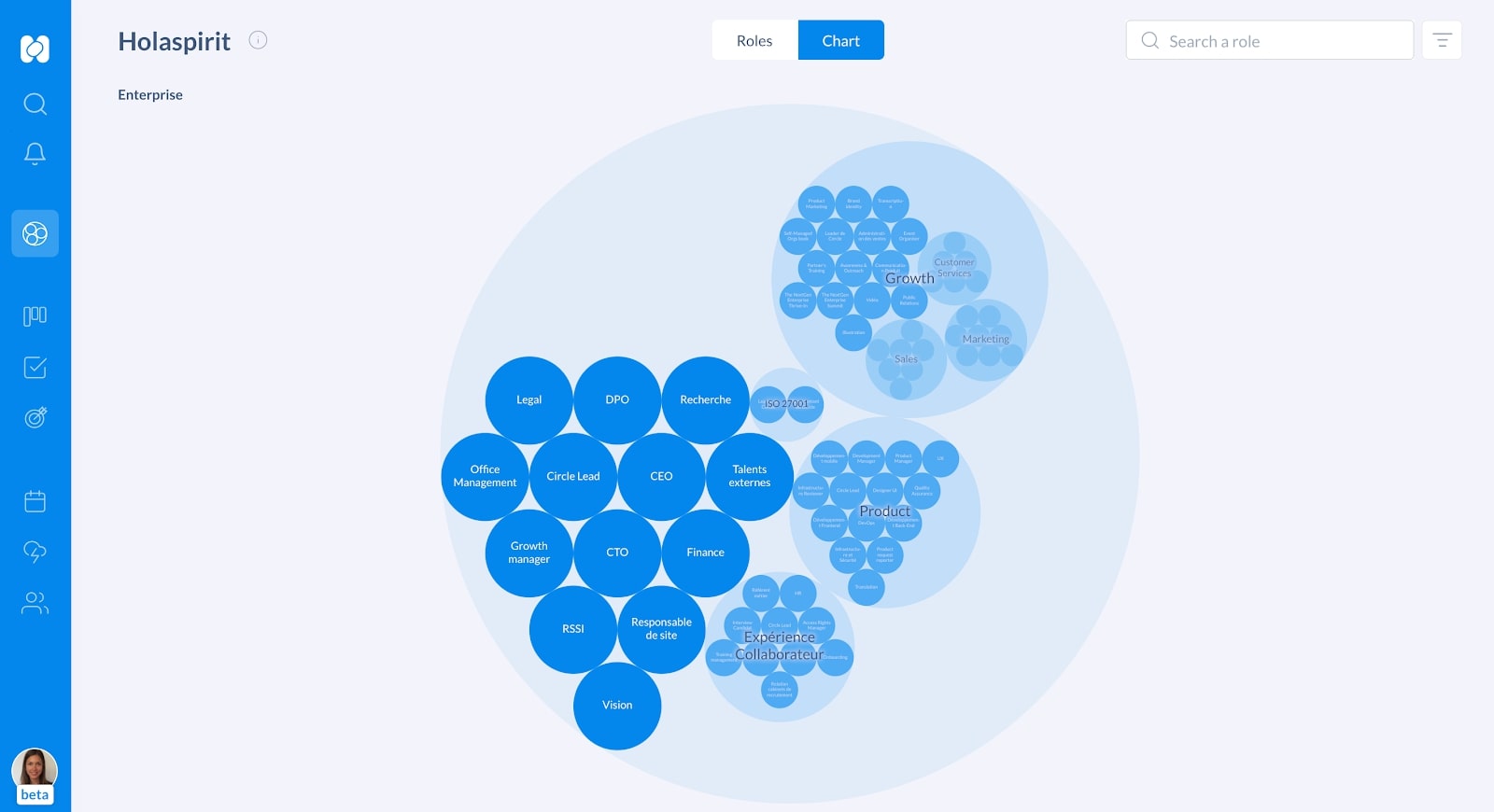
Note : la taille du cercle dépend de la position du rôle dans la hiérarchie et du nombre de rôles qu’il contient.
Comment naviguer entre les rôles dans votre organisation ?
Dans le menu des rôles, vous trouverez tous les rôles documentés pour votre organisation.
.jpeg)
Depuis le menu chart, vous pouvez :
- Cliquer n’importe où à l’intérieur d’un cercle (mais pas directement sur un rôle) pour zoomer et dézoomer sur votre chart.
- Vous pouvez naviguer vers tous les rôles qu’il contient. Cela vous aidera à identifier « qui fait quoi » de manière claire ! Facilitant la compréhension du fonctionnement. Pour afficher les détails d’un cercle ou d’un rôle, passez simplement votre souris sur le nom du cercle ou du rôle et cliquez dessus : les informations s’afficheront sur le côté.
- Pour revenir à la vue Chart, cliquez simplement sur le « X » dans le coin supérieur droit.
- Utilisez l’option de recherche et de tri en haut à droite de votre écran pour trouver directement ce que vous cherchez sur le chart.
- Utilisez la recherche globale si vous souhaitez obtenir une liste de résultats
Vous souhaitez savoir comment définir des rôles et des responsabilités sur une plateforme d’autogestion comme Holaspirit ?Réservez un appel avec notre équipe !
Comment les modèles organisationnels peuvent-ils vous aider à définir des rôles clairs ?
Les modèles organisationnels comme l’Holacracy, la Sociocratie ou Teal offrent un cadre clair pour définir les rôles et les responsabilités dans votre organisation. Donc si vous cherchez à rendre votre entreprise plus transparente, la mise en œuvre d’un modèle organisationnel devrait être l’une de vos priorités. Alors comment choisir et mettre en œuvre le bon modèle organisationnel ? Et comment assurer son succès dans le temps ? Téléchargez notre dernier livre blanc pour obtenir toutes les réponses 👇
Accéder au livre blanc
Dans notre livre blanc « Le guide ultime des modèles organisationnels », vous trouverez : un aperçu complet des modèles organisationnels innovants (comme Agile, Teal, Holacracy, le Management Constitutionnel, et d’autres), des témoignages d’organisations pionnières qui les ont adoptés avec succès, les meilleures pratiques pour choisir, mettre en œuvre et mesurer l’efficacité de votre modèle, ainsi que des outils numériques pour faciliter la transition.