
What Drives Company Performance?

.svg)
- Company performance is the degree to which an organisation reaches its objectives. It combines effectiveness, hitting the result, and efficiency, hitting it without waste.
- It is read across five dimensions: economic and financial, operational, commercial, social and environmental. A summary table sets them side by side with their indicators.
- First lever: the employee experience, through wellbeing at work and engagement. In 2021, 43% of companies had launched actions on it.
- Second lever: internal communication and collaboration. A 2019 Mitel survey puts the cost of getting them wrong at over €9,000 per employee per year in France.
- Third lever: an agile and transparent organisation. The 2017 Agile Performer Index found agile companies 2.7 times more successful than their peers.
- Fourth lever: tools that fit the business, then measurement. OKRs set the objectives, per-dimension indicators show where the gap is widening.
On the road to better performance, which route will you choose? 🤔 If you’re on a quest for growth and success, it’s important to take the right road! Performance isn’t just a destination, it’s a journey dotted with strategic decisions and levers to pull. What are the main levers that drive company performance? How can we best understand and analyze performance? In this article, discover the keys to proven gains in productivity! 🏆
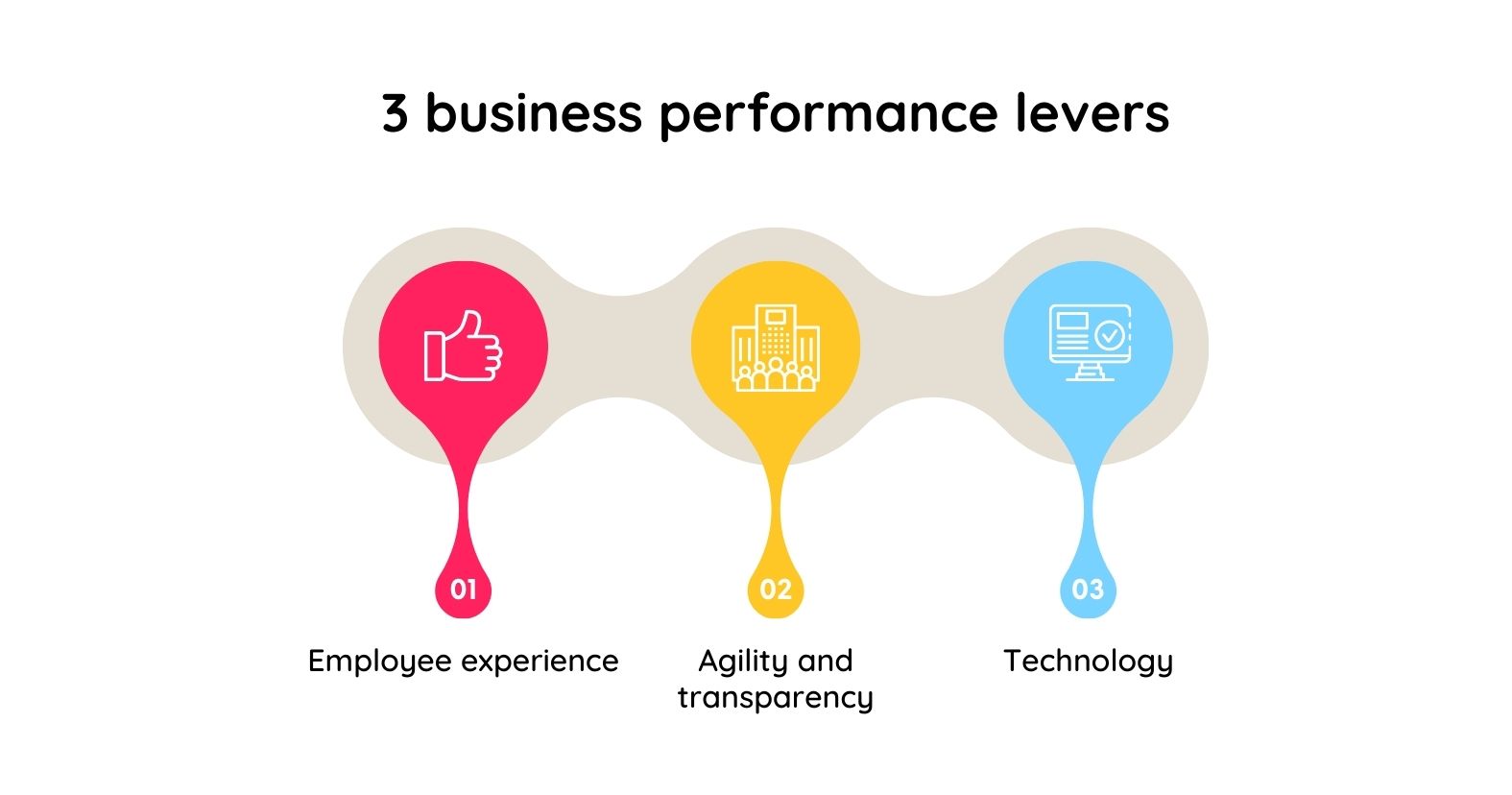
What is company performance?
Company performance is the degree to which an organisation reaches the objectives it has set itself. Two ideas sit behind it: effectiveness, hitting the intended result, and efficiency, hitting it while consuming as few resources as possible. A team that delivers its objective but takes twice as long as it should is effective, not efficient.
Performance therefore is not only a financial result. It is read across several dimensions, grouped under the heading of overall performance: economic and financial, operational, commercial, social and environmental. The levers below act mainly on the operational and social dimensions, the two an organisation actually controls day to day. Performance management is the discipline of pulling them together rather than one at a time.
Top-notch employee experience!
In the quest for optimizing company performance and success, the employee experience is essential. This means creating a work environment where trust reigns, modern tools smoothen work flow, and above all, a team where everyone feels important. Companies have understood this: in 2021, 43% of them have launched actions to improve the employee experience, a significant jump on the 25% of the previous year.
Well-being at work
To boost your company’s performance, turn to QWL! If these 3 letters don’t yet mean anything to you, you may have missed an episode… 😴 We’re talking here about Quality of Work Life, or wellbeing in the workplace, concepts essential to a company’s success. To achieve this, you can set up a program to raise awareness of psychosocial risks and offer your employees a healthy, balanced working environment. It’s a winning bet for improving overall company performance! According to a study by Harvard and MIT published in 2011, happy employees are on average 31% more productive!
Employee commitment
An employee who feels good is also an employee who wants to commit to his or her company. But for this to happen, you need several components. For example: freeing up feedback, congratulating and rewarding successes, applying a management style based on trust… These are just a few of the ways of valuing and giving meaning to your employees’ daily work.
In this way, you develop a genuine sense of belonging. This fosters strong, lasting commitment. 🤝 And commitment is one of a company’s key performance levers!
The 2 Cs: communication and collaboration
“All companies have to communicate and collaborate in order to function,” you might say. But did you know that to achieve better results, you need to reinvent the way you work? Get ready for change!
According to a 2019 Mitel survey, French companies lose over €9,000 per employee a year due to ineffective collaboration and internal communication. To avoid this, optimize the way you work!
Say goodbye to internal mail and scattered information. Opt instead for chat, news feeds and groups. Internal communication is clearer and reaches the right targets, fostering commitment and facilitating collaboration.
Effective collaboration, on the other hand, is about merging individual skills to achieve common goals. As you can see, communication and collaboration are inseparable levers for improving a company’s performance! ☝️
Are you seeking an all-in-one solution to communicate and collaborate more effectively? If so, meet Talkspirit! Our platform offers you incredible functionality that combines chatting, videoconferencing, information sharing, project management, and much more.
A more agile and transparent organization
To improve company performance, you also need to optimize your internal organization.
Agility is a highly beneficial approach! According to the Agile Performer Index, published in 2017 by Neoma and goetzpartners, agile companies are 2.7 times more successful than others.
How can you become an agile company? All it takes is flexibility, fast decision-making processes, and an innovative mindset. The longer the road, the more pitfalls you’ll likely encounter. But the ability to adapt quickly to change means you can not only seize more opportunities but also reduce risks. With that perspective, speed on towards performance! 🚀
Internal organization also includes the culture on which the company is built. For example, a transparent culture is one of the most attractive performance drivers! It’s characterized by an environment where communication is open, honest, and accessible at all levels. This strengthens individual and collective accountability, creates synergy, and encourages initiative. That’s the perfect recipe for boosting your teams’ performance. Platforms such as Holaspirit are invaluable allies in building and promoting this culture. This is what our CEO Philippe Pinault shares with you in this video. 👇
Technologies tailored to your needs
Choose the right tool
To be successful, you need to stay at the cutting edge of emerging technology. The world is changing, so why shouldn’t you? Break out of your routine and explore what’s newly available that can revolutionize the way you work! Choosing the right tool is the key to boosting company performance. A cloud storage solution? Self-management tools? An intranet? An enterprise social network? Perhaps even all of the above? 🤔 Adopting a solution tailored to your business can optimize your work processes and enhance the employee or customer experience.
👉 Have a look at our list of the best collaboration software to find your company’s next performance levers.
Know how to measure and analyze performance
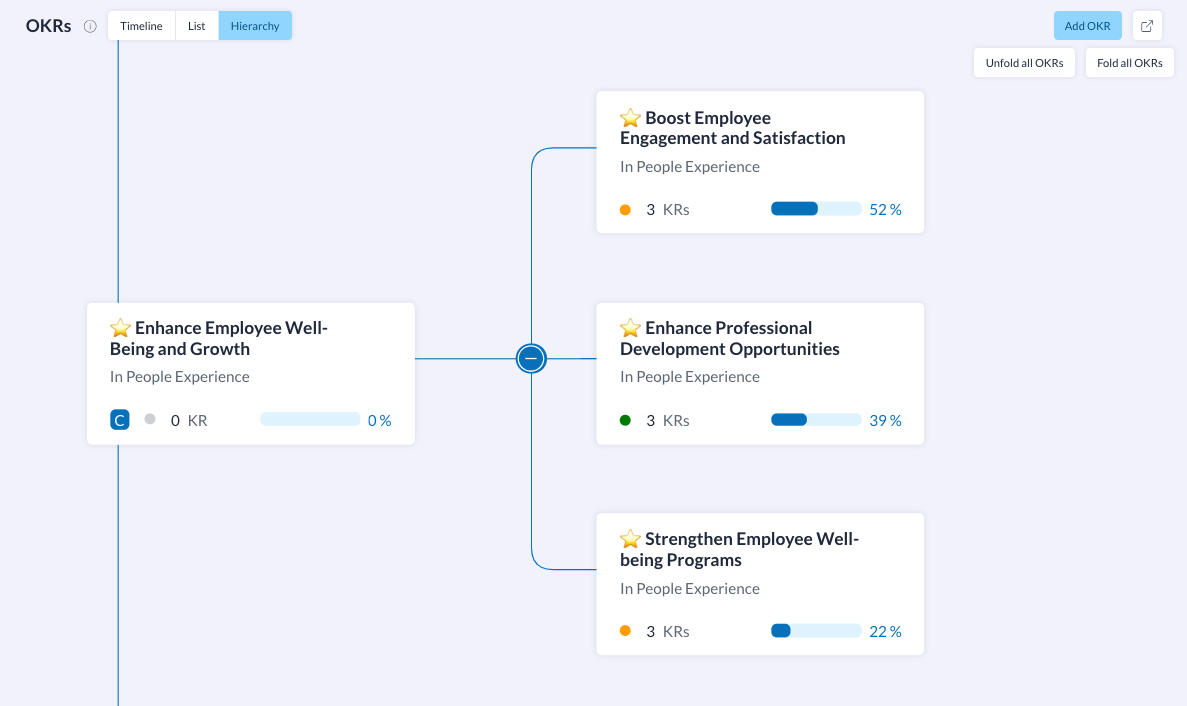
First of all, you need to have clear objectives. At Talkspirit, we use the OKR (Objective and Key Results) method to identify and track company and team objectives. This method associates each objective with ambitious key results to be achieved over a given period. To sidestep the most common mistakes, read our guide to using OKRs for project management.
Then get out the magnifying glasses, it’s time for analysis! 🔍 Pinpoint your company’s strengths and weaknesses by looking at the level of achievement of your OKRs. That way, you’ll be able to determine which teams need a little help and make better informed strategic decisions. Round the picture out with a few indicators per dimension, for instance the internal communication KPIs on the social side.
Activating these performance levers for your company is not trivial… To support your approach, you can opt for specific software. For example, our platform Holaspirit offers an OKR module for setting ambitious performance targets. 📈
To keep the whole picture in view, here are the five dimensions of performance, what each one measures and the indicators used to track it. No single lever moves them all at once, so start with the dimension where the gap is widest.
| Dimension | What it measures | Example indicators |
|---|---|---|
| DimensionEconomic and financial | What it measuresHow profitable and solid the business model is | Example indicatorsRevenue, margin, net profit, return on investment |
| DimensionOperational | What it measuresHow efficient processes and the organisation are | Example indicatorsCycle time, error rate, on-time delivery, output per team |
| DimensionCommercial | What it measuresThe ability to win and keep customers | Example indicatorsConversion rate, retention rate, customer satisfaction |
| DimensionSocial | What it measuresEmployee engagement and working conditions | Example indicatorsEngagement rate, turnover, absenteeism, eNPS |
| DimensionEnvironmental | What it measuresThe footprint of the activity | Example indicatorsCO2 emissions, energy consumption, share of waste recovered |
A final word
Now you better understand the main levers of business performance! By using these levers effectively, you can offer your company a new internal organization and boost productivity!
Want to discover another way to improve your company’s performance? Read our white paper on psychological safety👇
Access the White Paper
Discover methods and tools in this white paper to measure your team’s psychological safety, plus find an example of a participative workshop to involve your employees in the company’s strategy as well as a testimonial from a company that’s adopted this methodology.
FAQ
It is the degree to which a company reaches the objectives it has set itself. It goes well beyond the financial result: performance is read across five dimensions, economic and financial, operational, commercial, social and environmental, which together make up overall performance.
Four families of levers come up again and again: the employee experience, including wellbeing at work and engagement; internal communication and collaboration; an agile and transparent organisation; and tools chosen to fit the company’s own challenges. Measurement, through OKRs and a few indicators per dimension, then shows what actually moved.
Effectiveness is reaching the intended objective. Efficiency is reaching it with as few resources as possible, whether time, budget or effort. A team that delivers the expected result but takes twice as long as it should is effective without being efficient, and performance requires both.
Start from clear objectives. At Talkspirit we use the OKR method, which pairs every objective with ambitious key results to be reached over a set period. Add a handful of indicators per dimension: margin and return on the financial side, lead times and error rates on the operational side, engagement and turnover on the social side.
According to the Agile Performer Index published in 2017 by Neoma and goetzpartners, agile companies are 2.7 times more successful than others. Becoming agile means building in flexibility, adopting fast decision processes and encouraging a mindset that welcomes change.
A Mitel survey published in 2019 found that French companies lose more than €9,000 per employee every year because of ineffective collaboration and internal communication.


.webp)