
HR Trends, According to Gartner
.webp)
.svg)
- The most recent edition of Gartner’s HR priorities, published on 2 October 2025 from a July 2025 survey of 222 CHROs, sets out four priorities: harness AI to revolutionise HR, shape work in the human-machine era, mobilise leaders for growth in an uncertain world, and address culture atrophy.
- The value of AI comes not from the tool but from the redistribution of work it makes possible. Its governance conditions its acceptance: only 26% of candidates trust AI to evaluate them fairly.
- Only 32% of leaders say the last change they led was adopted healthily; organisations doing better than average report twice the year-on-year revenue growth rate.
- Only 47% of CHROs say their culture currently drives employee performance.
- Compared with the previous edition (15 October 2024, 1,403 HR leaders), AI moves from fifth place to first and leader and manager development disappears as a separate priority.
- Gartner refreshes these priorities every year, in October.
What are the top HR trends, according to Gartner? The most recent edition of the firm’s annual study of CHRO priorities was published on 2 October 2025. It draws on a July 2025 survey of 222 CHROs, and it puts realising the value of artificial intelligence at the top.
Gartner sets out four of them:
- Harness AI to revolutionise HR
- Shape work in the human-machine era
- Mobilise leaders for growth in an uncertain world
- Address culture atrophy to power performance
What does each of them cover? What has changed since the previous edition? And how do you turn them into a plan? Here is what to take away in order to improve the agility and the resilience of your HR function.
How often this is published: Gartner refreshes these priorities every year, in October. This page follows the most recent edition, and earlier editions remain available: the 2024 edition has its own article, and the previous one is covered further down.
The four HR priorities set out by Gartner
1. Harness AI to revolutionise HR
The first priority is not to adopt AI, it is to get something out of it. Gartner asks CHROs to put an HR-specific AI strategy in place and to evolve their operating model, rather than laying tools on top of unchanged processes.
The distinction matters in a mid-sized company, where every extra tool is paid for in administration: AI can improve productivity, but the value comes from the redistribution of work it makes possible, not from the tool. That is what makes the subject inseparable from the way work itself is changing.
Trust is the friction point. A Gartner survey published on 31 July 2025 shows that only 26% of candidates trust AI to evaluate them fairly, while 52% believe AI already screens their application. For a European software company and for its customers alike, AI governance (who decides what, on which data, with what human recourse) is therefore not an extra: it is the condition of its acceptance.
Best practice takeaways
- Set the objectives before choosing the tool. Gartner separates organisational objectives from HR objectives; the latter only matter if they serve the former.
- Write down the ground rules for AI: the permitted use cases, the data involved, and the decisions that stay human.
- Measure value, not adoption. The number of people using a tool says nothing about what it has earned you.
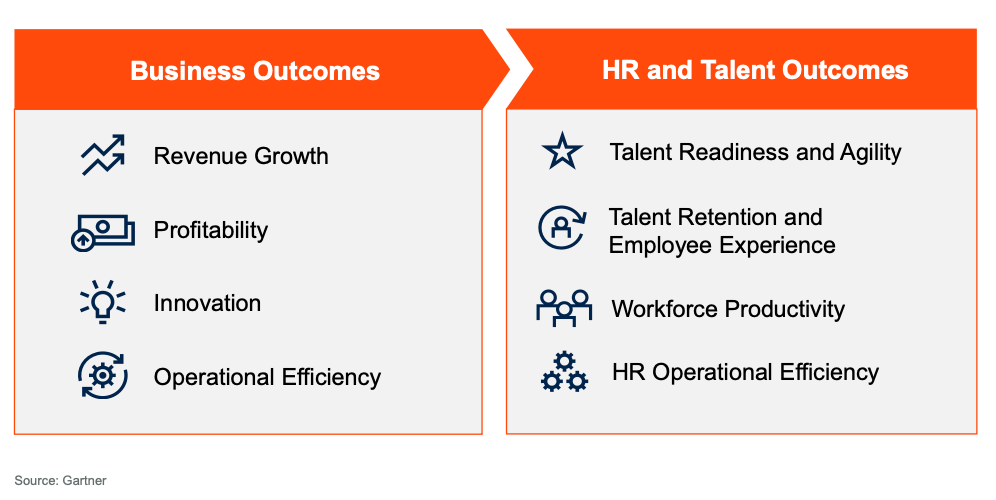
2. Shape work in the human-machine era
Second priority: deciding how work is shared between people and machines. Gartner invites CHROs to build a two-step talent strategy, an approach it calls now-next: get the most out of the skills available over the next twelve months, then aim for better outcomes over one to three years.
That first means knowing which skills you have, which is a matter of keeping skills management up to date, and accepting that ways of working change with it. It is also the level at which your ability to attract and retain talent is decided.
It is, finally, the Structure layer of an organisational operating system: documenting roles, responsibilities and objectives before automating anything, failing which AI automates a blur (which is what the Talkspirit Structure module is for).
Best practice takeaways
- Break the work into stages. For each one, identify the deliverables, the data used and the resources required, so that the return can be demonstrated.
- Pilot it in one department before rolling it out across the organisation.
- Prioritise on two criteria: the strategic relevance of the project, and your real capacity to deliver it.
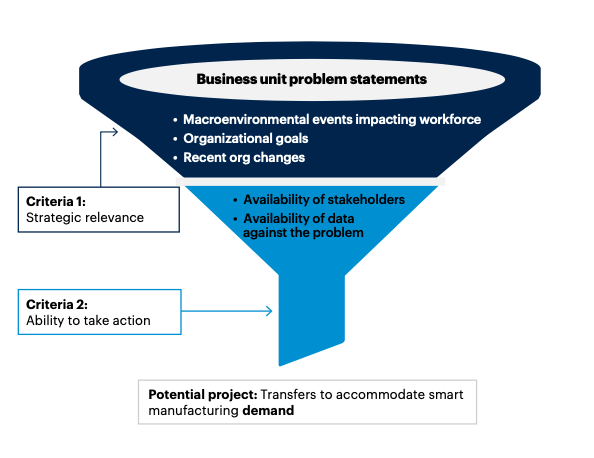
3. Mobilise leaders for growth in an uncertain world
The number of transformations run in parallel has grown, and leaders are not ready for it. Gartner research published on 8 July 2025 shows that only 32% of leaders say the last change they led achieved healthy adoption among their teams. Gartner calls healthy adoption the fact that employees act on the change, on time, without their performance, their engagement or their stress levels suffering for it.
The gap has a price. Organisations with better than average adoption report twice the year-on-year revenue growth rate. Conversely, those living through ungovernable change are 1.6 times less likely to sustain a high level of trust in change.
Gartner’s recommendation comes down to one word: routinise change rather than try to inspire it. That means equipping managers, following an explicit method, and treating resistance to change as a signal rather than an obstacle. Psychological safety is the starting condition: without it, nobody flags what is stuck.
Best practice takeaways
1. Prioritise the changes to run against three criteria:
- the potential impact of the change,
- the value it brings to the company and its stakeholders,
- the level of resistance in the teams.
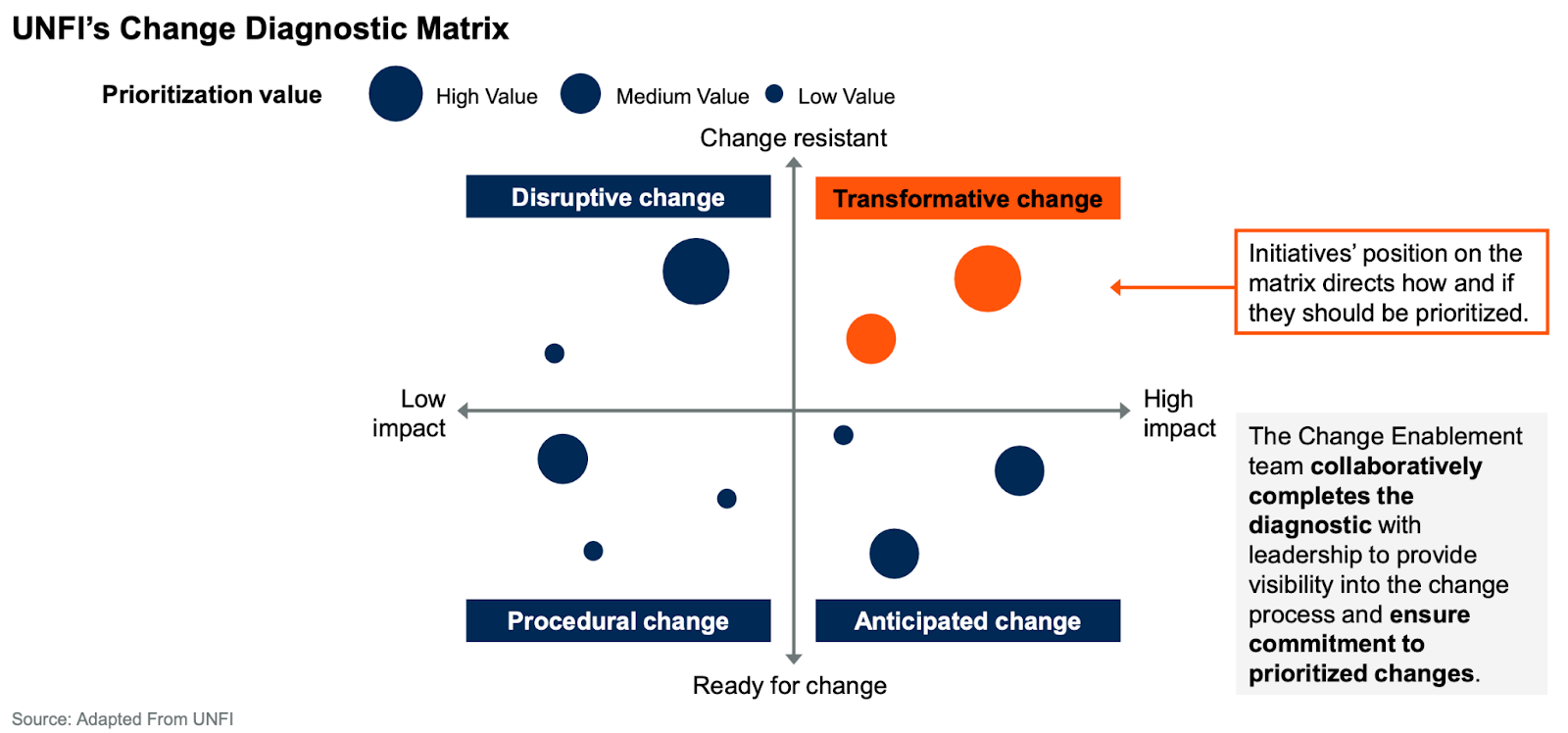
2. Train leaders differently. Split training programmes into several sessions spaced out over time, and alternate learning, peer exchange and practice. Formats that include team building and networking build bonds that outlast the session. Here is the path used by the banking group OCBC, cited by Gartner in the previous edition:
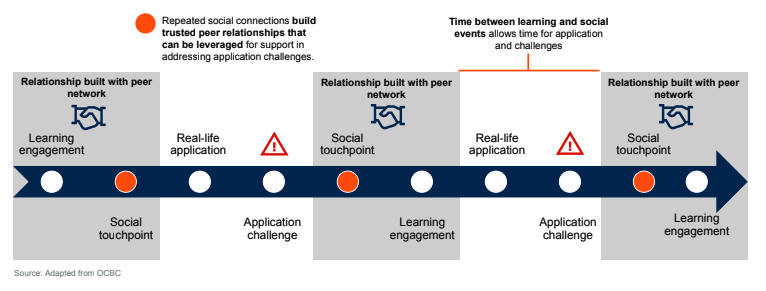
PS: if you do not have the bandwidth in house, an external provider can take over (for example, Ignition Program).
3. Lean on a network of ambassadors able to bring teams along and speed up adoption of the change.
4. Address culture atrophy to power performance
Fourth priority, and the most uncomfortable: culture is not delivering on its promise. In the July 2025 survey, only 47% of CHROs say their culture currently drives employee performance. Fewer than one in two.
A culture atrophies when it stays declarative. It holds when purpose translates into observable behaviours, when managers are held accountable for spreading it, and when the autonomy actually granted matches the one on display.
Best practice takeaways
- Clarify your values and what they mean in practice, in expected behaviours as much as in the workspace itself.
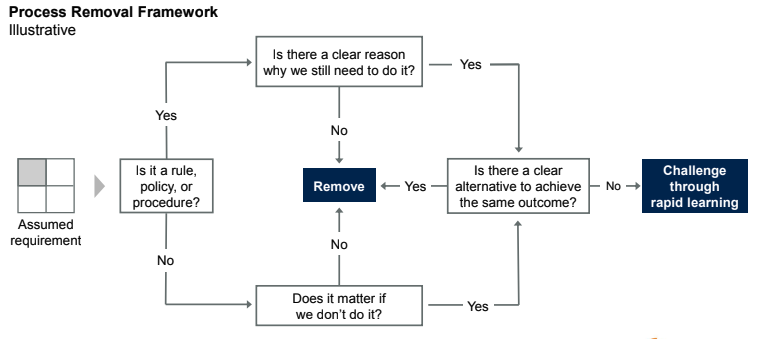
- Align your processes with your organisational culture. Every process must have a clear purpose and stay as simple as possible; otherwise it has no reason to exist. Here is the framework Pharmavite uses to streamline its business processes:
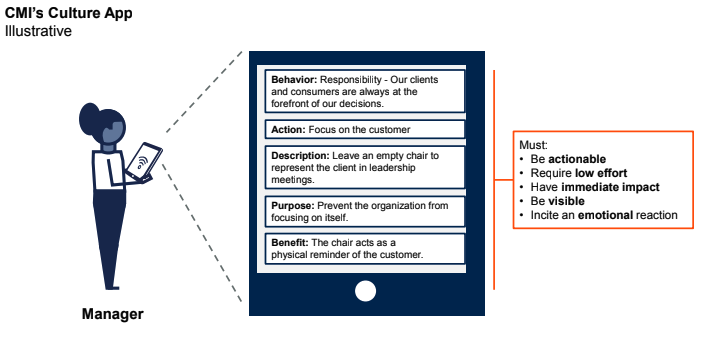
- Give your managers concrete tools. The multinational CMI, for instance, built a culture app offering examples of behaviours to adopt depending on the situation.
Then it has to be measured. Without team performance indicators, a culture is judged on atmosphere, which cannot be steered.
What the previous edition said
The 2025 edition, published on 15 October 2024 from a July 2024 survey of 1,403 HR leaders, set out five priorities: leader and manager development (number one for the third consecutive year), organisational culture, strategic workforce planning, change management and HR technology.
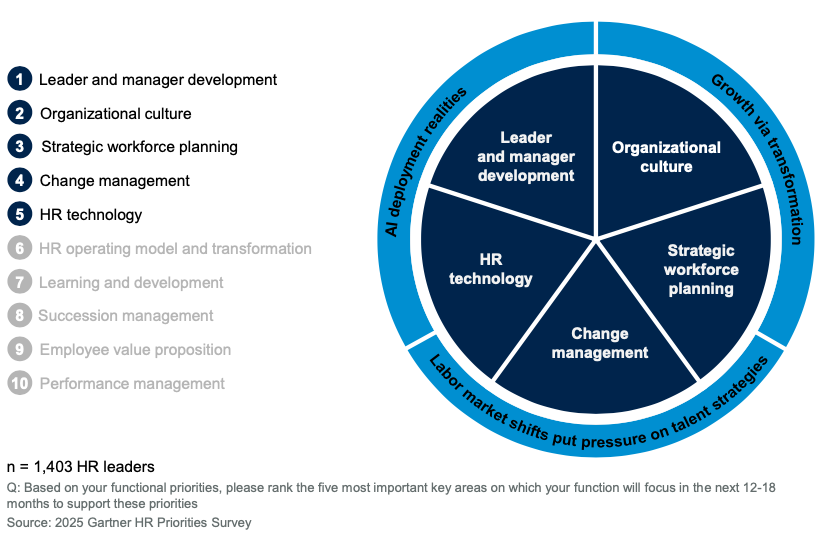
Two breaks separate the two editions. First, AI moves from fifth place, under the HR technology label, to first. Second, culture changes in nature: it is no longer a communication exercise, it becomes a performance lever that Gartner finds is not working. Leader and manager development, the number one priority for three years, disappears as such and is folded into mobilising leaders. The 2024 edition is summarised in a separate article.
| Edition of the study | What Gartner puts first |
|---|---|
| Edition of the studyHR priorities 2024, published on 7 November 2023 | What Gartner puts firstLeader and manager development, organisational culture, HR technology, change management, career management and internal mobility |
| Edition of the studyCHRO priorities 2025, published on 15 October 2024 | What Gartner puts firstLeader and manager development, organisational culture, strategic workforce planning, change management, HR technology |
| Edition of the studyCHRO priorities 2026, published on 2 October 2025 | What Gartner puts firstHarness AI to revolutionise HR, shape work in the human-machine era, mobilise leaders for growth in an uncertain world, address culture atrophy |
A final word
Gartner’s four priorities say the same thing from four angles: AI, the organisation of work, leaders and culture all run into the way the company is structured. An HR transformation that leaves the distribution of roles and authority untouched produces tools with no effect and values with no translation.
Hence the order to respect: structure first, that is, clarify who does what and who decides what, then let information circulate, and only then automate. The same foundations serve to document your commitments, including on ESG criteria.
Download our white paper to explore the alternatives to the hierarchical model, and find out how to put them in place👇
Access the White Paper
In our white paper The ultimate guide to organisational models, you will find:
- an overview of innovative organisational models (Agile, Teal organisation, Holacracy, Constitutional Management, and others),
- accounts from organisations that have adopted them successfully,
- best practice for choosing, implementing and measuring the effectiveness of your model,
- tools to make the transition easier.


Explore similar articles


Frequently asked questions.
Four, in the most recent edition: harness AI to revolutionise HR, shape work in the human-machine era, mobilise leaders for growth in an uncertain world, and address culture atrophy.
On a July 2025 survey of 222 CHROs. Gartner published it on 2 October 2025, and refreshes these priorities every year, in October.
Not much: only 26% of candidates trust AI to evaluate them fairly, while 52% believe AI already screens their application (Gartner survey of 31 July 2025).
Because adoption is not healthy. Only 32% of leaders say the last change they led was adopted healthily, meaning acted on in time without damaging their teams’ performance, engagement or stress levels (Gartner research of 8 July 2025).
Rarely, by their own account: only 47% of CHROs say their culture currently drives employee performance. A culture atrophies when it stays declarative and is not translated into observable behaviours.
Two things. AI moves from fifth place, under the HR technology label, to first. And leader and manager development, the number one priority for three years, disappears as such and is folded into mobilising leaders.