4 étapes pour gérer efficacement un projet

.svg)
Gérer un projet est une responsabilité importante. Il y a de nombreux paramètres à maîtriser : comment distribuer les tâches, gérer la communication, s'assurer que les livrables sont remis dans les délais.
Et si vous ne maîtrisez pas efficacement tous ces paramètres, vous vous exposez à des contretemps, à des délais dépassés ou, dans le pire des cas, à un projet qui n’aboutit jamais.
Heureusement, une bonne stratégie suffit à gérer efficacement vos projets. À quoi ressemble concrètement cette stratégie ?
Voyons ensemble les quatre étapes clés à suivre pour gérer votre projet de la manière la plus efficace et la plus productive possible :
Définissez le périmètre complet du projet
Avant de pouvoir gérer efficacement un projet, vous devez savoir précisément ce que vous gérez.
Autrement dit, vous devez définir le périmètre du projet.
Avant d'entrer dans la phase de planification ou de gestion, prenez le temps de définir les éléments clés du projet, notamment :
- Les objectifs du projet. Qu'essayez-vous d'accomplir avec ce projet ?
- Les livrables du projet. Que devez-vous créer ou remettre pour mener le projet à bien ?
- Le calendrier. De combien de temps disposez-vous pour réaliser le projet ?
- Le budget. Quelles ressources financières pouvez-vous consacrer au projet ?
- Les besoins en ressources humaines. De quel type de compétences avez-vous besoin pour mener le projet à terme, et quelles ressources votre organisation peut-elle mobiliser ? (Par exemple, si le projet est centré sur le design, vous aurez besoin d'une équipe de designers.)
- Les outils. Quels outils sont disponibles pour vous aider à planifier, gérer et finaliser votre projet ? Existe-t-il des lacunes, et si oui, quels outils faut-il pour les combler et mener le projet à bien ?
Définir le périmètre de votre projet vous donne une vue d’ensemble de tous les éléments nécessaires pour le mener à bien. Vous pourrez ainsi considérer le projet dans sa globalité. Et une fois cette étape franchie, quelle est la suivante ?
Découpez-le en parties plus petites et plus faciles à gérer…
Avoir une vision globale du projet est essentiel. Mais si vous voulez mener votre projet à bien, vous avez besoin d'un plan d'action concret pour passer de l'idée initiale à la livraison finale.
Comment y parvenir ? En décomposant votre objectif global en sous-objectifs plus petits et plus faciles à gérer.
Cette approche vous aidera à atteindre votre objectif global de plusieurs façons :
- Rend le projet moins intimidant. Envisager un projet dans son intégralité, surtout s’il est vaste et complexe, peut donner le vertige. Découper un projet d’envergure en parties plus petites rend le processus plus abordable et moins intimidant.
- Crée un plan d'action concret. Pour mener un projet à terme, vous avez besoin d'un plan d'action. Décomposer le projet en parties plus petites (puis ces parties en tâches actionnables) est essentiel pour transformer un objectif global en un plan opérationnel qui produit des résultats.
- Crée des jalons pour suivre l’avancement. Découper un projet en parties plus petites permet aussi de mieux suivre son avancement. Plutôt que d’attendre la fin du projet pour évaluer la progression et l’efficacité, ce découpage vous offre plusieurs occasions de faire le point en cours de route, de vérifier que vous êtes en bonne voie pour atteindre vos objectifs et d’ajuster votre stratégie si nécessaire.
Si vous vous apprêtez à piloter un projet, prenez le projet dans son ensemble et découpez-le en objectifs plus petits et plus faciles à gérer.
…puis décomposez ces parties en tâches actionnables
Ensuite, décomposez encore davantage ces sous-objectifs en tâches concrètes à assigner à votre équipe.
Prenons un exemple : imaginons que l’objectif de votre projet soit de créer un nouveau pitch deck pour votre entreprise.
Vous pourriez découper cet objectif global en objectifs plus petits, comme “analyser les données commerciales”, “créer les visuels” ou “recueillir des témoignages clients”. Ensuite, vous décomposeriez chaque objectif en une liste de tâches à assigner à votre équipe (par exemple, “recueillir des témoignages clients” pourrait se découper en tâches comme “planifier un entretien de cas client avec le client A”, “rédiger le témoignage du client B” ou “relire le témoignage du client C”).
Attribuez les tâches de façon appropriée
Une fois votre projet découpé en une liste de tâches claires et actionnables, l’étape suivante d’une gestion de projet efficace consiste à attribuer ces tâches.
Au moment d’attribuer les tâches, plusieurs éléments méritent votre attention, notamment :
- Le temps que vous laissez aux collaborateurs et aux équipes pour réaliser la tâche. Gérer efficacement un projet, c’est aussi respecter son calendrier. Et pour cela, vous devez fixer des échéances réalistes. Il n’existe pas de recette universelle en matière d’échéances, mais efforcez-vous d’en fixer qui gardent votre équipe mobilisée tout en restant atteignables. (Des échéances irréalistes risquent de démotiver votre équipe et de compliquer l’avancement.) Et dès que possible, gardez un peu de marge dans vos délais. Ainsi, si un imprévu survient, vous avez le temps de le corriger sans bloquer l’ensemble du projet.
- La façon dont chaque tâche s’inscrit dans l’ensemble du projet. Lorsque vous attribuez les tâches, il est également important de réfléchir à la place de chacune dans l’ensemble du projet, puis d’attribuer les tâches et les échéances en conséquence. Imaginons par exemple que vous pilotiez la conception d’une nouvelle brochure marketing. Vous ne pouvez pas attribuer les tâches de relecture tant que toutes les tâches de rédaction ne sont pas terminées : vous aurez donc intérêt à planifier toutes les échéances de rédaction avant d’attribuer leurs tâches aux équipes de relecture.
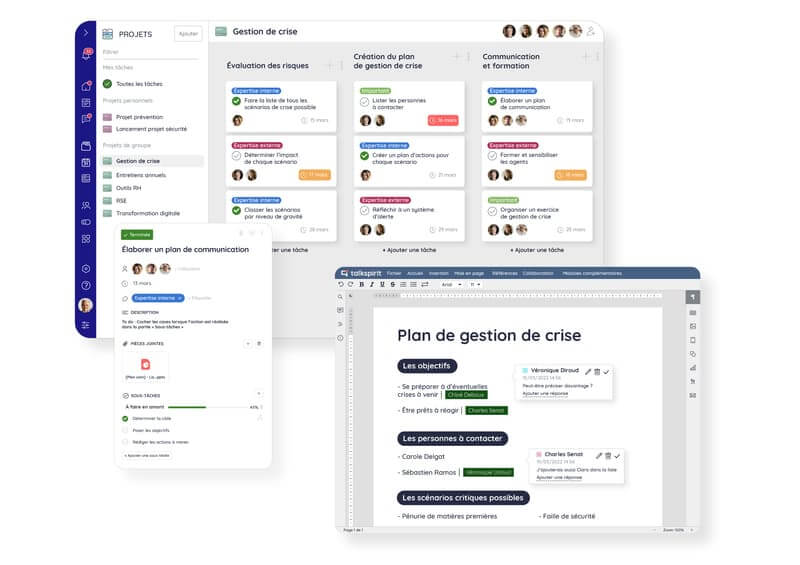
- La manière dont vous attribuez les tâches. La manière dont vous attribuez les tâches liées au projet joue un rôle déterminant dans votre capacité à gérer efficacement un projet. Et la meilleure façon de les attribuer ? Utiliser un outil de gestion de projet. Il vous permet non seulement d’attribuer des tâches à vos collaborateurs, mais aussi de partager les informations et les fichiers essentiels à chaque tâche, de suivre l’avancement et d’organiser les conversations liées au projet. Il vous permet également de visualiser chaque tâche dans le contexte du projet global, ce qui vous aide à tenir vos délais.
Talkspirit est une solution tout-en-un, une plateforme collaborative qui offre une multitude de fonctionnalités facilitant la gestion et la collaboration au sein de votre équipe, dont la gestion de projet. La plateforme de gestion de projet de Talkspirit vous permet d’organiser vos projets, d’attribuer et de prioriser les tâches, et de suivre l’avancement du projet. L’outil vous permet en outre de discuter avec votre équipe, de planifier et d’organiser des réunions en présentiel et des réunions à distance, de stocker vos documents dans un drive sécurisé et de coéditer des documents en temps réel. Avec Talkspirit, vous disposez de tout ce qu’il faut pour gérer efficacement un projet du début à la fin !
Vous souhaitez découvrir comment Talkspirit peut simplifier et améliorer la gestion de projets pour vous et votre équipe ? Planifiez une démo ou inscrivez-vous pour un essai gratuit dès aujourd'hui !
Planifiez des réunions régulières pour faire le point et pivoter si nécessaire
Votre projet est lancé. Les tâches sont attribuées, les collaborateurs sont à l’œuvre et vous avancez vers les buts et objectifs de votre projet.
Mais la gestion de projet ne s’arrête pas là ! Si vous voulez mener efficacement votre projet jusqu’à la ligne d’arrivée, vous devez suivre votre avancement en continu, et pivoter si nécessaire.
Lorsque vous pilotez un projet, il est important de planifier des réunions régulières avec les parties prenantes clés afin de faire le point sur votre situation, sur votre progression et sur ce qui doit éventuellement changer pour atteindre vos objectifs. Cela peut passer par une révision des échéances ou par la réattribution de tâches à d’autres équipes ou services.
À lire aussi : 10 astuces pour améliorer l'efficacité de vos réunions à distance
Imaginons par exemple que vous ayez fixé au départ un délai de 30 jours pour boucler le projet, mais qu’après une réunion d’équipe au bout de 15 jours, vous constatiez que vous êtes loin d’en avoir fait la moitié. Dans ce cas, vous chercherez à comprendre pourquoi vous n’avancez pas comme prévu, puis vous ajusterez votre stratégie pour mieux atteindre vos objectifs et faire avancer le projet.
Dans certains cas, vous pourriez même envisager de changer la direction du projet.
Imaginons par exemple que le projet que vous pilotez soit le lancement d’un nouveau produit. Mais dès le début du projet, votre équipe d’études de marché termine ses premières recherches et découvre que le concept du produit ne séduit pas votre audience cible. Dans cette situation, vous n’allez pas poursuivre le projet comme prévu. Vous allez au contraire revenir en arrière et imaginer de nouvelles idées de produits.
En résumé, si vous voulez gérer efficacement votre projet, vous devez surveiller en permanence la façon dont il progresse et avance. Et s’il n’avance pas, vous devez en comprendre la raison, puis ajuster votre stratégie en conséquence.
Appliquez ces conseils pour gérer efficacement votre prochain projet
Si vous voulez mener vos projets de leurs premières étapes jusqu’à une réussite complète, vous devez savoir en piloter le déroulement. Avec ces conseils, vous disposez des informations nécessaires pour gérer votre prochain projet de la manière la plus efficace possible, et pour en récolter tous les bénéfices.
Vous cherchez d’autres outils pour mieux gérer vos projets ? Découvrez notre sélection des meilleurs logiciels de gestion de projet de 2022 !
Découvrir les meilleurs logiciels de gestion de projet
–
Auteure : Deanna deBara